![MaritimeJournal[Seawork]](https://www.maritimejournal.com/wp-content/uploads/2026/09/MaritimeJournalSeawork.svg)





CTV earmarked as test case for AI ship design
Artificial intelligence will be used by a consortium that aims to transform ship design by bringing robots into the process.
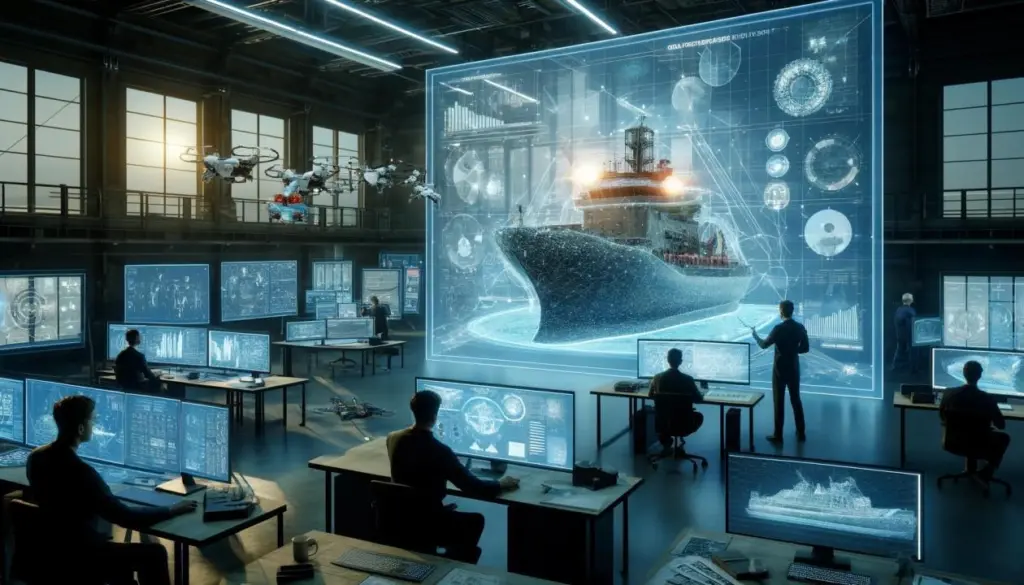
GenDSOM is a £700,000 (€801,000) initiative being run under the UK government’s Clean Maritime Demonstration Competition that will combine generative AI, robotics and 3D printing to transform ship design.
Led by Compute Maritime, the London-based developer of the world’s first generative AI tool for naval architecture – NeuralShipper – the consortium includes simulation, optimisation and digital twin solutions provider Siemens Digital Industries Software; robotic large-format 3D maritime components printer Rapid Fusion; technology firm HP, or Hewlett Packard; UK/Canada-based BYD Naval Architects; and the University of Southampton.
GenDSOM aims to reduce the design-to-manufacture cycle and deliver more efficient vessel solutions by embedding intelligence at every stage, from simulation and optimisation to validation against 3D printing constraints, Compute Maritime said.
A crew transfer vessel designed by BYD Naval Architects and used in the offshore wind sector will serve as the test platform. Its hull form will be optimised with hydrofoils produced by Rapid Fusion’s Apollo robotic large-format 3D printing system.
“The transformation of ship design is no longer optional; it is a critical survival strategy in an industry historically anchored in tradition,” said Shahroz Khan, CEO of Compute Maritime. “With NeuralShipper and the expertise of our partners, we believe we can achieve a 10% reduction in costs, 20% faster cycles and a 50% gain in overall efficiency.”
For Rapid Fusion, the challenge lies in scalability. “Additive manufacturing [3D printing] has expanded design freedom but remains constrained in production terms,” said Martin Jewell, the company’s chief technical officer. “GenDSOM’s modular approach will ensure designs remain compatible with both traditional and robotic processes while integrating real-world constraints such as build envelope limits and material compatibility.”
The project brings generative AI, digital twin optimisation, advanced simulation and robotic manufacturing into a single workflow. According to Dmitry Ponkratov, marine director at Siemens Digital Industries Software, bringing design, performance and manufacturability into the same loop ‘unlocks a new paradigm where these elements evolve simultaneously rather than sequentially’.
With the greatest fuel savings coming from optimising vessel form and components, said Professor Tahsin Tezdogan of the University of Southampton, intelligent tools like NeuralShipper could make these savings even greater as they are not constrained by limited tools and evaluation methods.
“Today, intelligent tools like NeuralShipper can generate highly efficient, unconventional hull shapes, supported by advanced simulations that accurately assess performance,” he said.