![MaritimeJournal[Seawork]](https://www.maritimejournal.com/wp-content/uploads/2026/09/MaritimeJournalSeawork.svg)

FiFi4Marine pledges instant Li-ion-battery fire knockout with zero vessel risk
One of the most prescient concerns with electrification in vessels of all shapes and sizes is the risk of fire caused by thermal runaway that lithium batteries are thought to pose. One company at Europort claims it has solved the problem.
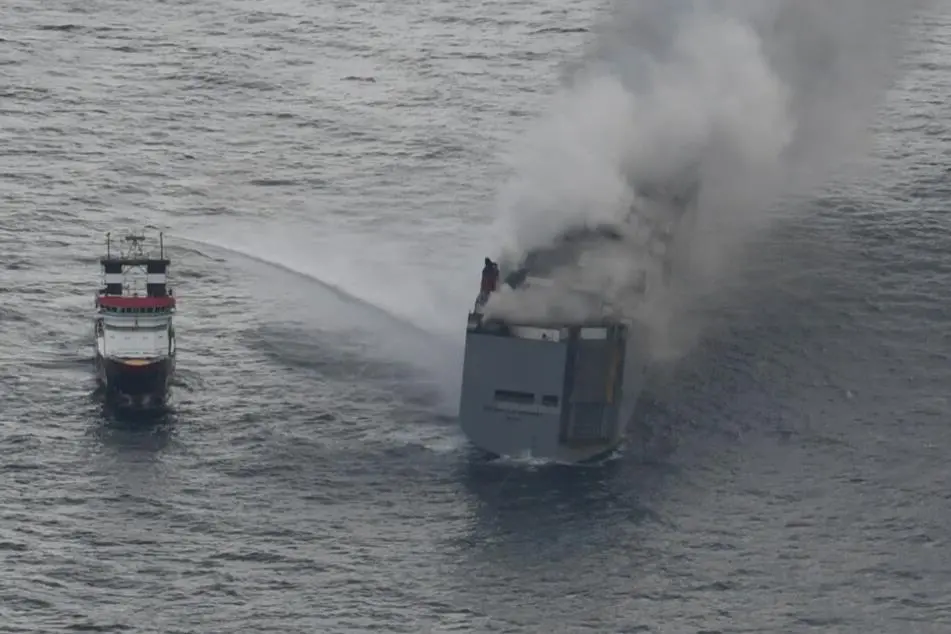
While the cause of the blaze has still not been officially confirmed, the betting is that it began in an electric vehicle (or more precisely, its lithium batteries).
Owned by Shoei Kisen Kaisha, the vessel was on route from Bremerhaven to Singapore when the fire broke out before her Port Said transit stop. She was carrying 3,783 vehicles, 498 of which were electric, according to the Dutch Coast Guard and charterer K Line.
The blaze began on July 2025 and was only confirmed to be out more than a week later, on August 2.
Burnt-out cargo vessel loaded at Rotterdam | News | Maritime Journal
Dangers of lithium batteries
“All kinds of lithium batteries are a danger,” said Wim de Dobbelaar, manager Projects with Netherlands-based FiFi4Marine. “If they get hot, they all burn. The electrolyte is made from several chemicals and all the chemicals will degrade.
“They are fine at first, which is why they are used, and a new anode, cathode and electrolyte are perfect. But every cycle they degrade. After a certain amount of time there will be damage, the heat goes up by one or two per cent and eventually you will get thermal runaway. This can happen when the batteries are discharging, or while they are just sitting around.”
De Dobbelaar says the Battery Management System (BMS) itself can sometimes cause the problem, even though the purpose of one is to monitor the batteries’ performance.
“It’s monitoring how much charge is in the battery and it needs information,” says de Dobbelaar. “Each time it monitors it causes a little bit of damage.
“All batteries are created differently – whether they are air tight, whether they are packed in metal, etc. The heating up of the battery is based on the degradation and thermal runaway is the end result. If there are 42 batteries in a row and you charge them all up at once, if one isn’t very good it will create a spike – that one will have a lower internal resistance but they all receive the same power, and that’s when the cells can propagate.”
Fire-fighting solution
Fifi4Marine’s fire-fighting solution acts as soon as it senses there is a problem, says de Dobbelaar – and it might be that the system is activated before a blaze actually breaks out.
“Within two minutes the battery fire is out and there’s no re-ignition,” he says.
The ‘F4M’ system senses and immediately activates and smothers the affected battery pack with foam, he says, with a fire – or potential fire – thwarted before it can spread.
With a nod to the environment, the company says the foam is also biodegradable.
A week before the Fremantle Highway disaster, a fire broke out on the 60m electric ferry Ellen, which was sailing to Søby in Denmark.
F4M was on the vessel and the fire was put out within minutes and it sailed back to shore without firefighters even boarding the vessel.
Seventy-five passengers and four crew were on board the vessel and it could have been fatal.
Since then, FiFi4Marine has seen an uptick in business despite the traditional mindset still opting for more conventional fire-fighting methods, such as water or CO2, says de Dobbelaar – but at Europort this week the company proudly exhibits a model of the 254m RoPax ferry Grimaldi, which is to date the largest vessel to be equipped with F4M.