![MaritimeJournal[Seawork]](https://www.maritimejournal.com/wp-content/uploads/2026/09/MaritimeJournalSeawork.svg)






Hefring Marine launches collision analysis tool
Hefring Marine has unveiled a transformative advance in marine safety analytics that the company says sets a new standard in vessel collision reporting.

The Impact Report provides unprecedented visibility into impact incidents that records how to detect and analyse them with a view to acting upon them and thus avoid similar incidents recurring.
Users or fleet managers can now get a clear, sensor-driven breakdown of what happened in any collision or allision, where it happened, and why it matters.
“Unlike traditional systems, which only capture raw accelerometer spikes, Hefring Marine’s latest innovation combines sensor data with intelligent analysis to uncover the full story behind each impact,” the company says.
“Traditional impact analysis has been limited to basic accelerometer readings that miss critical context,” says Karl Birgir Björnsson, CEO and co-founder of Hefring Marine. “Our Impact Report feature goes far beyond simple magnitude measurements. It analyses each impact to determine hull location and impact type, and can automatically flag various scenarios including propeller strikes, grounding events and potential collisions.”
Hefring Marine’s IMAS sensors already collect vast amounts of data, from wave slamming forces to engine telemetry. The new feature harnesses this data and delivers it through a highly visual and interactive interface that turns complex readings into actionable insights.
Accuracy in detail
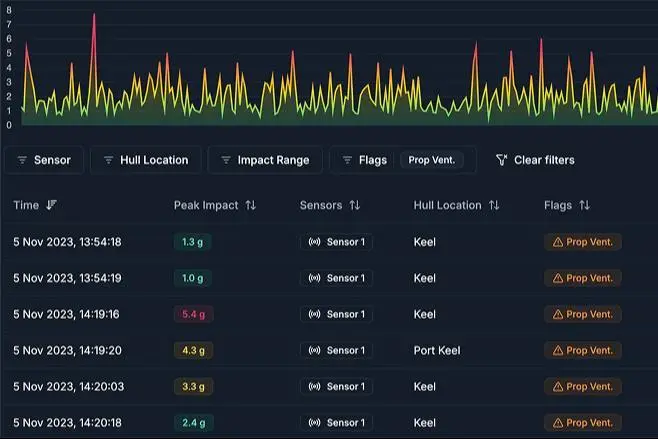
The report opens with a detailed sensor breakdown, indicating how many impacts each sensor recorded, peak impact values, and where these occurred on the vessel. This immediate clarity helps maintenance crews and safety officers prioritise inspections and assess structural integrity with pinpoint accuracy.
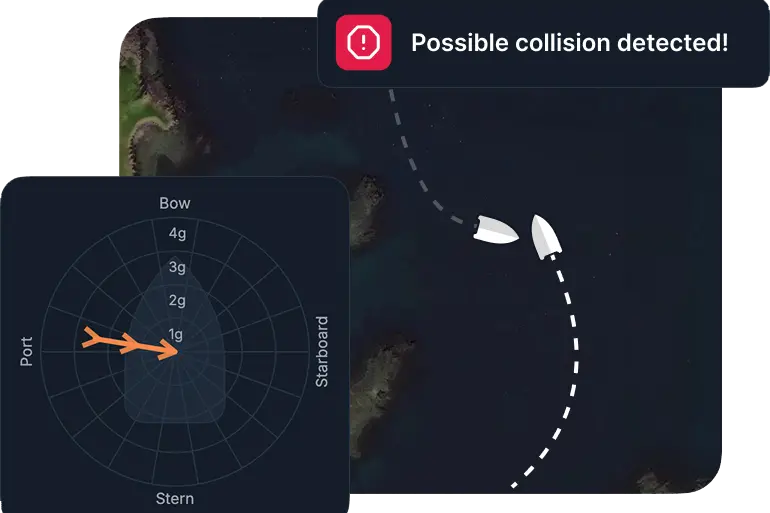
Two distinct visualisations, side and top vessel views enhance the ability to diagnose impact scenarios. Vertical forces, such as bottom strikes or hard landings from waves, are revealed through a lateral profile, while side impacts like port/starboard collisions are tracked in the overhead schematic.
Each impact is plotted on a timeline, allowing users to drill into specific events. Clicking into a flagged incident brings up an in-depth data card, detailing metrics such as duration, peak g-forces, and per-sensor performance. An interactive map pinpoints the exact location of the event, complete with directional arrows to show impact vectors.
Perhaps most impressively, the Impact Report automatically classifies impact types, identifying potential causes like propeller ventilation or contact with submerged objects, crucial in avoiding misdiagnosis or unnecessary downtime.
Event prevention with diagnostics
The release comes at a time when the maritime industry is increasingly focused on predictive maintenance, real-time diagnostics and reducing human error. By equipping fleets with this level of analytical clarity, Hefring Marine positions its customers to not only respond faster to incidents but to prevent them altogether through data-driven operational changes.
“Whether investigating a safety incident or optimising operations, the Impact Report puts all the relevant data at the operators’ fingertips,” says Björnsson. “It’s designed to be clear, concise and immediately actionable.”
For existing Hefring Marine clients, the Impact Report requires no new hardware, leveraging the company’s current IMAS sensor setup and analytics infrastructure. This plug-and-play compatibility means that the benefits of the new system can be used immediately without added installation costs or disruption.