![MaritimeJournal[Seawork]](https://www.maritimejournal.com/wp-content/uploads/2026/09/MaritimeJournalSeawork.svg)






MAIB: How substandard engine parts triggered catastrophic failure
A routine sea trial in the Firth of Forth turned into a drifting emergency and engine room fire when a single weak component buried deep inside a diesel generator failed without warning. According to a Marine Accident Investigation Branch (MAIB) report.
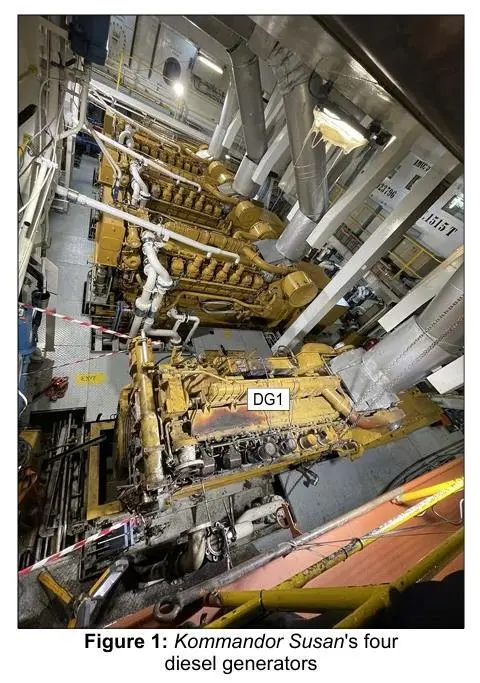
What followed aboard the Kommandor Susan on 25 January 2025 was a textbook example of how invisible maintenance decisions can cascade into a full-scale marine casualty.
At 13.05, as the 83-metre site investigation vessel entered open water, the chief engineer heard a subtle change in engine tone. Seconds later came a loud bang, followed by smoke and fire.
The engine room filled with oil mist and fumes and the crew shut down the running diesel generators, plunging the vessel into blackout, and scrambled to contain the blaze, which was quickly put out, but not before the real damage had been done. With no propulsion, the vessel drifted in a force 5-6 wind; attempts to anchor failed because the winches had no power, and only after tug assistance arrived and a second generator restarted did the crew regain limited control.
Thankfully there were no injuries, but investigators have concluded that the incident had been years in the making.
A failure that began in 2019
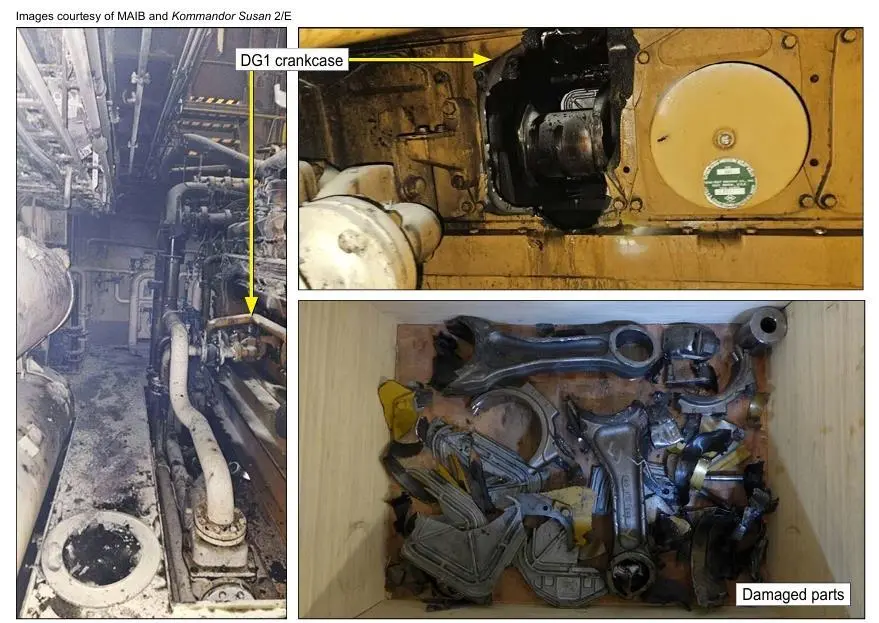
At the heart of the incident was diesel generator 1 (DG1). When engineers dismantled the destroyed engine, the damage was catastrophic: pistons shattered, connecting rods torn loose and punched through the crankcase.
Investigators discovered that many of the engine’s critical internal components – including pistons, connecting rods and bearings – were not original equipment manufacturer (OEM) parts. Instead, they were aftermarket components installed during a major overhaul in 2019, never approved by the engine manufacturer or certified by a classification society.
Critical weakness: bearings
The immediate cause of the failure was traced to a single component: a connecting rod bearing. The most likely sequence began when one bearing “ran out”, wearing down to the point of failure. It thinned and failed, the connecting rod broke free, internal components collided violently and within seconds the engine tore itself apart.
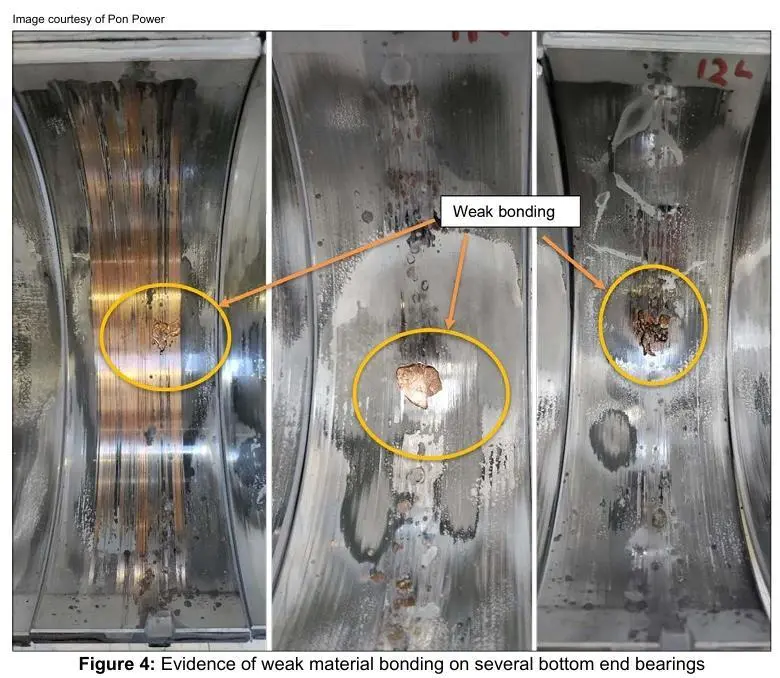
Because the aftermarket bearings differed fundamentally from genuine parts – they were made from a copper-backed layer with weaker bonding properties instead of aluminium-backed OEM bearings – the material degraded faster until it could no longer withstand normal loads.
Evidence of this was found across multiple bearings, many showing signs of weak material bonding and advanced wear.
Dangerous mismatch
Following the 2019 overhaul, the engine manufacturer had approved extended service intervals of up to 24,000 hours, but only on the condition that genuine OEM components were used. On the Kommandor Susan, they were not. The aftermarket parts were designed for standard intervals, yet the engines continued operating under the assumption they could safely run far longer between overhauls.
By the time DG1 failed, it had accumulated more than 13,000 hours since its overhaul, potentially beyond the safe lifespan of the substitute components. The investigation concluded that extended service intervals were inappropriate when non-OEM components were in use.
Oversight gap
The overhaul was carried out by a third-party repair company with no formal verification process was in place: no documentation confirming the origin or certification of the parts, no independent checks and no audit trail.
The issue was never communicated when the vessel changed ownership in 2022, and the latent defect passed from one operator to the next. Even routine oil analysis failed to detect the problem: samples taken just weeks before the failure showed no abnormal wear.
The engine failure aboard the Kommandor Susan was not caused by a single mistake, but by a chain of decisions: uncertified non-OEM components installed in 2019, service intervals extended beyond those components’ capability, and an absence of verification at every stage.