![MaritimeJournal[Seawork]](https://www.maritimejournal.com/wp-content/uploads/2026/09/MaritimeJournalSeawork.svg)


New boat-landing system remains Buoyant at WindEurope
UK-based Buoyant Works unveiled its FlexLanding boat-landing system at WindEurope this week, which it says could replace all conventional steel systems.
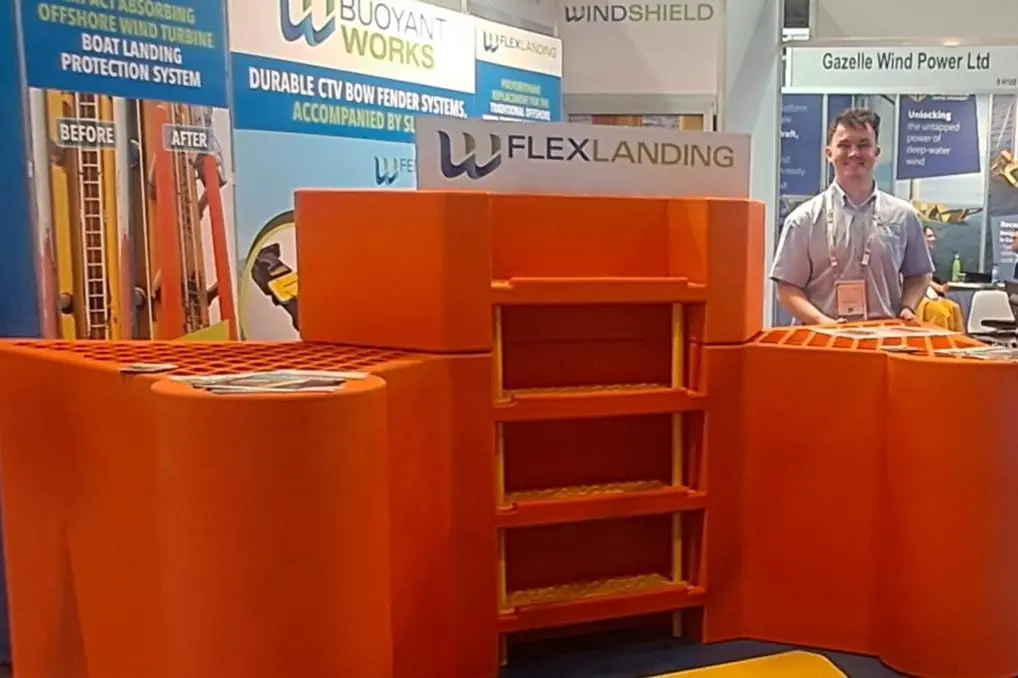
Speaking to Maritime Journal at the event, marketing manager Tom Cox explained how a key benefit is the material it is made from – polyurethane, a form of polymer – which is cheaper, lighter and does not corrode from sea water like conventional steel.
“It is a replacement for the steel offshore wind boat-landing and ladder system structures,” he said. “It comes in 2m lengths, so is modular. If a steel one gets damaged you have to take out the whole lot to replace or repair it – with this you can replace just the bits that are broken.
“It absorbs more energy than steel so there’s less damage to the bow of the boat or the boat landing itself.”
Buoyant Works, a regular Seawork exhibitor, says the new boat-landing system will be going into production next month, before Seawork on June 9-11.
The company’s primary product is its boat fenders, which Cox says fit with its boat-landing products for better bonding and less thrust requirement.
FlexLanding is designed to outlive the turbines on which they are installed, says Cox, with a 40+ year life expectancy. It’s possible that they could be removed from a turbine that has reached its end of life and placed on another one.
Polyurethane, he said, arrives at Buoyant Works’ facility in liquid form at controlled temperatures and is poured into moulds.
“There’s no algae growth on it and it’s immune to the salt,” he said. “It also has slower sinkage than steel, so retrieval is much easier. There is no need to coat it or repaint it over its lifetime.
“You could retrofit wind turbines with FlexLanding, but it’s a much better idea to have them installed from the start.”
Designed for use on monopile, jacket and floating wind foundations, FlexLanding can be configured for both crew transfer and cargo operations. A crew-access version incorporates ladder steps, while a cargo-focused variant removes these to create an unobstructed interface for lifting and vessel contact.
Being completely re-useable it also ticks the green box.