![MaritimeJournal[Seawork]](https://www.maritimejournal.com/wp-content/uploads/2026/09/MaritimeJournalSeawork.svg)

Stillstrom reveals fully automated offshore charging cable
Stillstrom by Maersk has demonstrated an automated cable-control system designed to allow hybrid and electric offshore wind vessels to charge while maintaining position on dynamic positioning (DP).
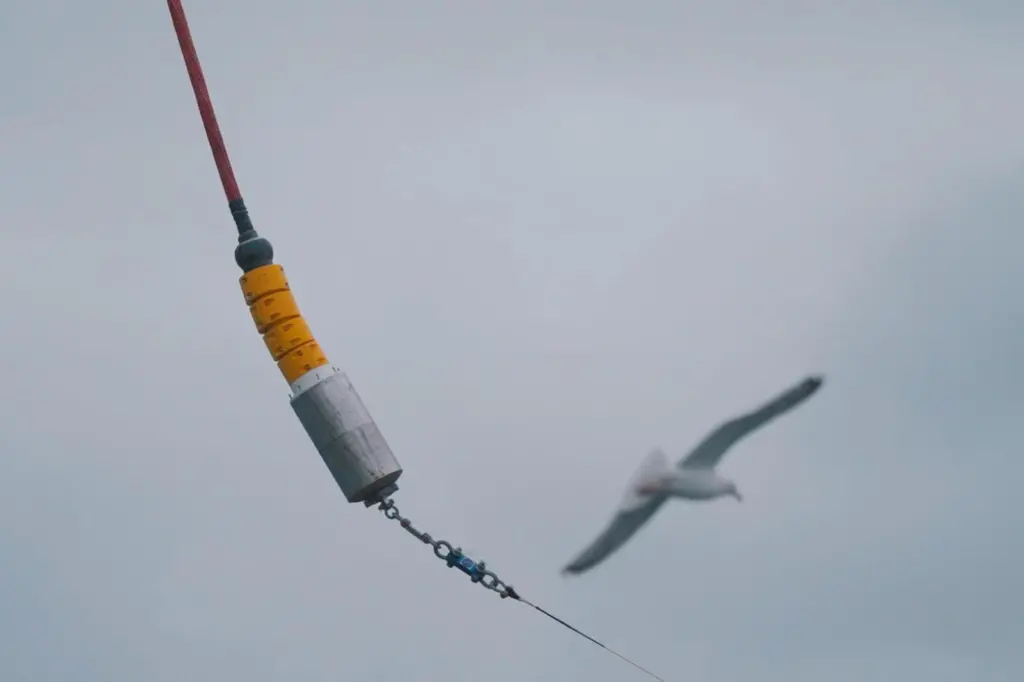
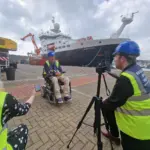
The trial, carried out with offshore wind vessel operator ESVAGT and development partner Semco Maritime at its Esbjerg yard in Denmark, tested the cable-management system on Stillstrom’s Offshore eCharger (SOeC). The trial was witnessed by DNV as part of its technology qualification process.
The engineering challenge is the cable itself. A vessel holding position on DP is continually making small movements relative to the charging point, requiring the power cable to be paid out and recovered while maintaining a controlled profile and avoiding excessive loads.
During the test, the charging connector was deployed from a height of 15.5 metres, representing the elevation at which an eCharger could be installed on an offshore wind turbine or substation. A tower-mounted reel carried 125 metres of cable.
As the vessel moved away from the charging point, the system automatically paid out cable and then recovered it as the vessel returned, while maintaining the cable profile. A pull-in winch installed on the vessel was synchronised with the tower-mounted reel.
The trial assessed five functions: automated cable control, RTK GPS positioning, synchronisation between the reel and vessel winch, the user interface and data logging, and system behaviour under realistic yard conditions.
“Cable control is one of the trickier parts of offshore charging to get right,” said Stillstrom CEO Kristian Borum Jørgensen. “This successful trial showed our system safely managing it automatically as the vessel moves and communicating reliably well beyond our planned range.”
The test follows yard and harbour trials in 2024 and a dry test completed in February 2026. Stillstrom’s next step is an integrated test involving a service operation vessel (SOV) and the complete charging system, followed by a sea trial required for final certification.
The technology is intended to allow offshore wind SOVs and other support vessels to use electricity generated at wind farms rather than running engines while carrying out prolonged operations alongside turbines or substations.
For operators, automated cable handling could remove the need for continuous manual intervention during charging. The remaining challenge is demonstrating that the system can maintain the same level of control in offshore conditions, where vessel motion, wind, waves and current will place greater loads on the cable and its handling equipment.