![MaritimeJournal[Seawork]](https://www.maritimejournal.com/wp-content/uploads/2026/09/MaritimeJournalSeawork.svg)






Meet the buyers: What commercial marine suppliers need to know
Seawork’s 2026 programme was packed with sessions, but few offered as direct a line into commercial vessel buyers’ thinking as the ‘Meet the Buyers’ session jointly organised by the Workboat Association and Society of Maritime Industries.
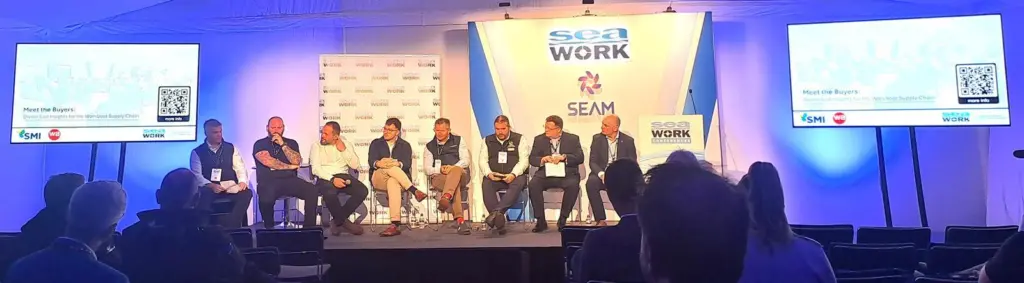
Moderated by Andy Page, managing director of Chartwell Marine, and Noel Tomlinson, Maritime Sector senior leader and strategist at BMT, the session brought together six operators to tell the supply chain, in their own words, what they need.
On the panel were:
- Richard Thurlow, technical director at CTV and workboat provider NR Marine;
- Ian Baylis, managing director of SeaCat Services, a UK builder and operator of high-speed aluminium crew transfer vessels (CTVs) for the offshore wind sector;
- Joseph Hodgson, naval architect at OS Energy, which supplies vessels, surveys and engineering support;
- Tim Greenwood, managing director of Alpha Marine, an Irish marine services operator;
- Ben Wheatley, marine superintendent at Marine Plant Hire, part of the Ancora Group;
- David Gowing, commercial manager at Briggs Marine, a long-established UK firm spanning diving, port management, navaids and survey services.
Growth and supply chain
Several panellists opened by setting out how fast their businesses were moving.
Ben Wheatley described an Ancora Group strategy built on expansion: “We expanded into coastal towage, anchor handling and salvage,” he said. “We work in other European countries and are going through a growth phase.” That growth is backed by new tonnage, including the Damen multicat Tom Scruby, handed over at Seawork itself, as the group invests in coastal infrastructure.
Richard Thurlow said NR Marine was on a similar trajectory, with most of its expansion concentrated in the past 10 months. For Alpha Marine, growth is pulling the company into new equipment categories. Tim Greenwood said the firm was looking for “robust suppliers” across anodes, ROVs, ropes and marine electronics, adding that the team’s engineers had been making the most of the show floor.
“There’s no better show for workboat operators than Seawork,” he told the panel.
Ian Baylis painted a clear picture of how specialised buyer needs have become. Seacat Services builds all of its vessels in the UK, drawing on the domestic supply chain, but operates in a CTV market for offshore wind that never stops.
“It’s 24-7, 365 days a year,” he said. “Trying to squeeze maintenance in overnight is quite challenging,” and this means that one of the most important factors for him was the willingness of a supplier to go the extra mile to meet requirements.
Gowing, attending Seawork for the first time, traced Briggs Marine’s growth from modest beginnings.
“Briggs Marine started off almost as a one-man band, but over the years there has been growth and development of a variety of maritime services,” he said. “We now turn over £112 million a year across a fleet of around 50 vessels.
“I’m fairly new to Briggs Marine and I’m constantly surprised at the diverse range of services we offer, from diving to port management, navaids, energy storage, subsea cables, survey vessels.” That range, he said, comes with an equally diverse supply chain requirement.
Crew and the price of doing business
Moderator Andy Page turned the conversation to costs, asking whether rising prices were pushing operators to buy now or hold off until the future direction became clearer.
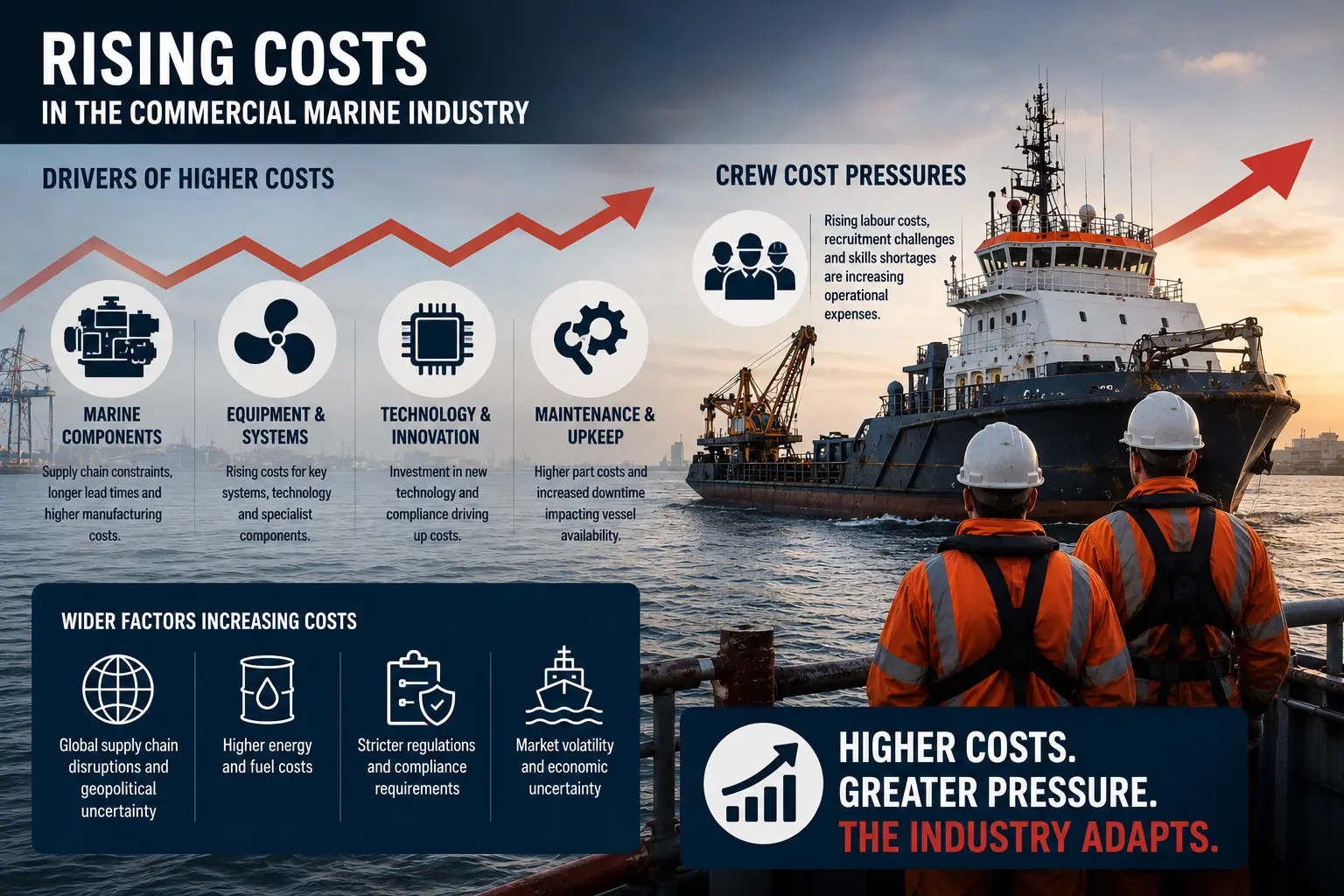
The answers made clear that crewing costs are as pressing as equipment costs, but in fact not the main concern.
“We are paying crew members 65% more than a decade ago,” said Baylis. “We see more and more expected to be included in the day rate. We are partly to blame for agreeing to do things.
“Cyber security is another cost we have got to swallow. We are not just buying things, there’s a whole pile we’ve got to squeeze in. We’re looking for responsible supply chain and end customers.”
Ben Wheatley said Marine Plant Hire was in active acquisition mode, but flagged the same wage pressures: “We are actively acquiring tonnage. We want to add strings to our bow. We’ve gone into areas we never thought we would, like government resilience, but crew wages and passing along those costs is also a challenge.”
Tim Greenwood pointed to a gap between sectors in how readily new technology is adopted. Alpha Marine is moving into offshore wind and marine civils contracting, he said, but the consistent adoption of new technology isn’t as strong in marine civils contracting as in offshore wind.”
“Every time we come back to the table there’s something new in offshore wind, but your day rates are expected to remain the same,” he said.
Joseph Hodgson was more optimistic: OS Energy, he said, had doubled its fleet and had four newbuilds under way, with versatility the key component.
“Uncertainty brings opportunity,” he said. “A diverse fleet is able to do multiple jobs. Versatility means being able to adapt.”
Service, reliability and Brexit
If there was a single thread running through the session, it was that price has slipped down the list of what buyers actually prioritise.
“Cost is almost secondary,” said Hodgson, illustrating the point with a story of a supplier driving at midnight to deliver a part and fitting it by 2am so the vessel could sail again by 6am. “That’s what we need,” he said.
“Price is not king any more,” said Wheatley. “Honesty, transparency, reliability, that they will step up every time and givea rapid response to queries is worth more than money.”
Priorities at Briggs Marine had also shifted from cost to delivery, said Gowing.
“The important thing used to be price but as an operator providing a service to a multitude of customers, it’s about service delivery,” he said. “Getting the right kit to the right place on time is much more important. Reliability, partnering and then leveraging that supply across the entire business.”
Brexit surfaced as a complicating factor, particularly for Greenwood’s Irish-registered Alpha Marine.
“Traditionally our main supply chain was the UK but we’ve had to pivot to Europe with a heavy heart,” he said. “We’d rather trade in the UK because of the same culture, the language is the same and it’s right on our doorstep.”

Gowing said the practical cost of post-Brexit trade had become a serious operational burden. “Dealing with the UK suppliers is fundamental to our business but Brexit has made it much more blockaded,” he said. “Just arranging the paperwork etc is costing four times the total product and five weeks instead of two days.”
That was also a factor in crewing. “We are all operating vessels in Europe and have massive issues with the right to work, etc. How could we be one of the most integrated continents in the world that collaborates on so many aspects yet we have this antiquated system where seafarers can’t go and work in other countries?”
Even so, panellists were keen to stress their preference for UK suppliers where capability exists. “If there were yards building boats to the standards we want we would buy them in the UK,” said Wheatley. “Known brands from Europe are attractive to our customers. If there was one in the UK we would be knocking on their door.”
Hodgson closed the session looking ahead to the next propulsion challenge facing the sector, appealing directly to the audience: OS Energy is examining newbuild methanol vessels and is “appealing for anyone who knows or has anything,” he said.
Overall, the panel’s messages to suppliers were consistent: speed, reliability and partnership now outweigh price; UK capability is valued but not always matched by capacity; and the practical friction of post-Brexit trade is a cost every buyer in the room is still absorbing.