![MaritimeJournal[Seawork]](https://www.maritimejournal.com/wp-content/uploads/2026/09/MaritimeJournalSeawork.svg)



AI takes the helm – but naval architects are staying on the bridge
A deep-tech company says it has used to AI to design a Crew Transfer Vessel (CTV) that could save 100,000 litres of fuel a year compared with a conventional vessel.
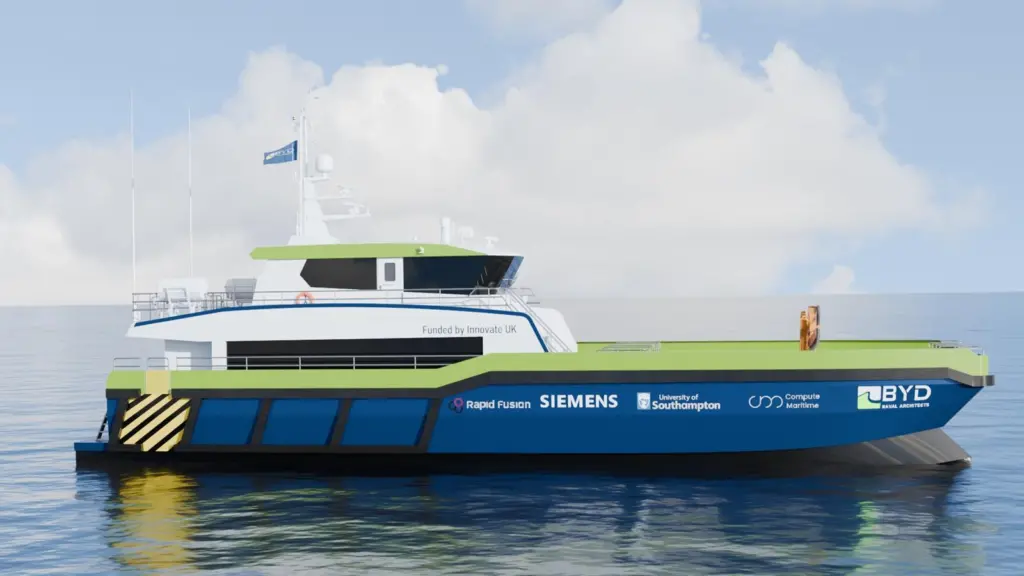
Using its AI-powered design platform ‘NeuralShipper’, Compute Maritime led a consortium comprising BYD Naval Architects, Siemens Digital Industries Software, Rapid Fusion, HP and the University of Southampton to design a 32-33m aluminium catamaran.
Compute Maritime says the hull form, paired with diesel-electric hybrid propulsion, delivers an 11.1% reduction in annual fuel consumption compared with a conventional diesel vessel.
Modelled across a full day of operations, a conventional baseline vessel ended the day with a 34kWh energy deficit, drawing batteries beyond their safe discharge limit and failing to maintain a 25-knot service speed.
The NeuralShipper-designed vessel completed the same operational profile with a 106kWh energy surplus while delivering full service speed, the company claims.
“We and BYD Naval Architects are in active conversations about taking the design to build,” says Emma Williams, head of Operations at Compute Maritime. “The route to build, including the operator and funding, is exactly what those conversations are working through, and we will have more to say as they progress.
“Around 101,671 litres of fuel and 258.7 tonnes of CO2 per vessel every year, on the same mission, payload and service speed, go straight to the fuel bill and the emissions report with no loss of capability. The vessel is also future-proofed, specified for offshore fast-charging at the build stage, on a path toward roughly 95% lower emissions over its service life.
“In construction terms the vessel is a conventional aluminium catamaran, so the hull is immediately buildable with today’s shipyard capabilities and supply chains. A central goal of the project was to make our foundation model manufacturing-aware, so that what NeuralShipper designs comes out producible from the start rather than reworked for the yard afterwards.b
“Separately, with Rapid Fusion we showed that components can go straight from NeuralShipper geometry to large-format additive manufacturing, demonstrated on a printed hydrofoil. That is an added capability for specific parts, not something the vessel depends on, and nothing in the design requires a new supply chain to build.”
Keeping the naval architect in the loop
As generative artificial intelligence begins to demonstrate tangible applications in ship design, questions inevitably arise over what role naval architects will play in the future.

“As a matter of principle, we don’t feel it would be appropriate for us to comment directly on another company’s announcement or on the work of their consortium partners,” said Jake Rigby, Head of Innovation and Research at BMT.
“What we can happily offer instead is a purely macro, industry-level perspective on where generative AI and advanced optimisation sit within ship design more broadly.
“From BMT’s standpoint, this is an area we’ve been engaged in for some time. We see real value in using advanced optimisation, machine learning and simulation to make hull-form development faster and more efficient. But our experience consistently points to one thing – these tools are at their most powerful as decision-support systems rather than autonomous design engines.”
Rigby says BMT remains firmly committed to ensuring that naval architects stay central to the design process.
“We’re firm believers in keeping the naval architect ‘in the loop’ – with optimisation and machine learning acting as a co-pilot that helps designers explore options and understand trade-offs, while the final engineering judgement, and the human element, remain absolutely central,” he said.
“The reason that matters comes down to what ‘success’ actually means for a vessel. It’s relatively straightforward to optimise for a single metric – resistance, or speed in calm water, for example. The harder and arguably more important question is whether a vessel can still deliver its required capability when it matters most – in rough or contested seas, across a real operational duty cycle, doing the job it was built to do.
“There’s little value in getting somewhere quickly and efficiently if the vessel can’t then perform once it arrives – that would be a waste of time, effort, resources and emissions.”
According to Rigby, the greatest benefits are likely to come from balancing multiple factors simultaneously.
“The most meaningful gains tend to come from balancing the whole system – operational effectiveness and seakeeping, fuel efficiency and emissions, buildability, through-life cost and a customer’s specific and individualistic operational requirements – rather than excelling in any one area alone.
“In short, from where we sit, the future of vessel design isn’t AI replacing naval architects – it’s advanced optimisation and machine learning augmenting them, to achieve better commercial, operational and manufacturing outcomes across the board.”
BMT is currently preparing a white paper addressing machine learning and advanced optimisation tools, which is expected to explore many of these themes in greater detail – WATCH THIS SPACE.
Williams’ own views align closely with those expressed by BMT.
“The naval architect is, and will remain, a central part of the pipeline,” she said. “NeuralShipper is built as a co-design tool: the naval architect drives, and the AI explores and optimises within their intent and the real constraints. “GenDSOM was delivered with BYD’s naval architects throughout. The technology takes on the heavy lifting and widens the search; it does not remove the expert.”
From optimisation to construction
One criticism often levelled at AI-generated designs is that they optimise theoretical performance without considering practical constraints.
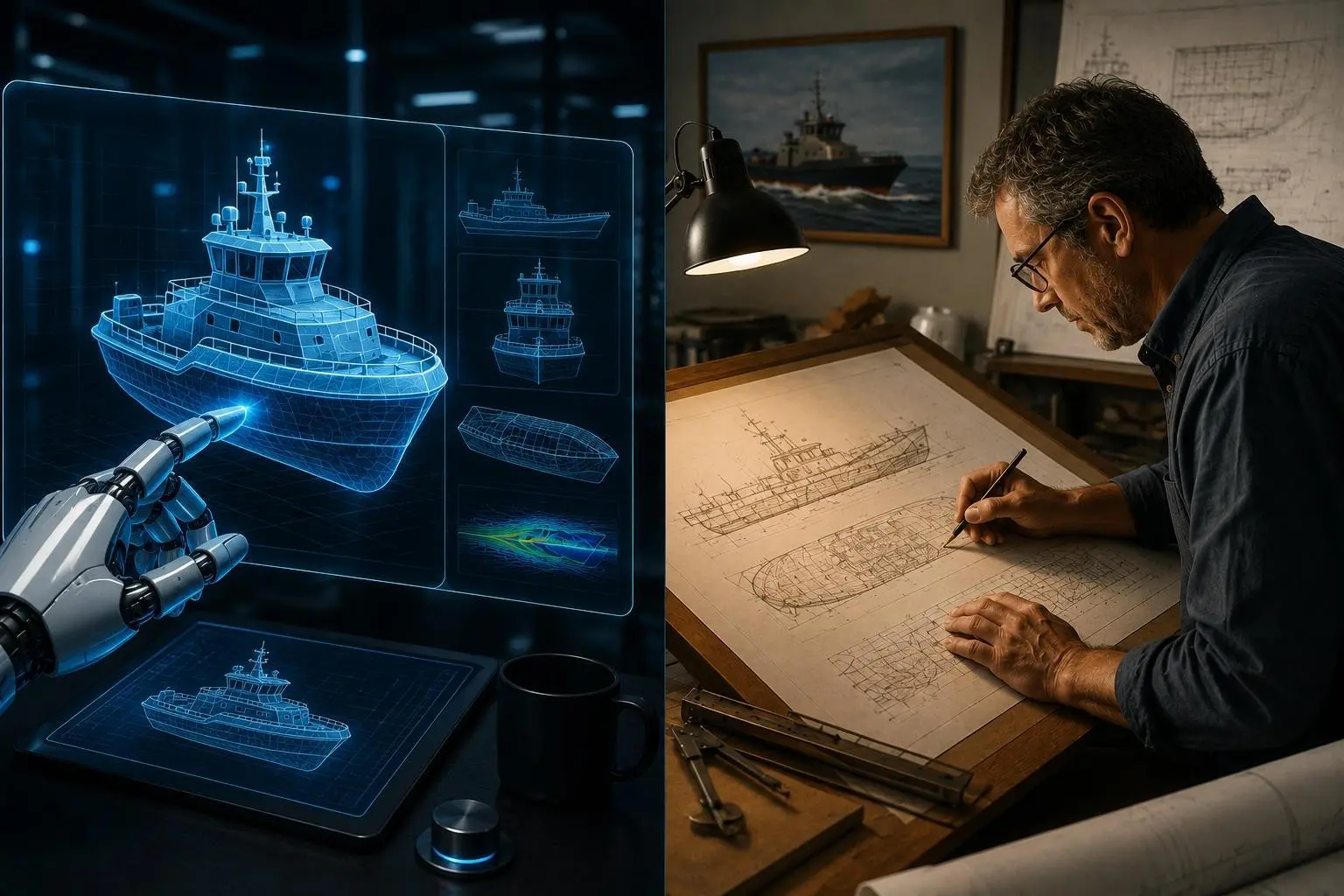
Williams says NeuralShipper was developed specifically to avoid that problem.
“The optimisation worked within the real constraints that make a CTV fit for purpose: seakeeping and operability, deck layout, structural requirements, classification rules, and the limits of aluminium fabrication,” she said. “The one element we did not incorporate into this particular optimisation loop was detailed human ergonomics, and that can certainly be integrated.”
The resulting hull remains instantly recognisable as a conventional offshore wind CTV.
“It is still a recognisable twin-hull aluminium CTV, which matters for buildability,” Williams says.
“But the geometry differs significantly in the specific regions that drive hydrodynamic performance.
“NeuralShipper concentrated its changes where they have the most effect on required power, so the differences are targeted and substantial where it counts, rather than a wholesale change of vessel type.”
Compute Maritime also sought independent verification of the vessel’s predicted performance.
“We took the deliberate step of having that validation done independently rather than relying only on our own results. It was run at full scale, so there is no model-to-ship extrapolation, and across the operating profile rather than at a single calm-water point.
“We did not use a towing tank; full-scale CFD across the envelope gives wider and more representative coverage than a tank campaign can practically achieve.”
For Compute Maritime, CTV appears to be only the start: is it already designing other vessels?
“Yes, it is already happening,” she said. “NeuralShipper is in use with a number of customers, and we have several case studies across different vessel types.”
Whether artificial intelligence eventually assumes a larger share of conceptual ship design remains an open question.
For now, however, both the advocates developing these tools and many of the naval architects assessing them appear to agree on one point: AI may be changing how ships are designed, but it is not yet replacing the people who design them.
Related Articles
 SPECIAL REPORTS
 FEATURES & VIDEOS
 FEATURES & VIDEOS