![MaritimeJournal[Seawork]](https://www.maritimejournal.com/wp-content/uploads/2026/09/MaritimeJournalSeawork.svg)





Remote survey platform trials completed
UK-based Bibby HydroMap announced at last month’s Oceanology International event in London successful completion of trials of its newly-developed Dynamic Remotely-Operated Survey Platform (d’ROP) assembly designed for remote surveying in challenging environments considered too taxing for inspection-class ROVs.
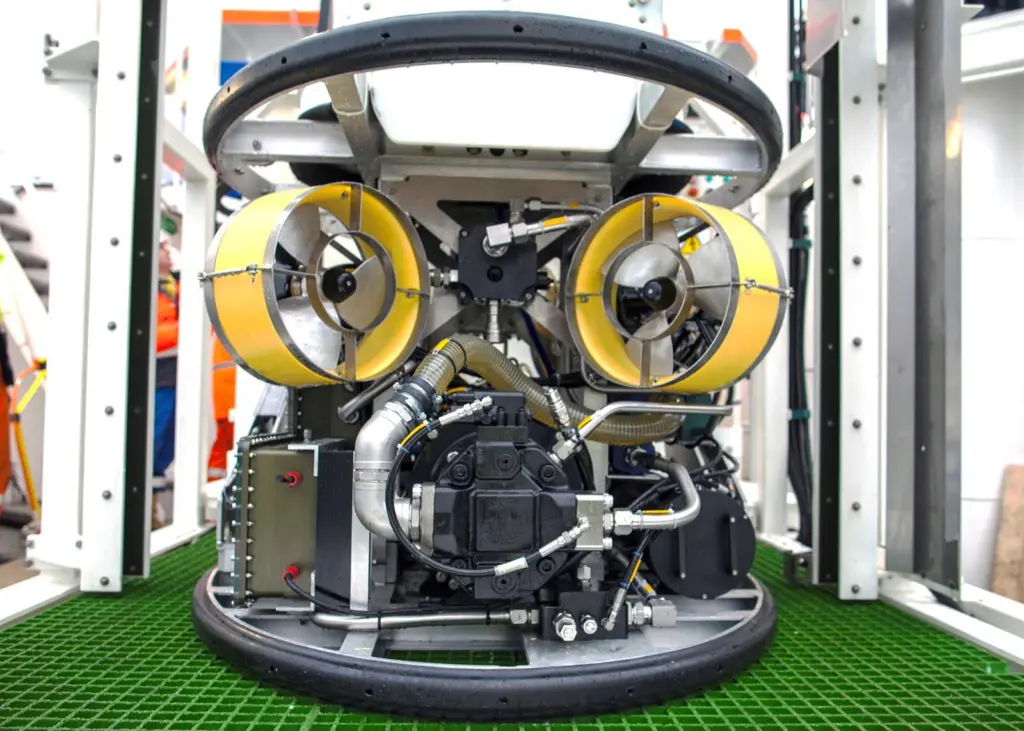
Comprising a variety of sensors including a Pangeo Subsea Sub-Bottom Imager (SBI), an Edgetech 2000 sidescan sonar and sub-bottom profiler and TSS 350 and 440 tracking units alongside visual inspection data, latest trials of a prototype system aboard the recently launched Bibby Athena 27.5m survey vessel have been conducted in the southern North Sea on behalf of oil and gas, telecoms and offshore renewables users. They follow earlier tests involving a baseline geophysical survey of the 187km East-West Interconnector (EWIC) cable route between Rush Bay in Ireland and Prestatyn in North Wales for which a Teledyne Reson dual-head 7125 multibeam unit was also used.
With the high-voltage direct current (HVDC) cable remaining in service throughout survey operations, coverage of the offshore burial phase of it totalling 170km was completed in 208 hours with the d’ROP maintaining an optimal SBI altitude of 3.5m from the seabed in up to 3 knots of tide and sand waves of up to 4m in height.
According to Andrew McLeay, Bibby HydroMap’s Managing Director, it marked the first realistic test of the system’s overall capabilities including exceptional line tracking at slow speed coupled with an ability to maintain fixed depths and headings for securing high-resolution 3D images. Future plans, he added, would involve installation of a second d’ROP system using similar off-the-shelf proven components on another company vessel this summer. Possible leasing of systems for operation aboard third party craft would be considered at a later stage.
By David Goodfellow

Related Articles
 OFFSHORE RENEWABLES
 OTHER NEWS
 MERGERS & ACQUISITIONS