![MaritimeJournal[Seawork]](https://www.maritimejournal.com/wp-content/uploads/2026/09/MaritimeJournalSeawork.svg)


Fugro AUV finds ocean grave of 1,000 WWII prisoners
A WWII Japanese transport ship carrying almost 1,000 Australian prisoners of war has been discovered at the bottom of the South China Sea 80 years after it was torpedoed.
The Montevideo Maru, which had been on its way from today’s Papua New Guinea to the southern Chinese island of Hainan, was spotted at a depth of four kilometres 110km north west of Luzon in the Philippines by a Fugro Hugin autonomous underwater vehicle (AUV).
All shipwrecks are tragedies, but this one was even more poignant as she was torpedoed by a United States submarine whose crew did not realise she was carrying POWs.
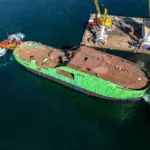
The Hugin was deployed from the hydrographic survey vessel Fugro Equator on April 6 and just 12 days later a positive sighting was made, says Fugro. Fugro Equator was built in 2012, is 65.65m in length and can accommodate 42 people.
Verification of the wreck came a few days later using expert analysis from the project team, which comprised maritime archaeologists, conservationists, operations and research specialists, and ex-naval officers.
An estimated 979 Australian citizens, 850 of them soldiers, were killed on the vessel, along with civilians from 13 other countries.
The search was carried out by Silentworld Foundation, a non-profit organisation that supports and promotes Australasian maritime archaeology and history, the Rabaul and Montevideo Maru Society, Fugro and the Australian military. It took five years, Fugro says.
“This maritime tragedy involved many countries and families, and all paid a terrible price, said Fugro CEO Mark Heine. “I’m proud that our skills and technology can help find resolutions to historical projects such as this and, in this way, make a real difference to people’s lives. At Fugro, we’re using our hydrographic and oceanographic solutions to contribute to relief efforts and live up to our purpose of creating a safe and liveable world.”