![MaritimeJournal[Seawork]](https://www.maritimejournal.com/wp-content/uploads/2026/09/MaritimeJournalSeawork.svg)




Measuring the cost benefits of real-time sea state data
As the offshore wind industry moves into deeper waters and harsher environments, the risks to offshore personnel will also inevitably increase.
According to the most recent annual incident data report drawn up by the G+ Global Offshore Wind Health and Safety Organisation, crew transfer vessels (CTVs) were the second-highest incident area across the industry in 2021. The organisation set up a work stream for 2022 to consider how to improve safety on board vessels, considering issues such as fatigue, staffing levels and vessel suitability.
But another major factor having an impact on safety offshore is the state of the sea itself, knowledge of which not only increases safety but can also significantly decrease operational costs.
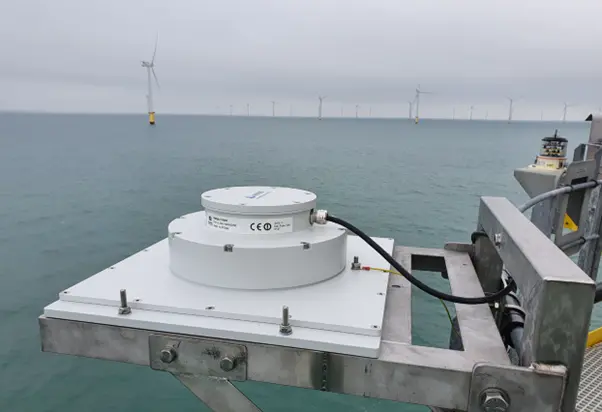
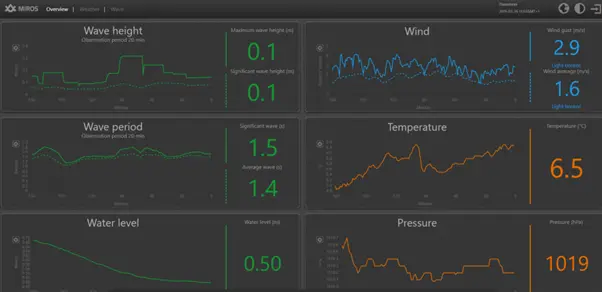
High-performance IoT-enabled sensor technology is being developed by companies like Miros, with its dry-mounted sensors that gather highly accurate offshore sea state and weather conditions which is easily accessible in real time with the option to download historical data as well.
Placing the sensors at specified turbine and offshore substation locations across a wind farm allow more accurate, localised wave and weather information to be gathered as well as a more precise holistic overview and mapping of different sea conditions across the entire project site, which are unique to each wind farm.
Case comparison study
In two recent case studies run by Miros and Trios Renewables, evidence was gathered to support the potential benefits of wave measurements for offshore wind farms.
One was an existing offshore site, the other a ScotWind site expected to be operational by 2030.
The first scenario assumed wave height access conditions were the same at every location across the site while the second, with Miros sensors deployed, used simulated distributed real-time measurements at five sensor locations across the site.
The main aim of the study was to assess whether turbine downtime and operational costs could be reduced by looking at suitable weather windows, missed opportunities and successful trips, and comparing the results between relying on forecasts and using sensors for real-time measurements.
The results clearly showed that deployment of sensors at various locations would enable operators to take better advantage of opportunities for site visits, leading to potential annual savings of more than £1million (€1.1 million).

Maggie McMillan, VP – Renewables at Miros, said: “One of our strengths as a supplier and a strategic partner is that we can connect all the disparate stakeholders through our data platform, Miros Cloud, allowing multiple teams easy and secure access to real-time sea state data.
“While we value the intrinsic worth of data, the added value for our clients comes from the holistic image we can offer to all their involved parties.
“To help our clients better understand the wave conditions across a site, we have also developed a sensor placement optimisation tool that ensures we can advise optimal installation points for instrumentation in an intelligent way across an offshore wind farm to maximise the value of the solution.
“Our cloud platform then enables us to easily make data available to all stakeholders, anywhere, on any device, in real time, allowing companies to use data to solve real problems. That is why we are focusing on adding applications on top of our data to enable our customers to improve their decision-making.
“We are also working with other service suppliers for these projects and integrating data both to and from their platforms – i.e. marine coordination, weather forecast, and even vessel access management systems. This all contributes towards enhancing and connecting the digital ecosystem on an offshore wind farm.
“There is value in the data we provide, but there is greater value in connecting all the project stakeholders and enabling them to commonly make faster and better-informed decisions about their operations and assets.
“We may not be able to control the weather but thanks to advances in weather and sea state monitoring technology, we can control the degree to which the weather controls us.”