![MaritimeJournal[Seawork]](https://www.maritimejournal.com/wp-content/uploads/2026/09/MaritimeJournalSeawork.svg)






Norway delays adopting FuelEU regulations
Norway’s Ministry of Climate and Environment has pushed back one of European shipping’s most closely watched regulations.
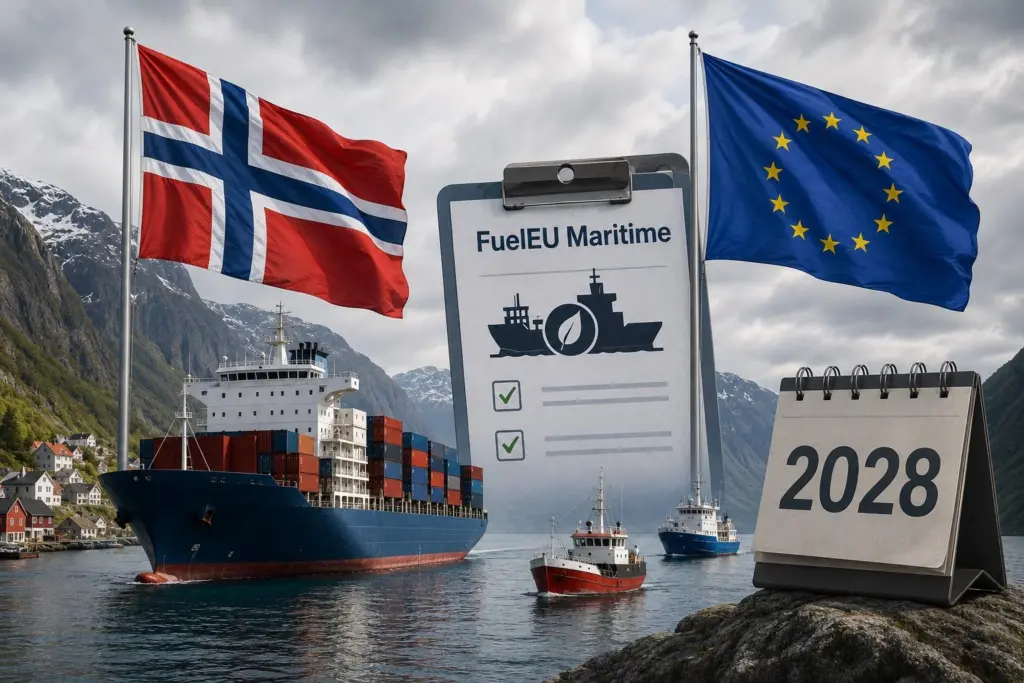
FuelEU Maritime, in force across the EU since January 2025, will now not apply in Norway until 2028 at the earliest – a further delay from a 2026 deadline that Oslo had previously indicated. It has also pulled out of the ReFuel Aviation regulation.
Iceland, also an European Economic Area (EEA) country outside the EU, has yet to offer any revised timeline of its own.
The regulation currently only affects vessels above 5,000GT, but it is widely expected to be expanded to include the smaller commercial sector, or vessels down to 400GT.
The official explanation is procedural: incorporation of the regulation into the EEA Agreement, and its transposition into Norwegian law, has taken longer than expected. In the meantime, only half the energy used on voyages between Norway or Iceland and an EU port counts toward FuelEU accounts, while voyages within Norway or to non-EU destinations don’t count at all.
While the ministry’s brief says it is working to ensure the regulations can be incorporated as soon as possible, it also says “it is necessary to see the regulations in the context of other regulatory developments in the energy and climate area.”
Reasons to be careful
The ministry does not explain what ‘other regulatory developments’ refers to, however, the European Commission is due to review FuelEU Maritime in 2028, which could be expanded to include vessels below the current 5,000GT threshold.
The IMO’s Net Zero Framework, which was postponed for a year in 2025, is also due to be brought back to the table by the MEPC (Marine Environment Protection Committee) later this year.
Is Norway’s delay the first ripple of a broader wait-and-see approach to European maritime emissions penalties – one that might not be so quick to pull smaller vessels into scope?
Norway has no seat at the table when the Commission conducts its review, and the more plausible explanation is a mundane one: slow EEA machinery, compounded by a reluctance to legislate twice in quick succession.
But regulatory feeling doesn’t always travel through formal channels, and for a sector watching to see whether it’s about to get hit with a big batch of rules, every signal means something.
Related Articles
 INSURANCE, LEGAL & FINANCE
 INDUSTRY NEWS
 ENVIRONMENT