![MaritimeJournal[Seawork]](https://www.maritimejournal.com/wp-content/uploads/2026/09/MaritimeJournalSeawork.svg)




Ewoud Visser: DUC Marine
“You can’t stay still in this kind of market,” said Ewoud Visser of DUC Marine, the Netherlands-headquartered offshore services group. “You have to make a decision about whether to scale up and meet the new challenges, or just downsize.”
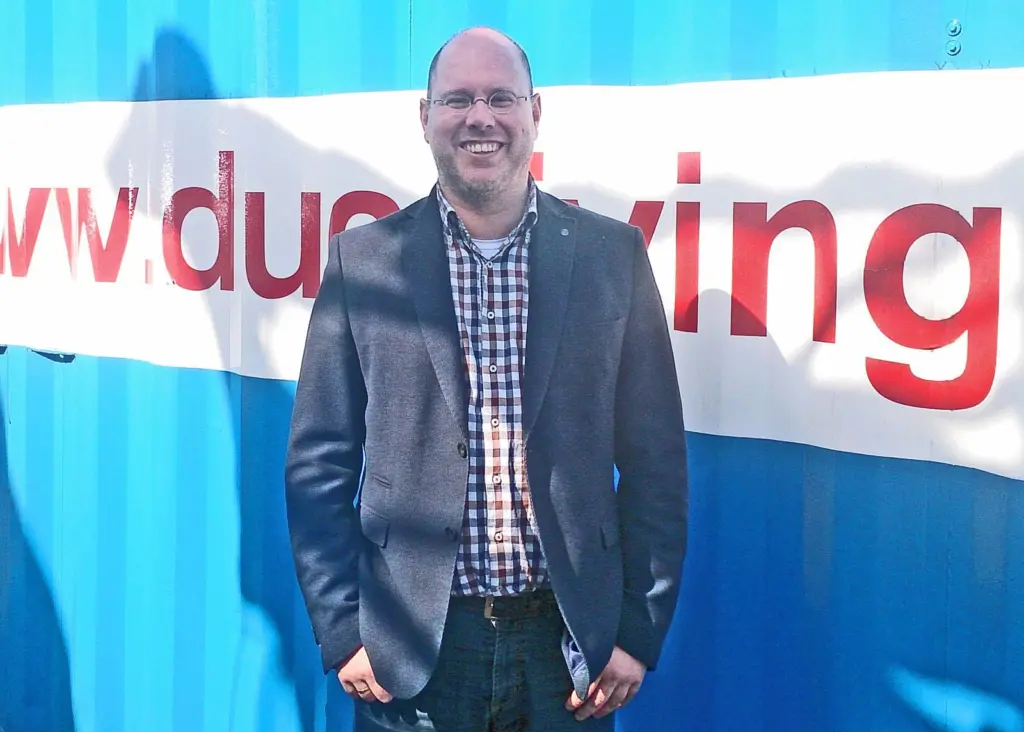
He was talking about the growing requirements for diving, subsea marine and offshore construction contracts: “There’s less room now for the small companies because the offshore wind contracts are getting larger and so the minimum requirements – things like turnover – are rising.” This even applies to relatively modest jobs which “puts prices up – the job could be exactly the same but it will cost more for a large company to do it simply because they have higher overheads. It also means a small company has to fight harder to grow”.
His response is to take it all on. “I’m used to exploring the possibilities… even when it comes to the really big jobs: it’s not that I don’t see the risks, I do, but I always see ways to mitigate them.”
It’s underpinned by his early work in production estimating: “It was all very theoretical: I was stuck in an office churning out equipment details, and quite soon I realised it wasn’t my cup of tea. But that first couple of years gave me the ability to analyse a job in detail, break it down and get some realistic answers.”
Certainly his imagination – and nerve – has come in useful: early on he was involved with a company “that at the time had virtually no equipment”. Nailing a large Dutch tender turned all this around even though Mr Visser then had to get hold of the necessary kit. “Everyone was surprised that we got the contract and even more surprised that we made a profit…”
Recently a large-scale grout hose removal job landed by DUC also needed some creative input: “We realized we were going to encounter weather delays and the standard method would not be fast enough – so we combined our expertise to devise a new approach, which proved to be efficient and much faster. In both cases we finished before the deadline.
Longer contracts like this one, he said, allow more time to “get over the learning curve,” and so tend to be more attractive, although he added: “The risks are much greater and if you estimate wrongly on a large job, it multiplies the pain.”
Overall, he said the most challenging aspect of his career “has been working so much out on my own, learning from job to job”. He added: “I must have bitten asphalt twenty times – although the twenty-first I learned.”
This also applies to “how to get along in life” he admitted. “Frankly I am what you might call a bit of an extrovert, but I had no-one to say ‘sit back, maybe think a bit more how to put that’ until more recently.” He concluded: “I realised having a mentor makes a huge difference… especially if you’re young and energetic.”
By Stevie Knight