![MaritimeJournal[Seawork]](https://www.maritimejournal.com/wp-content/uploads/2026/09/MaritimeJournalSeawork.svg)






PODCAST: Regal Rexnord charts course in marine
With a legacy of nearly a century in motion control, Bauer Gear Motor’s Esslingen facility recently played host to journalists exploring how parent company Regal Rexnord is pushing deeper into industrial sectors, including marine.

In an interview on site, Tony George, Global Product Manager, and Oliver Doidge, Business Development Manager Marine, laid out a clear and confident roadmap for how the firm intends to carve out a leading role in this fast-evolving industry.
“Marine is absolutely an area of specific focus for us,” said George. “We have a growth ambition in the marine space, and our brands – many of which have decades or even centuries of experience – are aligned and ready.”
Formed through the merger of Regal Beloit and Rexnord’s Process and Motion Control (PMC) business in 2021, and further bolstered by the acquisition of Altra Industrial Motion in 2022, Regal Rexnord now comprises 60 brands across a broad range of power transmission and motion control technologies.
The three segments of the $6 billion company – Industrial Powertrain Solutions (IPS), Automation Motion Control (AMC) and Power Efficiency Solutions (PES) – are delivered from 200 sites, 40 of them in Europe.
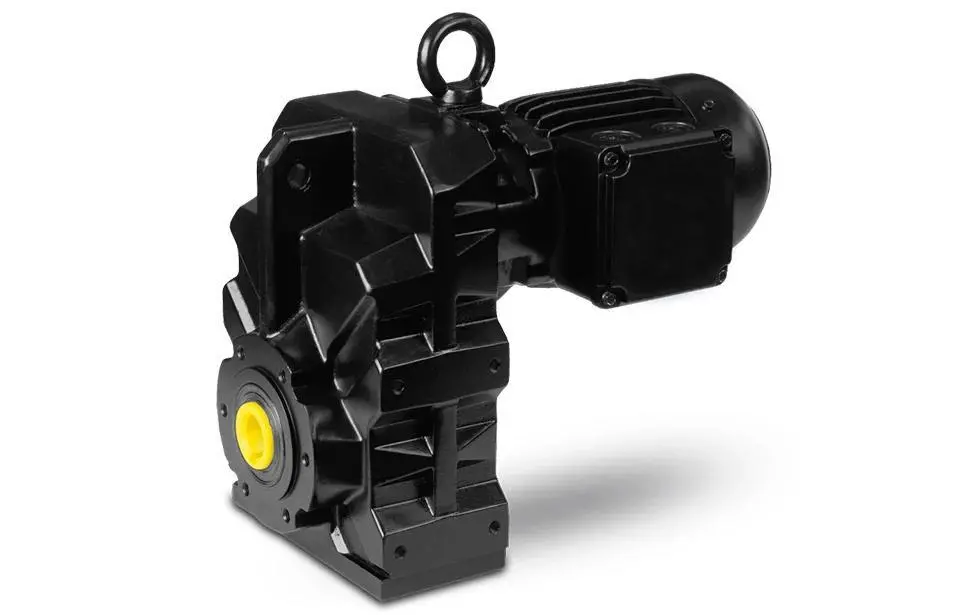
At the Bauer site in Esslingen, near Stuttgart, 150,000 units are turned out each year, including the IP68 motor, which Regal Rexnord says is the only underwater motor in the world that operates with gears.
Brand portfolio advantages
According to George, the company’s diverse brand portfolio provides a key competitive advantage.
“Everyone has their niche, and we absolutely still value specialisation,” he says. “But having the ability to bolt on complementary components gives us an incredibly strong position. We’re not just a parts supplier; we’re a solutions provider.”
This approach is especially pertinent as the marine industry adapts to electrification and ESG (Environmental, Social, and Governance) mandates. While traditional fuels remain compatible with Regal Rexnord’s mechanical components, the move to electric propulsion systems introduces new design challenges.
“As the market shifts to electrification, we see demand for hybrid drives and more intelligent coupling systems,” George says. “For example, our solutions now include braking systems and clutch-coupling combinations tailored to these applications.”
At the Seawork commercial marine show earlier this year, one electric tug featured multiple Regal Rexnord components – including a braking system – a moment George call ‘very pleasing’ as it showcased the company’s integration with both thruster and electric motor OEMs.

From below deck to above, Regal Rexnord is delivering full-spectrum solutions.
“We’ve got everything from flexible couplings for diesel engines to high-performance diaphragm couplings for gas turbines,” says Doidge. “And in hybrid systems, we offer two-in-one couplings that can disengage drives as needed, as well as TRB brakes that support both dynamic braking and maintenance safety.”
Above deck, George emphasises the importance of supporting high-demand systems.
“We’re supplying clutches for dredgers, brakes for jack-up rigs, hoists, and winches. Some of our systems are designed to handle prolonged, high-load operations like those in semi-submersibles,” he says.
One-stop shop
Both George and Doidge point to the company’s integrated team structure as another differentiator.
“We now have oversight that allows us to align experts across the entire product range,” Doidge said. “Rather than just shipping out individual parts, we’re looking at the whole ship. We can help shipyards reduce complexity for future maintenance by consolidating support into one team.”
This ‘single-source convenience,’ as George puts it, also extends to problem-solving in custom and challenging environments. “Yes, we have a catalogue of standard products,” he says. “But we’re also willing – and very capable – of tackling niche applications that others may walk away from.”
Doidge says the company’s deep engineering history gives it a fast head start on novel designs.
“When someone comes to us with a unique requirement, we often find we did something similar 10 or 15 years ago,” he says. “It means we can rapidly develop a tailored solution.”
Global presence and challenge
As with many manufacturers, supply chain disruptions remain a challenge. However, Regal Rexnord’s global presence helps mitigate the risk.
“We’ve got a myriad of sites globally,” Doidge says. “That gives us flexibility not only in sourcing but also in meeting local content requirements.”
Localisation is a growing need, especially driven by defence contracts, says George, but it’s spreading into commercial marine as well.
“Being able to say ‘yes, we can deliver in-country’ is a big deal.”
Challenges from the Far East – notably China – are both a challenge and an opportunity, George says.
“Everyone relies on low-cost country sourcing to some extent. But our strength is that we can also lean on Regal’s sourcing infrastructure. That gives us options others may not have.”
Looking ahead, Regal Rexnord is investing heavily in offshore wind – a sector experiencing rapid growth in both Europe and Asia.
“We’re working on winches, braking systems for davit cranes in turbine nacelles, components for crew vessels, and dynamic gangways,” says Doidge.
“We’re also active onshore – supporting port infrastructure and container terminals,” says George. “Offshore wind is utility-scale power, and we’re already one of the top suppliers of power transmission systems in that space.”
As the marine and energy industries continue to evolve, George believes Regal Rexnord is uniquely equipped to lead.
“With such a robust and proven portfolio, we’re in a rare position. We don’t just respond to trends – we shape them,” he says.