![MaritimeJournal[Seawork]](https://www.maritimejournal.com/wp-content/uploads/2026/09/MaritimeJournalSeawork.svg)

Rotterdam gears up for growth
Rotterdam Port Authority (RPA) has given an upbeat assessment of future prospects with the publication of its long term strategy.
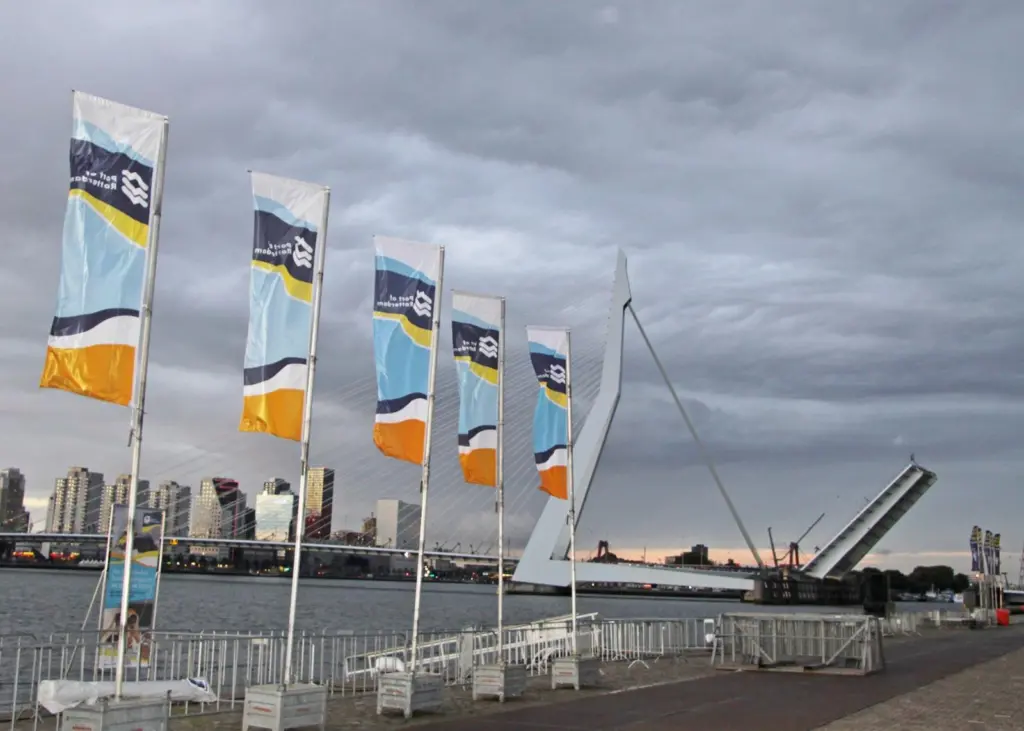
Predicting continued growth and transition for an industry gradually adapting to environmentally related developments, the strategy document looks to the next 20 years and takes a broad view of what will influence future developments and prosperity of the port, including the logistics and industrial elements of the overall operation. RPA envisage the port will be what they call a ‘Global Hub’ and ‘Europe’s Industrial Cluster’ by 2030, including trade both within Europe itself and beyond.
In a bullish assessment of trends in world trade, RPA is predicting container volumes to double or even triple in the coming 20 years. Preparing for such eventualities, of course requires long term vision and planning, and in this respect Rotterdam has such preparation in train with the Maasvlakte 2 port extension, the development of each phase dependent on clients’ commitment to the location. Construction of the first two terminals for Rotterdam World Gateways and APM Terminals is continuing, with operations due to commence in 2013. RPA’s ‘Draft Port Vision’ forecasts do not currently envisage a Maasvlakte 3 in 2030.
The movement of containers, and other cargoes, through ports like Rotterdam is increasingly dependent on the provision of efficient logistics and industrial complexes and Hans Smits, Port Authority CEO, predicts a healthy future for these sectors of the port.
A feature of Rotterdam’s future strategy, is its view that refining and chemical industries are on the threshold of a transition to more bio-based production, energy generated in 2030 being cleaner, and from a wide range of sources. While the port’s long history of continual expansion puts it in a strong position to respond to increases in conventional cargo volumes, it identifies an increasing emphasis on other markets, flowing from the gradual global change to green economies.
Newer types of cargoes such as CO2, biomass, and, with the scheduled opening of the Gate Terminal later this year, LNG, are now identified as becoming new growth areas in the mix of cargoes handled at the Port of Rotterdam. The throughput of goods is currently being reported as 430m tons a year.
Competition in the oil and chemical sector from as far away as Houston, Singapore and the Middle East, as well as within northwest Europe itself, is identified as an important consideration for the future of the region’s petrochemical industry. RPA recognises the need for increases in efficiencies together with the need for strong links between companies in Rotterdam and Antwerp ‘to function as one integrated complex’. Significantly, Rotterdam also speaks of the need to cater for more bio-based production to prepare for the post-crude oil era.
Sustainability is described as ‘an emphatic aim of the vision’. Industry’s transition to increased production of second generation biofuels and bio-based chemicals, together with increased uses of biomass, wind and solar energy, will result in less dependency on fossil fuels. While energy security will still be provided by coal, carbon capture at power stations will play a part in countering climate change, leading to Hans Smits’ conviction that the transition to a more sustainable port and growth will go hand in hand.
The recognition of global competition is again apparent with a word of caution that innovation will be essential in the way the Netherlands responds to opportunities and threats. The application of new technologies and simplification of rules and decision making is ‘sorely needed’ according to Hans Smits. Traffic congestion in particular is seen as a potential bottleneck within ten years, and despite planned traffic management developments, some naturally flowing from the additional infrastructure requirements of Maasvlakte 2, a call is made for the freeing-up of money by the State for projects such as the Blankenburg Tunnel and the A4 Zuid.
By Peter Barker