![MaritimeJournal[Seawork]](https://www.maritimejournal.com/wp-content/uploads/2026/09/MaritimeJournalSeawork.svg)

Green power for the world’s largest crane vessels
Two huge marine construction vessels are set to significantly reduce their CO2 emissions thanks to planned shore power infrastructure.
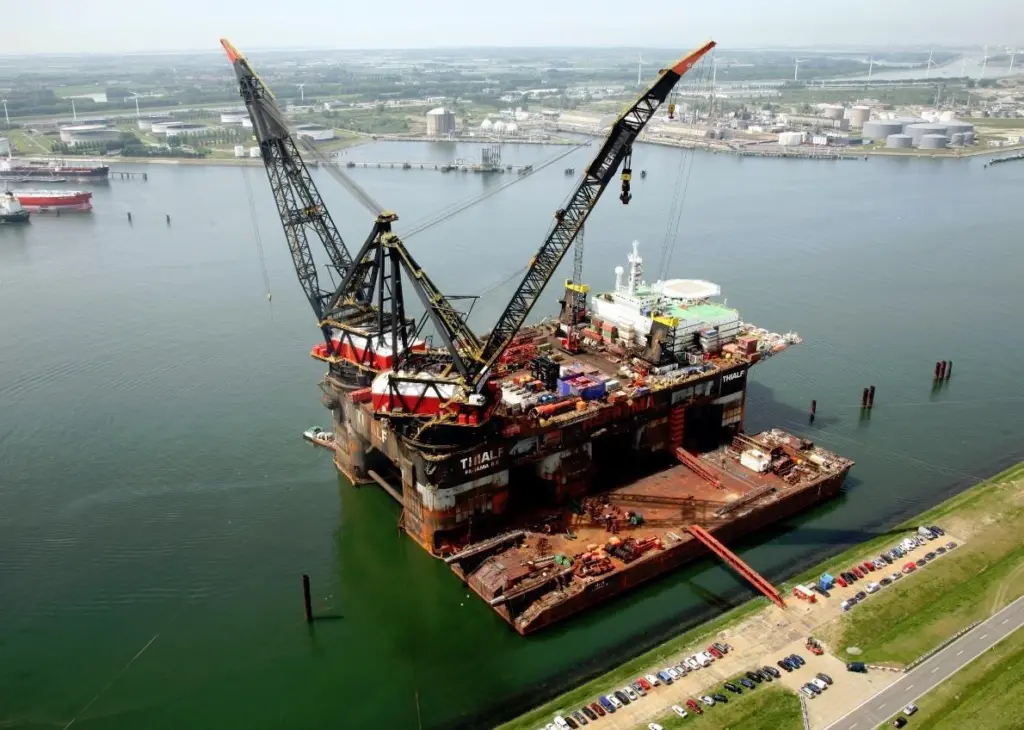
Heerema Marine Contractors will provide its crane vessels with clean energy. By switching off the diesel generators, total emissions will be reduced by the equivalent of the annual emissions of approximately 5,000 diesel cars. Eneco will supply power from the wind farm on Landtong Rozenburg. Heerema’s crane vessels are often moored in the Calandkanaal in Rotterdam. The use of clean energy will reduce noise and air pollution, significantly reducing CO2 emissions and improving the quality of life in Rozenburg and Maassluis.
To supply the power, an ‘e-house’ of 16 by 9 metres will be built on Landtong Rozenburg together with several transformers. Eneco and the Port of Rotterdam Authority have set themselves the goal of providing vessels, in addition to those of Heerema, with shore power at other locations in the vicinity. To get the project off the ground, the Municipality of Rotterdam has reserved a subsidy of €2 million in its 2020 budget, provided that the e-house on Landtong Rozenburg is properly integrated into its surroundings in consultation with local residents.
It is not very common internationally that these types of large vessels are connected to shore power. What makes the project truly unique is the direct supply of wind turbine power. Eneco (80%) and the Port of Rotterdam Authority (20%) are now establishing ‘Rotterdam Shore Power B.V.’ with Heerema as their first customer. In addition to supplying Heerema, this new company wants to supply shore-based power to several companies in the area. Discussions on this are ongoing.
Heerema’s Sleipnir and Thialf are the largest crane vessels in the world and are regularly moored in the Calandkanaal in Rotterdam for maintenance or to prepare for projects at sea. The vessels need energy to run on-board facilities. These include pumps, cranes, lighting, air conditioning and other equipment. Vessels usually deploy their diesel generators to generate the necessary power. They make noise and emit particulate matter, nitrogen oxide (NOx), sulphur dioxide (SO2) and CO2, among other things. It is believed that by switching off the generators on these two large vessels, emissions of CO2 will be reduced by approximately 15,000 metric tons each year.
If everything goes according to plan, Heerema’s vessels will be plugged in sometime next year.
By Jake Frith