![MaritimeJournal[Seawork]](https://www.maritimejournal.com/wp-content/uploads/2026/09/MaritimeJournalSeawork.svg)

Innovative anchor launch
Netherlands-headquartered Vryhof Anchors has launched a revolutionary new heavyweight anchor around the OTC 2017 event in Houston. Stevshark Rex is claimed to deliver holding power in extreme conditions unmatched by any other anchor and is aimed at the heavy marine construction, oil & gas and offshore renewables industries.
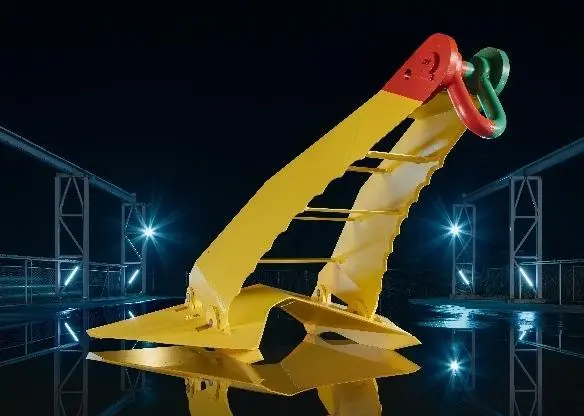
In particular, Vryhof thinks that the new technology will allow floating offshore wind developments in areas previously thought unworkable due to anchoring conditions.
Super-strong soils no longer represent an obstacle, says Vryhof thereby opening up economic opportunities for operators to develop new energy resources across a much larger area worldwide.
Evan Zimmermann, Vice President & CTO at Vryhof, is convinced that the new Stevshark Rex will be a game changer in creating a much more cost-effective solution for anchoring on substrates including calcarenite, a carbonite rock commonly found on Australia’s Northwestern Shelf. “The Stevshark Rex is probably the most anticipated development in the mooring industry over the last decade. I truly believe that the launch of this anchor will create huge excitement and that the market will view the Stevshark Rex as a game changer. Right now, the largest initial market for the new anchor is the oil and gas sector. The drilling community is set to embrace the tool since it offers them a very cost-effective solution in a very tight market. The Stevshark Rex will offer a cost-effective drag-embedded anchor system in place of driven, bored and grouted piles which are much more expensive and require long lead times for design, fabrication and installation. There is no other comparable cost-saving and efficient mooring solution available on the market, right now. This anchor will enable operators to develop fields and renewable projects which, until now, could not conventionally be economically developed. With its greater flexibility in vessel and timing options, unlike other anchors on the market, the Stevshark Rex can effectively penetrate even the hardest seafloors and perform predictably.”
INNOVATIVE PEOPLE
Senol Ozmutlu, Projects Director at Vryhof Anchors, explained the motivation behind developing the Stevshark Rex. “We are not your average hardware shop. At Vryhof Anchors, we offer anchoring knowledge based on long practical experience, as well as knowledge of the geotechnics, experimental research, modelling and testing.“
“Our latest offering is intended for anchoring under challenging and hard ground conditions, anywhere in the world. We are always focused on making life easier for our customers, and contributing to their success. It is our conviction that the best way of doing this is to offer state-of-the-art, innovative technology and tailored solutions. For that reason, Vryhof Anchors operates its own R&D Centre and invests well above the industry average on innovation. Thanks to our pioneering attitude we have already developed many cutting-edge mooring solutions for all kinds of floating structures, making everyday life more effective and more inspiring. This new Stevshark Rex is a perfect example of how we support our customers in optimising production, minimising downtimes and speeding up their operations.”
WORLDWIDE TESTING
The main goal of developing the Stevshark Rex was to expand the suitability domain of drag embedment anchors in challenging geotechnical areas. One of those areas is the Arctic, with its hard soil conditions, subsea permafrost, complex gravelly soils and over-consolidated clays or tills. Other difficult areas in terms of sub-seabed types include Australia and the United Arab Emirates, typically with the complex cemented soils of carbonite origin or calcarenite to calcilutite to limestone rocks. The future floating wind farms or other renewable energy development areas are located in relatively complex geological settings where standard anchors may not work.
Senol Ozmutlu added: “While developing the Stevshark Rex, we observed the penetration behaviour, stability and capacity of the ‘old’ Stevshark anchors. Combining these observations with rock excavations and cutting knowledge, we identified the critical features of this new anchor. But even before we start building scale models, we kind of need to solve the problem in our mind.
What can we expect when you start to drag something in such hard soil or soft rock? What will happen to the material on the seabed? What should an anchor look like in order to penetrate into the seabed? Essentially, the first step is to develop a conceptual model in your mind, which can be passed on to the designers for further detailing on the drawing board.” The outcome of this passionate and iterative conceptual model development process has resulted in a totally new anchor with radically new fluke and shank geometries.
The Projects Director continued: “After testing several fluke and shank models at laboratory scale, the best model is selected, produced in 7kg size and extensively tested in our R&D Centre. The laboratory scale tests were conducted in different soils, such as sand, clay, gravel and in an industrial material conditioned to stiff properties. Only after satisfactory laboratory tests did we produce the model scale test anchor of 7 tons for field testing offshore.
In 2016, the offshore tests were carried out at two oil fields with hard sub-seabed soil conditions. A total of 15 tests were carried out at three locations selected by a major Norwegian oil operator. The selected test locations are famed for their anchoring problems where the MODUs had to use piggy-back anchors to reach the required holding capacity. Each and every test proved successful, even exceeding our expectations.” Depending on the location, the holding power of the Stevshark Rex proved to be 22% to 47% higher than the older Stevshark version.
By Jake Frith