![MaritimeJournal[Seawork]](https://www.maritimejournal.com/wp-content/uploads/2026/09/MaritimeJournalSeawork.svg)




Unique lock gate project for Bremerhaven
Work is on schedule in Bremerhaven for the completion in March of a unique repair and overhaul project involving a trio of giant gates from the German port city’s most important sea locks.
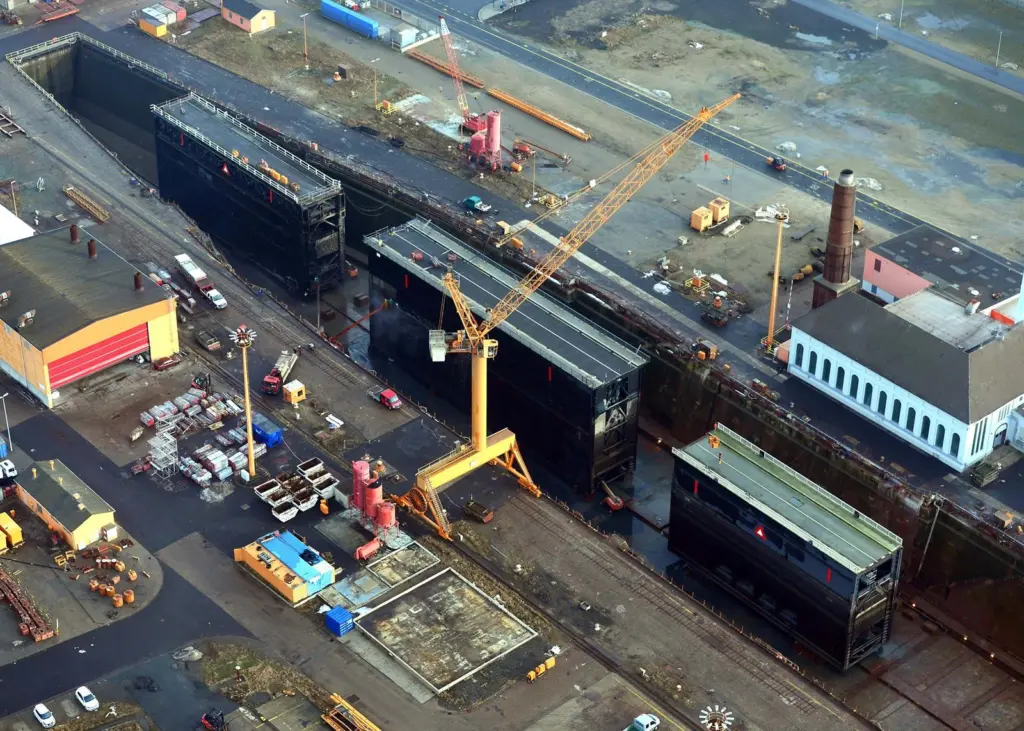
The gates are reserve units from Bremerhaven’s Nordschleuse, Kaiserschleuse and from the main chamber of the Fischereihafen-Doppelschleuse, all of which provide access from the North Sea to the port’s inner harbours. They were towed individually to LWB some months ago and placed end to end in Dock 2 at shipyard Lloyd Werft Bremerhaven (LWB).
Dock 2 is LWB’s biggest dry dock. It is 335m long and 40m wide with an available 35m clear width. The dock has in the past been used for impressive cruise ship conversion and refurbishment but is now gearing up anew to build new cruise ships in the wake of the take-over of LWB last year by the Genting Group.
A spokesman for lock operators bremenports, Rüdiger Staats, told Maritime Journal in late February the lock gate work at LWB was “going according to plan”. He explained that the gates “are being overhauled and repaired where necessary and in addition some gate parts are having their conservation renewed”. Worn gate parts were being renewed and sealings renewed, he elaborated.
Staats explained that all the gates were reserve units and “subject to great pressures when they are in operation”. He said “that’s why they have to be swapped over regularly, overhauled, technically inspected and conserved”. He noted however that “docking three big lock gates at the same time is a new experience for us. It saves time and money”.
The three Bremerhaven lock gates in Dock 2 together weigh more than 4,300 tons. The biggest is the 2,200 ton gate built for and installed in the new 305m long and 55m wide, €233 million Kaiserschleuse inaugurated in 2011. The gate itself is 57.38m long, 11.6m wide and 21.23m high.
The new Kaiserschleuse replaced an old 215m long lock and was described as “a guarantee for the future of the port” when it went into operation. But it has had more than its share of problems since then and its gates have been at the core of the trouble – something that has highlighted the importance of current gate overhauls at LWB.
The new KaiserschIeuse had to close in October 2014 – a little over three years after opening – when the discovery of extensive lock gate damage put it out of action. Then, just as it was due to open again mid 2015 further lock gate damage was found which closed it down for a second time – until last December.
It was while the lock repairs were being carried out between 2014 and 2015 that the gate now being overhauled at LWB was replaced and parked ready for its yard overhaul. Referring to that, Rüdiger Staats said apart from repairs and maintenance the gate was also being closely examined for possible indications of damage that might help bremenports explain why the new Kaiserschleuse broke down in 2014.
The 47.2m long, 8.4m wide 19.5m high Nordschleuse reserve gate was the first of the three gates to be towed to LWB and has not been overhauled for ten years. It was built in 1929 and weighs in at 1,104 tons. The Nordschleuse itself, completed in 1931, is Bremerhaven’s biggest lock and also still one of the biggest locks in the world at 372m in length and with a chamber width of 60m and a passage width of 45m.
The Nordschleuse stood in for the damaged Kaiserschleuse during the 15 months it was out of action. It also was Bremerhaven’s only lock for big ships during the four years it took to enlarge the old Kaiserschleuse up to 2010. One of the reasons for enlarging the Kaiserschleuse was to ease the pressure on the Nordschleuse.
Rüdiger Staats said that in order to better protect the inner port from flooding the Nordschleuse gate was now also getting a new steel top about 1.2m high bringing overall height to seven metres above normal water level. The new wall is made up of about ten steel plates anchored together. Staats noted that the other two available Nordschleuse gates had already undergone the same improvement during earlier yard stays.
The Fischereihafen’s main chamber lock gate – the third and smallest of the three lock gates in LWB’s Dock 2 – is getting its first yard revamp since it was built in 2000, according to reports. Weighing 1027 tons it is 37.18m long, 10.08m wide and 18.7m high.
The original Fischereihafen double lock facility was built in the 1920s and extensively renewed and expanded between 1997 and 2001 to cope with increased traffic. The lock’s smaller 106m long and 12m wide chamber remained as was while the bigger chamber was expanded from 100 to 181m in length and from 30 to 35m in width.
The smooth running of all locks and their gates is imperative for Bremerhaven, Germany’s second biggest universal port which handles about 80 million tons of cargo a year. When they break down or are closed for repair the port loses serious business.
The inner berths they serve are not only home to giant vehicle import and export handling terminals but also to leading shipyards like LWB, Motorenwerke Bremerhaven and German Dry Docks.
All rely on unrestricted access for big cruise liners, tankers and other ships seeking repair, refurbishment or completion. To that will now soon be added newbuilding as LWB returns to its roots and builds its first cruise ships for Genting. They could be very big indeed and pose new capacity challenges for bulging locks – underscoring the need for renewed lock vigilance not only in Bremerhaven but elsewhere.
By Tom Todd