![MaritimeJournal[Seawork]](https://www.maritimejournal.com/wp-content/uploads/2026/09/MaritimeJournalSeawork.svg)




Vector advancing sediment flux knowledge
Nortek’s Doppler instrumentation is helping university students understand sediment transport processes.
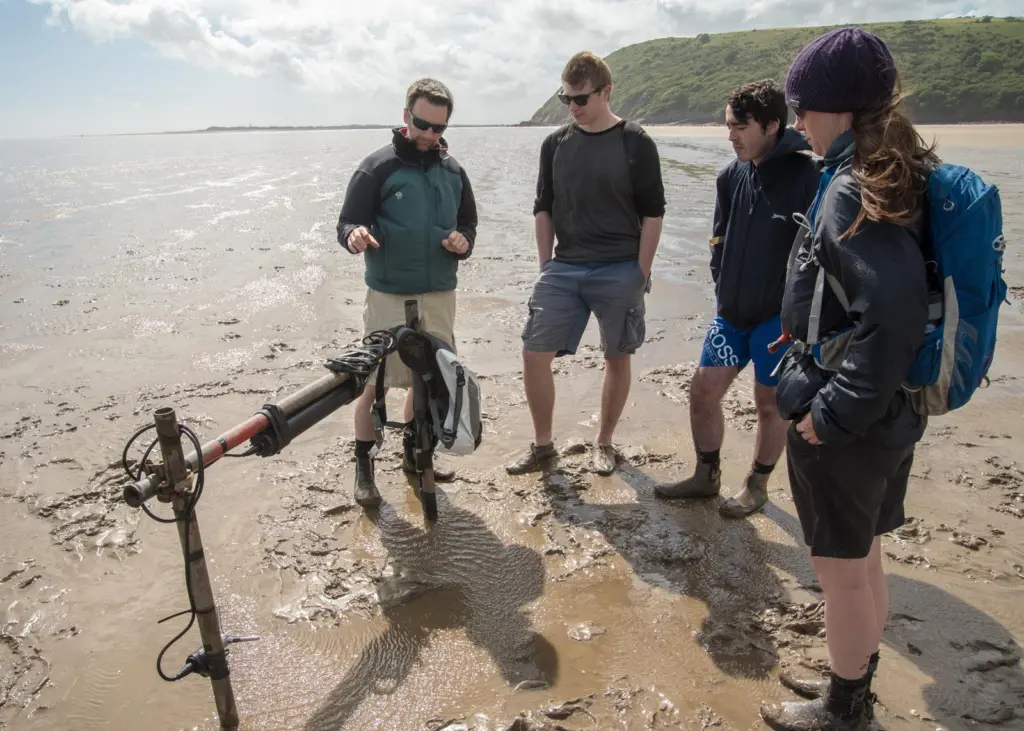
Ocean Sciences students at Bangor University in the UK are using the Nortek Vector Doppler velocimeter, an externally mounted optical backscatter sensor (OBS) and a pressure transducer (PT), to observe temporal patterns of sediment flux at Laugharne Estuary in South Wales.
Dr Martin Austin, lecturer in coastal sediment dynamics at Bangor University, said the students will acquire important skills to undertake field deployments and conduct analysis of numerical datasets.
Automatic recording
The Vector is set to operate in burst-mode, recording 10 minutes of data at 4 Hz every 15 minutes.
To enable the students to compute the near-bed suspended sediment flux, Bangor University’s team position the sensor head of the Vector together with the OBS around 20cm above the bed, while a PT flush positioned on the bed records even in very shallow water.
All the data is logged internally by the Vector during its burst operations.
Daily servicing
Each day, a small group of students service the Vector, checking sensor alignments, clearing any weed deposits and downloading ‘their’ data from the previous 24-hour period.
Back in the laboratory, students write Matlab code to analyse the data and compute the suspended sediment flux during the field course.
Survey data, collected by successive generations of students, indicate that the Laugharne Estuary is infilling with fine marine sand at a rate of 1-2cm per year.
The sediment transport results primarily from strong asymmetric tidal currents causing the influx of sand from Carmarthan Bay on the dominant flood tide.
By Rebecca Jeffrey