![MaritimeJournal[Seawork]](https://www.maritimejournal.com/wp-content/uploads/2026/09/MaritimeJournalSeawork.svg)


Versatile jack-up walks over water
‘WaveWalker 1’, the award-winning ‘walking jack-up barge’ (JUB), especially made to operate in rough seas and surf zones, on beaches and other intertidal locations, has been proving its worth on a range of contracts. Since delivery in October 2012, different projects have seen it deployed in four different countries and within different sectors.
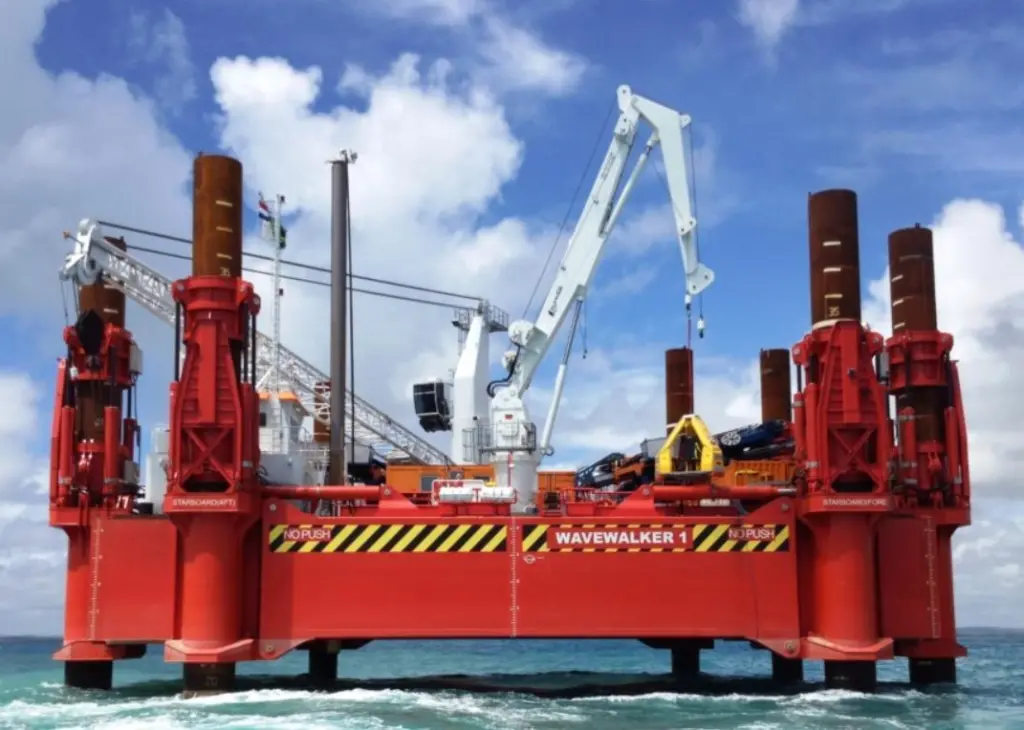
This innovative, 8-legged, self-contained walking jack up platform, is owned by WaveWalker BV, a Netherlands registered company formed in a 50/50 joint venture between Fugro and Van Oord.
Both Dutch joint venture companies have large fleets of specialist vessels working across the globe in operations that range from geotechnical investigation, wind farm construction and support to cable laying and capital dredging. WaveWalker 1, however, is a unique innovation and is the most advanced of its kind.
WaveWalker 1 successfully completed three contracts in 2015; first working offshore at the Gemini offshore wind park off Eemshaven, the Netherlands, which it finished in April, followed by an offshore windfarm in Ireland. The third job of the year was at St Nazaire, at the mouth of the River Loire in western France.
Built at Neptune Shipyard in Hardinxveld-Giessendam in the Netherlands in 2012, WaveWalker 1 can walk in a bi-directional movement whilst elevated allowing the JUB to move or ‘walk’ and relocate without floating. The secret of the JUB’s success lies in the fact that it has two sets of four spud legs, with two on each corner of the 32m square hull. ‘Walking’ is achieved with a two-phase jacking and sliding sequence. The legs can be moved horizontally in a leg bearing unit which slides on bull rails built into the hull structure. Once on site, two pairs of legs can be lowered to the seabed, allowing the barge to be jacked up in the normal way. The other four raised legs can then be moved to the end of the walking stroke by the walking cylinders. These legs can be lowered and the weight transferred to them from the first set of legs. These are then retracted and the walking cylinders slide up to 4 metres in the required direction. Depending on the seabed conditions WaveWalker 1 can walk up to 40m per hour.
The JUB has a maximum displacement of 2400 tonnes (including payload, which in walking mode is 450t, and 850t in conventional 4 leg mode). The legs are 1.8m diameter and 40m long. Jacking is operated by the Fugro designed Fast Gripper System.
Two cranes are a permanent fixture of WaveWalker 1: a Lagendijk LWC900 Offshore Lattice Boom crane, rated at 100t at 6m operating radius, and a Lagendijk LKB13.0/20.0-10.0 Knuckle Boom crane rated at 10t at 4m operating radius. The hydraulics (HPU) are driven by two Caterpillar power packs and power is generated by a pair of Caterpillar C9 220kvA generators. The central moon pool measures 17m by 9m and can be covered over completely or partially when required. There is a bridge/control centre as well as basic day facilities, with optional accommodation for 24 crew that can be added when required. All functions are automated and the crew can even start the crane by remote control and swing the man cage out to an adjacent vessel, if needed. The vessel has Germanischer Lloyd classification and is registered at Rotterdam.
WaveWalker 1 can walk fore-and-aft or port-starboard but with a square vessel, the direction and attitude is not immediately obvious to tugs or other marine vessels. Each corner is therefore clearly marked ‘bow’ ‘stern’, ‘fore’ and ‘aft’. The hull is 4.5 metres deep with the lower deck housing generators, compressors, spares, stores, ballast tanks and internal pipework.
The barge is self-sufficient and carries 80t of fuel and 44t of fresh water. Both the fuel and water are cleaned constantly. The hydraulic system is based on a ring main within the hull. Bilge water and greywater from the crew quarters are kept clean. Fuel is marine gasoil which is constantly cleaned and separated.
In the early part of 2014 the barge received two awards: the British Engineering Excellence Award and the Ground Engineering Product and Equipment Innovation Award. As Nick Puttick, WaveWalker 1’s Bargemaster says, “The vessel control systems have been designed by WaveWalker BV to enable this 2400 tonne vessel to walk above the waves, or onshore, in a variety of soil conditions for various purposes. Having operated WaveWalker 1 for the past four years I know that it performs exactly as it was designed to. We know what we can do with it, although conveying the benefits of WaveWalker 1 to new clients will remain a challenge for a while, as quite simply the vessel is so unique.”
WaveWalker 1’s first job in 2012 was in Brazil to support drilling and blasting works on a contract awarded to Van Oord to deepen the Suape Outer Channel, where constant swells precluded the use of floating platforms. The vessel’s walking ability enabled it to relocate to multiple positions without attendant tugs, so minimising costs and downtime. The JUB was transported across the Atlantic on the flat-top barge Osprey Trader, towed by the 50tbp tug Compass.
After returning to Europe in August 2014 under tow by Fairplay 33 (100tbp), WaveWalker 1 was deployed at the Gemini offshore windpark, 60 kilometres from the coast of the Dutch Schiermonnikoog Island, where it was used for bi-directional drilling and cable installation, on a contract awarded to Van Oord. Two export cables needed to be run under two existing submarine cables; having to contend with strong currents and very shallow water, the JUB carried out horizontal drilling operations for the two ducts separated by 25 metres, and was able to walk between locations. The central moon pool was covered over and a directional drilling unit with a steering unit with gyro compass, working to tolerances of millimetres, was installed. The unit was controlled by a single operator using remote control.
WaveWalker 1 has very good storm survivability and during a North Sea storm on the Gemini project it was the only vessel to stay on site, with London Offshore Consultants’ (LOC) approval. The Gemini offshore wind park is due for completion in 2016 and the project will be fully operational in 2017. The 600 MW wind park consists of 150 wind turbines, each with a capacity of 4 MW.
WaveWalker 1 completed the scope on the Gemini project in April 2015 and the following month it mobilised for its next assignment. The JUB was towed by an MTS tug to Ireland for the final stages of mobilisation for an offshore wind farm operations and maintenance (O&M) contract. Its ability to walk in shallow water meant WaveWalker 1 was the only suitable means of reaching the turbines that required gearbox replacements. During the mobilisation the JUB walked up to the quay to load a 500t super lift Liebherr mobile crane on to the barge; if needed the barge could walk on land. The offshore wind farm is located on a shallow sandbank where large waves and intertidal currents, combined with a shifting and recently exposed sandbank, presented the owners of the wind farm with the possible need for an expensive dredging operation to enable access to the turbines with standard floating JUBs.
“With WaveWalker 1 we can provide a range of O&M services at offshore wind farms where turbines are located in shallow water zones. These tasks could not be undertaken by standard JUBs as the water depth would prevent them being floated into the required positions,” explained Les Lugg, joint Managing Director, WaveWalker BV. This was another perfect scenario for WaveWalker 1 which could walk the required 90 metres to each of the turbine locations. One turbine was standing in just half a metre of water, and the JUB was able to walk directly onto the shallow location. In three days the turbine’s 36-tonne gearbox had been replaced. Crews working in the turbine nacelles and aboard the barge completed the gearbox replacements on time and without incident. Once the work was completed the barge was able to walk away from the site, regardless of the state of the tide, weather conditions and water depths.
For the subsequent commission in France WaveWalker 1 was fitted with 24-man accommodation units and undertook a geotechnical site investigation for a proposed wind farm in shallow waters. The barge was towed by the 50tbp MTS Vigilant which remained on site throughout the job that lasted from July to September 2015. The temporary accommodation facility allowed a crew of 24 to stay onboard and not have to depend on transfers to and from the shore. Geotechnical, triple barrel coring and CPT operations, geophysical logging and HPD testing were undertaken at 12 separate locations at the site which was exposed, with consistent swell, varying conditions and a bare rock seabed – ideal conditions that proved the worth of WaveWalker 1.
Following the successful completion of the contract in France, WaveWalker 1 was towed by MTS Vigilant from Brittany to its home port of Falmouth, UK. MTS, which has a base at Falmouth, was the tug company that undertook the tows on all of WaveWalker 1’s European projects. The Cornish port town is also Fugro GeoServices headquarters and while the barge was berthed there, it was decommissioned and a programme of scheduled routine maintenance was undertaken.
More information available at www.wavewalkerbv.com
By Graeme Ewens