![MaritimeJournal[Seawork]](https://www.maritimejournal.com/wp-content/uploads/2026/09/MaritimeJournalSeawork.svg)


Floating foundations first wins €millions in public funding
Developers of a ‘first-of-a-kind’ factory that will fabricate concrete substructures for floating wind farms has won €126 million in public funding.
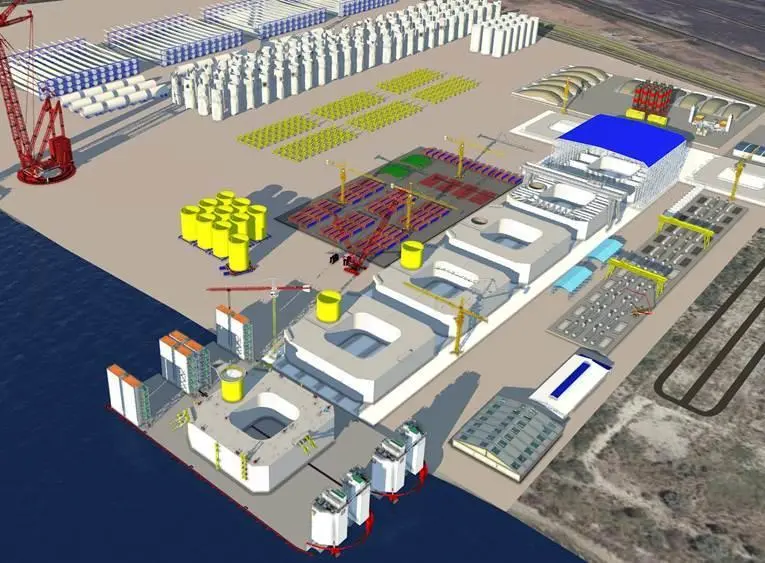
French offshore floating wind technology firm BW Ideol has been handed a €74 million grant from the EU Innovation Fund after already securing €52 million from French tax payers for what it calls a factory ’dedicated to the serial production of concrete floating wind foundations’.
The Fos3F factory, which will be built on France’s Mediterranean coast at Fos-sur-Mer, will have a capacity of up to 30 floating foundations a year, capable of supporting either 15MW turbines or the next iteration of 20MW-plus giants.
The substructures fabricated will use BW Ideol’s patented Damping Pool design, a central water-filled cavity within the floating foundation, which uses the moonpool principle to counter wave motion, reducing pitch and roll. This stabilises turbines even in high sea states, allowing deployment in deeper waters, where the winds blow more strongly.
”This design is the only floating foundation proven at sea on two continents and is engineered to meet the requirements of both current and next-generation floating wind turbines,” the company says. “The project’s core innovation lies in applying field-proven technologies like gantry slip-forming, skidding systems and automated prefabrication commonly used for civils infrastructure and adapting them to the serial production of BW Ideol’s foundations.”
The factory, BW Ideol says, will serve multiple floating wind farms across France, Spain, Italy and Greece – all Mediterranean countries – with an initial estimate of 8GW by 2043.
“This recognition by the European Commission underlines the strategic importance of this factory for the energy transition of the Mediterranean coast and the relevance of our positioning and products,” said Paul de la Guérivière, CEO of BW Ideol. “Support from the European Union will be a catalyst for the implementation of this factory and for structuring a competitive floating wind industry.”
The Meditgerranean is generally considered a good bet for floating wind because it has some deep water close to shore, where fixed-bottom turbines would not be so suitable. However, the sea is not generally considered particularly windy.
Related Articles
 ENVIRONMENT
 INDUSTRY NEWS
 MARINE CIVILS