![MaritimeJournal[Seawork]](https://www.maritimejournal.com/wp-content/uploads/2026/09/MaritimeJournalSeawork.svg)






Pioneering sea wall project aims to stave off flooding
A pioneering research project that aims to strengthen the resilience of sea walls to coastal flooding has been launched by a UK and US collaboration.
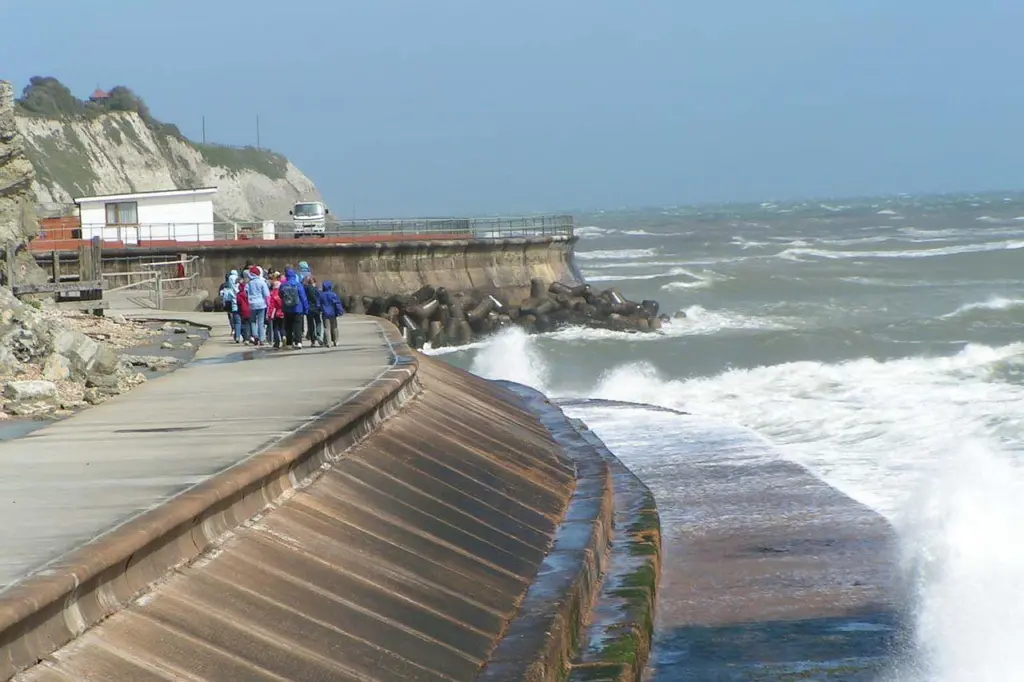
The project by by Heriot-Watt University in Edinburgh, Scotland and Virginia Tech in Blacksburg, Virginia, USA and funded by the Engineering and Physical Sciences Research Council (EPSRC), hopes to be the first step in an international collaboration to strengthen coastal sea defences globally.
“The sea level around the UK has already risen by around 1.5 millimetres a year on average from the start of the 20th century. And even in the best case climate change scenario, the sea level will continue to rise,” said Dr Melis Sütman, an assistant professor in Geotechnical Engineering at Heriot-Watt’s School of Energy, Geoscience, Infrastructure and Society.
“Our coastal defence structures will be of paramount importance to defend our shorelines – not only for the UK, but also for the United States on the other side of the Atlantic.”
Flooding crisis
Around 148 million people worldwide are exposed to coastal flooding events, which are predicted to surge in frequency and severity in the coming decades as climate change drives sea levels higher.
By the year 2300, the sea level for London and Cardiff is predicted to rise between 0.5 metres and 2.2 metres and up to 1.7 metres for Edinburgh and Belfast.
In the US, the coastal sea level by 2050 is predicted to be between 0.25- 0.30 meters higher than in 2020 – and as much as the rise measured over the last 100 years before that, from 1920 to 2020.
Dr Sütman said that rising sea level also has strong economic consequences.
The investment needed to protect London is expected to exceed GB£20 billion. And at Staten Island in New York City, US$165 million is being invested to build an 8.5 km seawall along the coastline to build resilience to sea level rise and extreme events.
The research being conducted by Heriot-Watt and Virginia Tech will investigate how the soil behind sea walls is impacted by repeated wetting and drying cycles over time from waves overtopping the sea walls. It’s hoped this will highlight areas where the design and resilience of sea walls could be strengthened. It will involve testing wave overtopping scenarios on interfaces that mimic the interaction between sea walls and the backfill soils.
At Heriot-Watt, tests will take place in the lab on a small-scale device that the University says it has developed as a world first. This is called a thermo-hydro-mechanical direct shear interface device and it allows numerous scenarios to be tested and measured. This includes, for example, different water contents, overtopping frequencies and lengths and different properties of the both the soil behind the wall and the wall itself.
Virginia Tech will then conduct its set of experiments on a full-sized wall that is five metres in height.
Related Articles
 INDUSTRY NEWS
 MARINE CIVILS
 MARINE CIVILS