![MaritimeJournal[Seawork]](https://www.maritimejournal.com/wp-content/uploads/2026/09/MaritimeJournalSeawork.svg)





UK scraps €29 billion 3,800km subsea cable project
The UK government has made a shock decision to scrap an ambitious £26 billion (€29.3 billion) 3,800km subsea cable link project between Morocco and the UK.
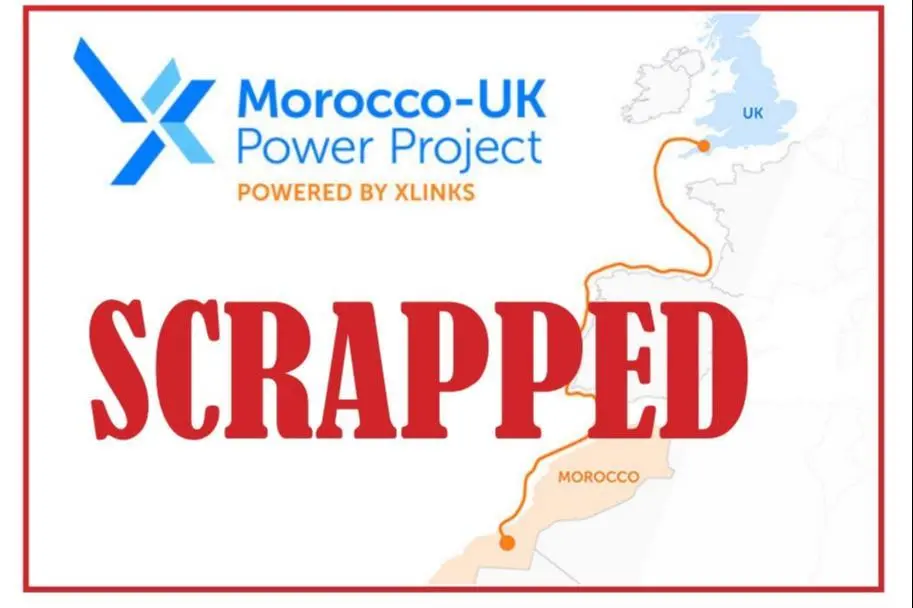
The Xlinks project was designed to link up the UK’s power grid with electricity from Morocco that would be generated by solar panels and 600 wind turbines in the Sahara desert.
The project would have entailed use of a new cable-laying vessel twice the size of the world’s largest, Leonardo da Vinci, and a new cable factory being built at Hunterston, in the north of Scotland.
Making a statement to Parliament, Labour life peer Lord Wilson of Sedgefield said officials in the Department for Energy Security and Net Zero (DESNZ) had evaluated the project and ’concluded that it is not in the UK national interest at this time’ and would not be inline with the government’s ‘two pillars’ of delivering clean power by 2030 and accelerating to net zero.
”The government has concluded the project does not clearly align strategically with the government’s mission to build homegrown power here in the UK,” he said. ”This would be a first of a kind mega project which has a high level of inherent, cumulative risk (delivery, operational, and security). We acknowledge the excellent work of Xlinks on trying to mitigate these risks where possible but nevertheless, this remains a factor in decision-making.
“Ultimately, we have determined there are stronger alternative options that we should focus our attention on to meet the government’s plans to decarbonise the power sector and accelerate to net zero at least risk to bill payers and taxpayers. The government also believes that domestic alternatives can see greater economic benefits whether that be through jobs or supply chains.”
Full response from Xlinks

“We are hugely surprised and bitterly disappointed that the UK Government would choose to walk away from an opportunity to unlock the substantial value that a large-scale renewable energy project like this would bring, not least the opportunity to lower the wholesale price of electricity, which is currently one of the highest in Europe,” said Xlinks chairman Dave Lewis.
“We developed this project to rapidly realise the potential of long-distance electricity generation and connection for the UK and Morocco – potential that was recognised by the UK in 2023, when it was designated as a Nationally Significant Project.
“The project requires no upfront government investment and offered a highly competitive CfD strike price. It would reduce wholesale electricity prices by over 9% in its first year; bring in £20bn of socio-economic value, including a £5bn injection into the UK’s green industries; provide 8% of the UK’s electricity needs at a time when demand is rocketing; cut power sector CO2 emissions by c.10% in its first year; and increase energy security through increased diversity of supply and reduced reliance on imported gas.
“Furthermore, it would address the challenge of sharp drops in UK power generation when the wind isn’t blowing or the sun isn’t shining. It would do this at significantly lower cost than the nuclear alternative and be connected to the grid much sooner.
“The international investment community identified the potential of the opportunity. Over £100m from leading energy sector players has already been spent on project development, and demand from lenders to participate in the construction phase is greater than we require.
“Most importantly, Morocco – a world leader in renewable energy – recognises the strategic value of interconnections. We have been continuously impressed by the vision, framework and environment that Morocco has put in place to foster international energy collaboration through supporting innovative initiatives, as part of its long-term vision to lead the international community’s efforts towards net zero.
“Ultimately, we have no choice but to accept DESNZ’s decision. We are now working to unlock the potential of the Project and maximise its value for all parties in a different way.”
Related Articles
 INDUSTRY NEWS
 MARINE CIVILS
 MARINE CIVILS