![MaritimeJournal[Seawork]](https://www.maritimejournal.com/wp-content/uploads/2026/09/MaritimeJournalSeawork.svg)






Work progresses on Scotland’s largest renewables hub
The creation of Scotland’s largest renewables hub at the Port of Leith has taken a major step forward with the start of construction works for the new riverside marine berth.
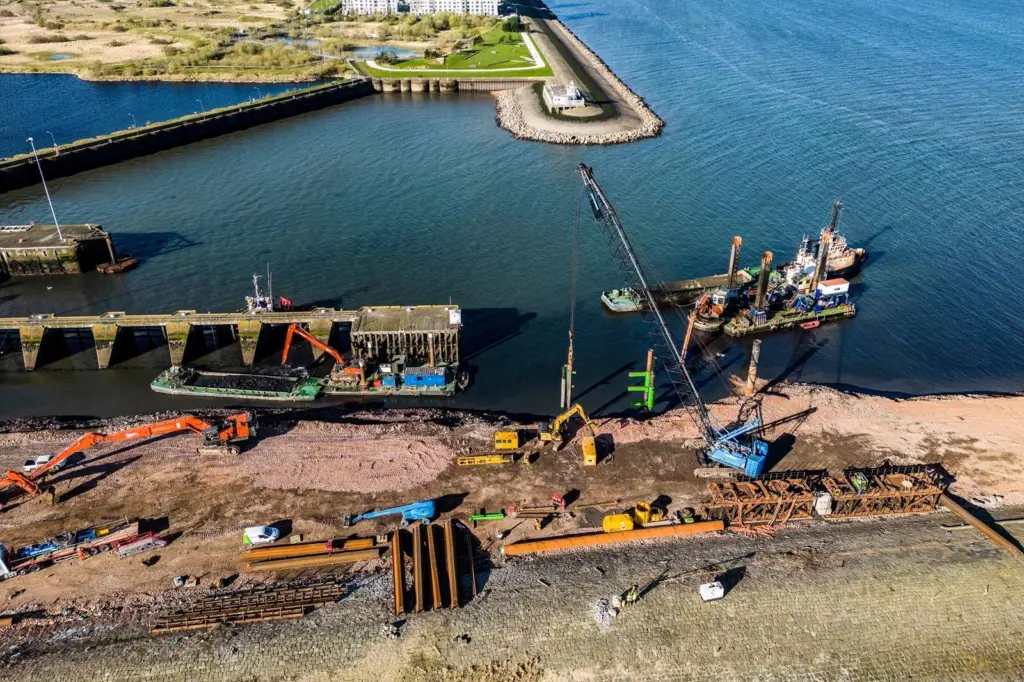
Forth Ports’ ambitious £50m (€57m) project in Leith will create Scotland’s largest renewable energy hub on a 175-acre site – supporting Scotland’s economic recovery, energy transition plans and its move towards net zero.
“The work under way in Leith will pave the way for Scotland to maximise the supply chain value and jobs from the ScotWind offshore wind leasing round,” said Charles Hammond, group chief executive of Forth Ports.
“Our major investment in Leith’s logistics and marine infrastructure will be crucial to the success of the Forth Green Freeport. With existing and future offshore wind farm development plans in the North Sea, this renewables hub has the potential to support offshore wind construction projects for the next 30 years.”
World class
When completed, the bespoke riverside berth will be capable of accommodating the world’s largest offshore wind installation vessels and will feature a heavy lift capability of up to 100 tonnes per square metre (t/m2).
This will be backed up by 175 acres of adjacent land for logistics, marshalling and manufacturing.
Working with specialist contractor Graham, the berth is being created immediately outside the port’s lock gates, meaning that vessels do not need to enter the locked port itself, leading to faster ship turnaround times and the ability to accommodate larger vessels.
Works began in January on the marine and land-side port infrastructure upgrades, with completion expected in summer 2024.
The Leith Renewables Hub will be part of the Forth Green Freeport’s strategically located tax and customs sites which aim to reindustrialise central Scotland, bringing up to 50,000 high-quality green jobs by increasing trade and supporting the growth of businesses across the Firth of Forth.
Leith’s proximity to the important North Sea offshore wind sites, coupled with the natural deep waters of the Firth of Forth and existing skills base, makes the port a strong location to support planned developments, as well as the anticipated pipeline of ScotWind projects, both fixed and floating.
Related Articles
 INDUSTRY NEWS
 MARINE CIVILS
 MARINE CIVILS