![MaritimeJournal[Seawork]](https://www.maritimejournal.com/wp-content/uploads/2026/09/MaritimeJournalSeawork.svg)




Heads up in fast water
A new large-size buoy with a twin keel hull design that has already won orders across the world, has recently found a special niche in waters closer to home.
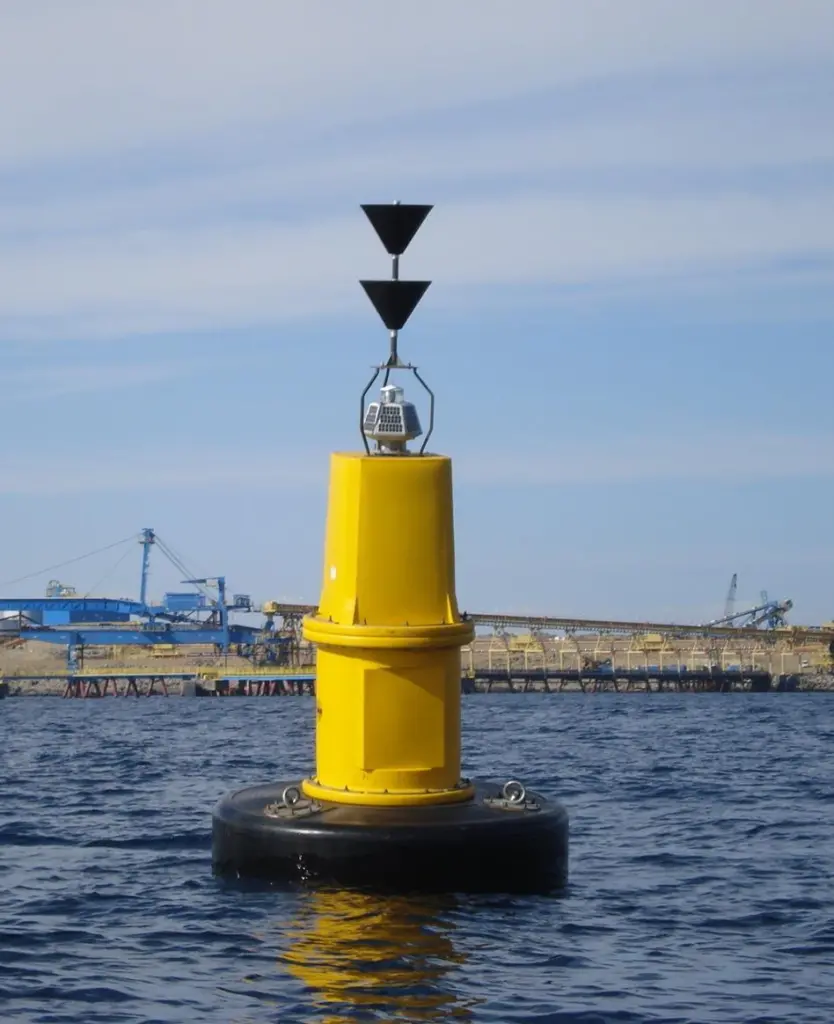
The SB-2200 was chosen for the job of replacing a heavy steel unit in Kilkerrin, in the Shannon estuary where currents can run at six knots on a spring tide. Kilkerrin Harbour Master Alan Coghlan is particularly pleased, saying, ‘The buoy performs well in this strong current with little of no tendency to lean, which is a major benefit in improving the lantern’s range and visibility.’ He added that the other features, including the unit’s low weight and construction, greatly reduces the maintenance required.
Ian Burgess of Tideland Signal told MJ how the buoy’s advanced hull design evolved through experience, and is based on Tideland’s popular SB-98 buoy which also has an asymmetric twin keel hull to take advantage of hydrodynamics and maintain the tower in the near vertical. ‘Since marine lanterns typically have a fresnel lens which focuses the light beam to what should be a horizontal plane, it is important that the tower stays fairly upright, keeping the light beam parallel to the water. This maximises visibility to the mariner, rather than illuminating the fish and the seagulls.’
The new buoy is made from rotationally moulded polyethylene with a solid core of expanded and fused polystyrene foam. The first benefit it has over more conventional construction is that it makes an asymmetric design relatively easy to form. Both the SB-98 and the SB-2200 take advantage of this, with a shallower draft to point up into the current, keeping the buoys stable on a selectable single point mooring.
However, the SB-2200’s twin keel hull also gives the unit an extra, cost effective edge, because as well as even more stability on the sea, it also stands upright on deck and is designed for a single point lift. This means that less deckspace and lighter lifting equipment is required thus keeping the expense of deployment and maintenance to a minimum.
The other benefits accruing to this kind of construction is that the process also gives an increased thickness of polyethylene at major stress points in the structure, and being seamless it eliminates all the problems associated with a steel frame or tower, preventing significant ingress in case of a puncture.
An added feature is that the buoy’s integral self colour won’t simply ‘bleach out’ over time, since before moulding, the polymer is compounded with UV inhibitors and pigment so that the complete shell is evenly UV-stabilised and colour is permanent and uniform throughout. There is no need for the buoy to be taken ashore for repainting and any marine growth or fouling can be removed with the buoy on location. All this means that the lifecycle costs of a polyethylene unit can be as low as 50% compared to a traditional steel buoy.
The result is an adaptable, lightweight buoy (supporting up to four 40W solar modules and an optional radar reflector) which is virtually unsinkable and has a working life in excess of 15 years. It can also be used as a platform for other navigation aids, such as self contained solar lanterns, a RACON, and/or an AIS AtoN transponder. The unit comes with a range of options such as IALA standard markings and extras such as top marks, day mark wings and access ladders.
Related Articles
 VESSELS
 MARINE CONSTRUCTION
 VESSELS