![MaritimeJournal[Seawork]](https://www.maritimejournal.com/wp-content/uploads/2026/09/MaritimeJournalSeawork.svg)


EU presents roadmap to speed up renewables
European Commission has presented “AccelerateEU” at WindEurope, its response to the current energy crisis, stressing that price relief must align with faster deployment of renewables and electrification.
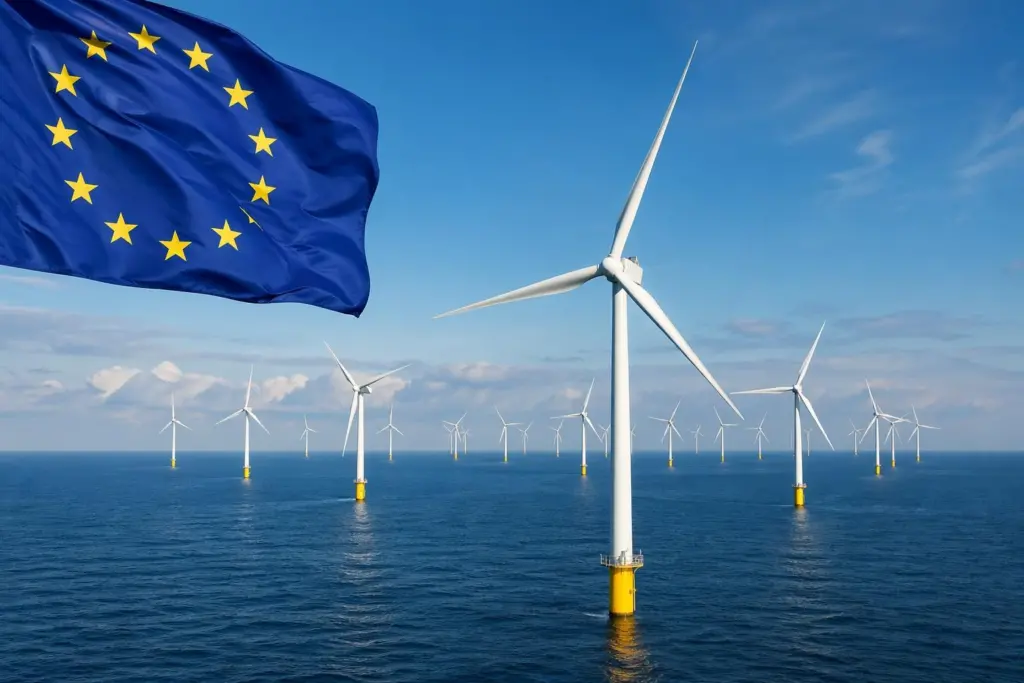
While not limited to offshore wind, these measures are directly relevant to scaling offshore capacity, particularly through faster permitting and grid access.
Europe remains heavily dependent on imported energy, with 64% of consumption sourced externally. This structural reliance on fossil imports has increased costs and vulnerability to global price shocks.
AccelerateEU prioritises replacing these imports with home-grown renewable electricity and has called on member states to fully implement EU permitting rules and accelerate project delivery.
A key focus is repowering existing wind farms to quickly boost renewable output. Although largely applicable to onshore wind, similar principles may support offshore upgrades and efficiency gains over time.
“Electrification is a strategic imperative for Europe’s independence, security, and prosperity. It needs to happen immediately and at scale. We must make home-grown electricity the cheapest option,” said Tinne van der Straeten, CEO of WindEurope. She highlighted the need to cut taxes on electric technologies and accelerate uptake across sectors.
To shield consumers from fossil-driven price spikes, Member States may introduce support schemes, including energy vouchers and reduced electricity taxes. Industrial support measures are also expected under updated State aid rules.
Grid infrastructure is another major priority. The Commission urges implementation of the European Grids Package and action on connection delays, with around 400 GW of wind capacity currently awaiting grid access. Reducing these bottlenecks is essential for both onshore and offshore wind expansion.
AccelerateEU also outlines upcoming reforms to network charges and taxation to ensure electricity is taxed less than gas, alongside a forthcoming Electrification Action Plan.
However, the package allows for windfall taxes on energy producers. Similar interventions in 2022 created uncertainty and slowed investment. “Wind investments hit their lowest since 2009… Let’s not repeat past mistakes,” van der Straeten warned.
Overall, AccelerateEU reinforces electrification, grid development, and permitting reform—key enablers for accelerating offshore wind deployment.
Backing up the intention, five European Transmission System Operators (TSOs) from Belgium, Denmark, Germany and the Netherlands signed a Memorandum of Understanding (MoU) at the event. Their intention is to enhance the affordability, efficiency, and reliability of the future electricity system by boosting cooperation on offshore cable infrastructure in the North Sea.
Related Articles
 OTHER NEWS
 FEATURES & VIDEOS
 MARINE CIVILS