![MaritimeJournal[Seawork]](https://www.maritimejournal.com/wp-content/uploads/2026/09/MaritimeJournalSeawork.svg)



Malta’s different approach to offshore wind
Malta’s Environment and Planning Authority has started a public consultation on a proposed wind turbine project that would see a departure from the more established vision of offshore windfarms.
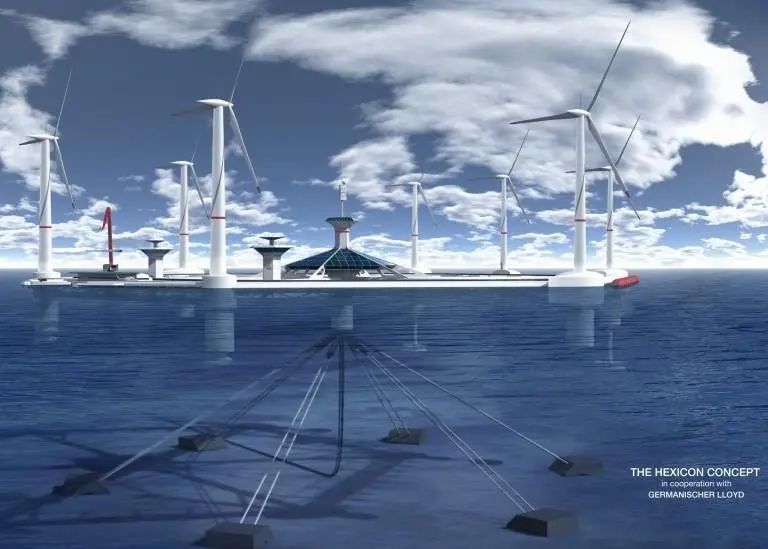
The traditional image of an offshore windfarm is an array of individual turbines installed in various configurations, dependent on specific circumstances. Malta’s vision however involves adopting Copenhagen based Hexicon AB’s concept based around two different types of turbines mounted on a floating, hexagon shaped platform, which uses a specifically designed swivel system to rotate around its own axis and automatically align itself into the wind.
Currently, Malta gets up to around 2% of its electricity from renewable energy, while the EU as a whole is heading down the road towards the 20% by 2020 target and they are now taking steps to meet their own target of at least 10% by 2020. The island’s location, surrounded by deep water, restricts the use of traditional fixed foundations. Also, their renewable energy plans date back to days when economical and feasible floating turbine solutions were still somewhat distant. The adoption of offshore wind was, therefore, always going to present challenges. Malta considers that the proposal from Hexicon offers a viable prospective solution that could, it is claimed, supply the island with 9% of its energy needs.
The Hexicon concept comprises a hexagon shaped lattice form platform, constructed from an FMS patented hull system with a composite outermost layer. A centralised swivel system allows the entire structure to rotate around its centre axis and align itself with the wind directions. The platform is secured to the seabed with a patented Seaflex mooring system, without using anchor chains, along with a gravity anchor system.
Six 6.5MW conventional horizontal turbines are positioned at the apex of each point of the platform. At the base of each turbine, and below the waterline, a node ballast system provides stability, with azimuthing thrusters included for transport and positioning purposes. A number of smaller vertical turbines can be incorporated in the various connecting ‘legs’ of the platform to maximise energy production.
The size and design of the platform allows for the inclusion of various structures including a docking and service facility, along with a helipad. In the centre of the platform a 24/7 surveillance and lodging area can be included. Export cables are fed through the swivel wheel arrangement at the centre, which incorporates a substation above the waterline.
Malta’s plans involve a 36 turbine, 54MW, 460m wide Hexicon platform to be located 11 miles off the island’s north east coast in water depths between 100m and 150m. If the application is successful, and EU funding is forthcoming, Hexicon consider the project could be completed by 2014.
By Peter Barker
Related Articles
 OTHER NEWS
 FEATURES & VIDEOS
 MARINE CIVILS