![MaritimeJournal[Seawork]](https://www.maritimejournal.com/wp-content/uploads/2026/09/MaritimeJournalSeawork.svg)



MOREDATAS Project
Five companies based at locations in Ireland, France and the UK have announced plans to collaborate on an innovative project to help limit the risks faced by developers of tidal and wave energy initiatives around the north western European coast.
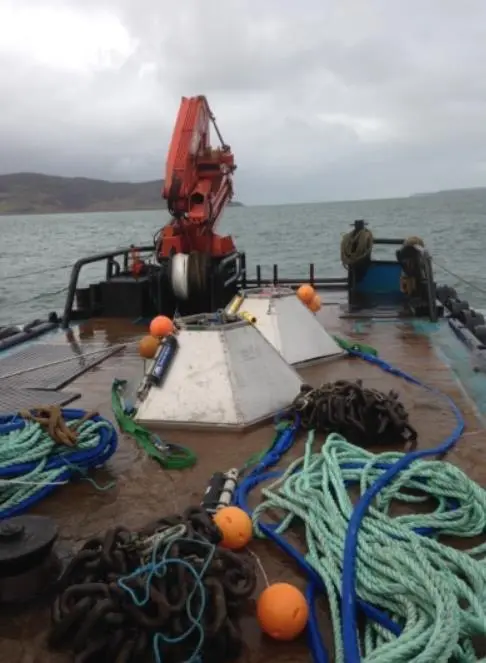
The key objective of the MOREDATAS project (short for Methods to Obtain Refined Environmental Data from the Seas) is to address the range of uncertainties posed to developers by the implementation of Acoustic Doppler Current Profilers (ADCPs) – seabed mounted acoustic devices that are used to measure tidal currents and wave heights.
As Eloi Droniou, Managing Director at DynamOcean, and coordinator of the MOREDATAS project, explained, the fact that ADCPs are used for the resource assessment of ‘virtually all tidal energy projects and the majority of wave energy projects’ it is of ‘paramount importance’ to have an in depth knowledge and practice of the advantages and limitations of this type of instrument.
To gather this knowledge, she revealed that the project team will deploy next-generation ADCPs at a number of sites to gain a ‘better understanding and characterisation of unquantified or unknown aspects of the wave and tidal energy resources.’
“These instruments were not originally designed with the requirements of the marine energy industry in mind and it is common for the instruments’ capabilities to be pushed to their limits to provide useful data in demanding sub-sea marine environments,” said Droniou.
Acoustic Doppler Current Profilers (ADCP) measure water velocities throughout the water column along a number of beam directions, as well as water surface elevations where the beams hit the sea surface. They have been extensively used in the oceanography sector since the 1980s and have also been applied, with little or no adaptation, to the resource assessment and characterisation of wave and tidal energy.
As part of the project, ADCPs will be used to acquire new datasets at challenging wave and tidal sites, which will be used to develop new techniques to analyse waves and turbulence.
In doing so, the partners – including DynamOcean, as well as Applied Renewables Research, DP Energy, Tidal Energy and Ecole Centrale de Nantes – will undertake measurements at three different sites using new five beam sensors to collect relevant data sets. This data will be used to develop advanced processing techniques, including turbulence analysis and wave spectral analysis with a medium to strong ambient current. The data will be used alongside existing and new techniques to stress test the new IEC (International Electrotechnical Commission) standards and produce standardised methods and tools to analyse ADCP data and calculate its ‘associated uncertainties.’
“This will have a potentially significant impact on the development of ocean energy technologies as it will make investments less risky as the energy production is less uncertain. By reducing the investment risk for ocean energy projects the investment income will increase and thus promote the development of the industry,” said Droniou.
By Andrew Williams
Related Articles
 OFFSHORE RENEWABLES
 OFFSHORE RENEWABLES
 ENVIRONMENT