![MaritimeJournal[Seawork]](https://www.maritimejournal.com/wp-content/uploads/2026/09/MaritimeJournalSeawork.svg)



Sheerness wind turbine manufacturing base
Following Siemens’ decision to manufacture offshore wind turbines at the UK port of Hull, further evidence of the industry’s desire to establish manufacturing facilities in the UK has arrived.
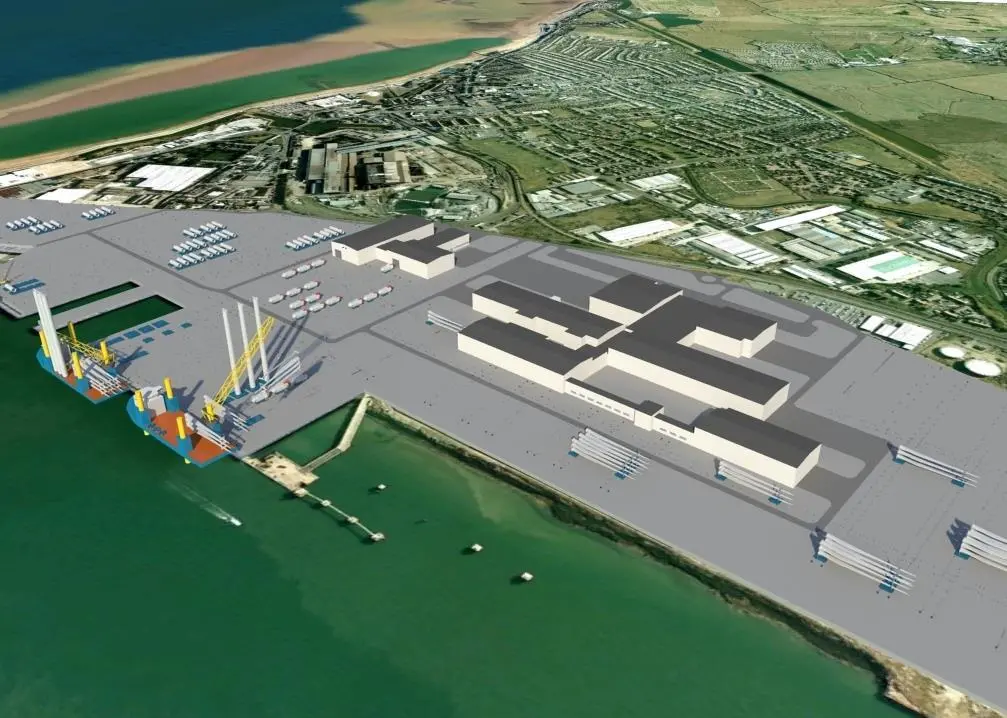
The Danish turbine manufacturer Vestas has selected the Kent port of Sheerness as the site for a fully integrated offshore wind turbine manufacturing and installation facility, potentially creating over 2,000 jobs locally.
With the potential of major orders for turbines to satisfy the demands of the UK Round 3 projects, together with continued expansion of the offshore wind farm market in general throughout Europe and beyond, Vestas recently launched the V164-7.0MW turbine, their first ever purpose built offshore turbine, fully optimised for conditions in the North Sea. The company’s plans involve manufacturing the new turbine at Sheerness.
The port option agreement with Peel Ports, operators of the Port of Sheerness, gives Vestas exclusive rights to 70 hectares of land, potentially leading to a full lease and building agreement involving turbine tower storage, nacelle assembly and storage, blade manufacturing and storage, and installation vessel loading facilities. The proposed site includes areas currently home to the fresh produce terminal and the import car terminal.
Vestas points out however, that while they have shown their willingness and commitment to make major investment benefitting the UK, they alone cannot make it happen, describing the potential of job creation as a two way street. Referring to the requirement that they are able to secure orders for the new turbine, Anders Søe-Jensen, president of Vestas Offshore said, “Before our customers can provide us with the needed order pipeline, they need to see stability in the market and a long term political and regulatory certainty that ensures their business case. Making things happen lies in the hands of the policy makers, so we are looking forward to seeing the UK government providing the best possible terms for the offshore wind industry to truly take off and the potential jobs become a reality.”
In September 2010, the UK Energy Research Centre published the report ‘Great Expectations: The cost of offshore wind in UK waters – understanding the past and projecting the future’ (MJ December 2010). It investigated the increasing costs associated with offshore wind farms. The report identified concentrating turbine manufacturing in the UK as part of the solution to reducing costs. This development from Vestas, together with similar plans from other major turbine manufacturers will therefore be welcome news for those who consider reducing costs important for the future of the industry.
Vestas, together with others considering the UK government’s appetite for encouraging growth in the marine renewable industry, will therefore be analysing closely the detail behind this week’s announcement on the fourth carbon budget. The statement revealed legally binding carbon reduction targets up to 2027, broadly following the recommendations of the official advisory body, The Committee on Climate Change.
Renewable energy is but one part of the overall picture and there are caveats, probably influenced by political considerations around the current coalition government, but the general message will hopefully provide the extra confidence investors in renewable energy, among others, are seeking.
By Peter Barker
Related Articles
 OTHER NEWS
 FEATURES & VIDEOS
 MARINE CIVILS