![MaritimeJournal[Seawork]](https://www.maritimejournal.com/wp-content/uploads/2026/09/MaritimeJournalSeawork.svg)


Successful Norwegian trials for MaXccess
OSBIT Power (OP), Siemens Wind Power and Statoil announced on Wednesday that they have successfully completed offshore trials of OP’s innovative offshore wind turbine access system, MaXccess.
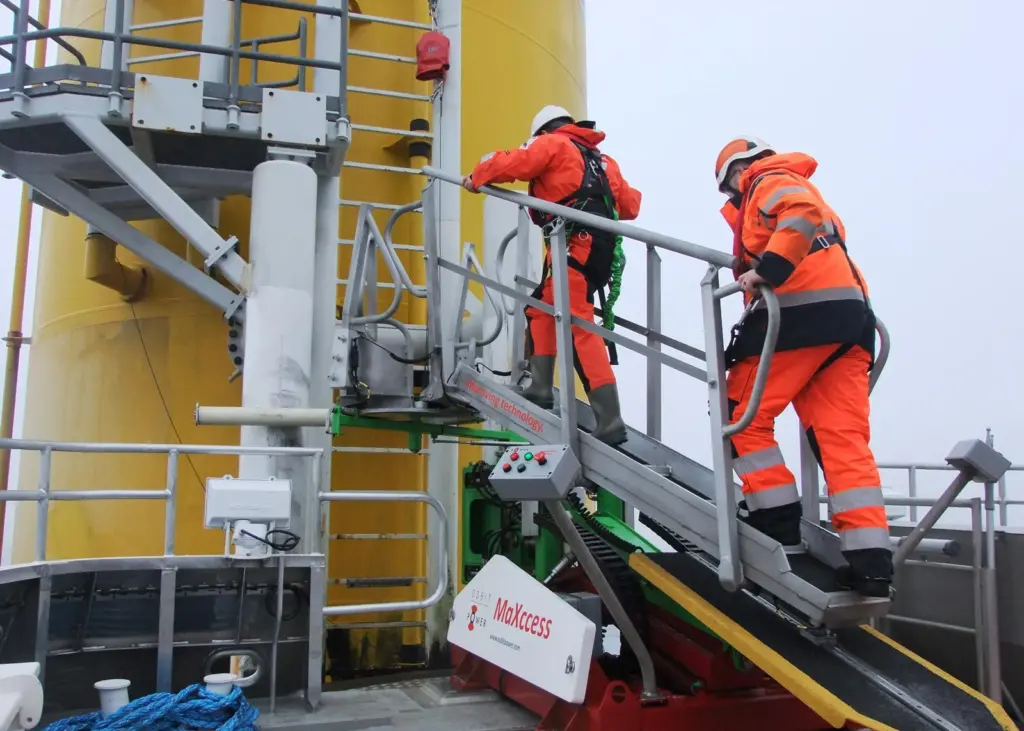
The trials were conducted with the backing of Siemens Wind Power and Statoil, at the Hywind Demo floating offshore wind turbine off the coast of Norway.
MaXccess was installed on the wind farm service vessel Bayard 3, operated by Fred Olsen Windcarrier, for the duration of the trials conducted over the past month from Statoil’s Hywind operations base at Skudeneshavn, Norway. The trials saw successful safe transfer of personnel taking place in conditions ranging from 1.2m up to 1.9m significant wave height (Hs). During the nine days of offshore operations, over 100 connections were made, with MaXccess being clamped to the turbine buffer tube for over 12 hours in total, during which time 36 personnel transfers were made.
The MaXccess system has been developed by UK based OP, with the first production MaXccess unit, MX11/01, being completed in summer 2011. “Following an extensive review of offshore access solutions, Siemens Wind Power and Statoil chose to support trials of MaXccess believing it shows great potential to provide significant benefits to both safety and productivity of their offshore projects, a safe step forwards in offshore access”, said Dr Tony Trapp who established OP 18 months ago, with the aim of improving offshore technologies, particularly those related to wind.
The MaXccess system provides a stable platform from which personnel can transfer to and from the boat landing platforms mounted on turbine foundation structures. A friction based clamp connected to the vessel by a carefully engineered linkage geometry ensures that the bow of the vessel is held stationary while the vessel is allowed to roll, pitch and yaw freely. The system incorporates instrumentation to measure and log load and position data.
MaXccess incorporates a traffic light warning system to indicate when safe transfer conditions are present, thereby removing the uncertainty to which technicians are currently exposed when transferring using a vessel contacting the turbine with its bow fender only. On top of these benefits the lack of a requirement to continually thrust into the boat landing at high power results in less strain on vessel engines, and will therefore help reduce engine maintenance and fuel costs.
“There is huge need to reduce costs and increase safety in offshore wind projects”, concluded Tony Trapp. “For the industry to have a viable future the current situation has to be improved. Transferring personnel is not only one of the most hazardous activities on a wind farm but also a major bottleneck due to the weather limits of current transfer technology. With MaXccess OP has created both a safer, more predictable means of transfer and a route to cost reduction through greater accessibility to turbines.”
Related Articles
 OTHER NEWS
 FEATURES & VIDEOS
 MARINE CIVILS