![MaritimeJournal[Seawork]](https://www.maritimejournal.com/wp-content/uploads/2026/09/MaritimeJournalSeawork.svg)





Turbine arrives for floating wind farm
Construction of a floating wind farm off Scotland’s north east coast is near completion and will enable wind energy to be generated in deep water unsuitable for conventional turbines.
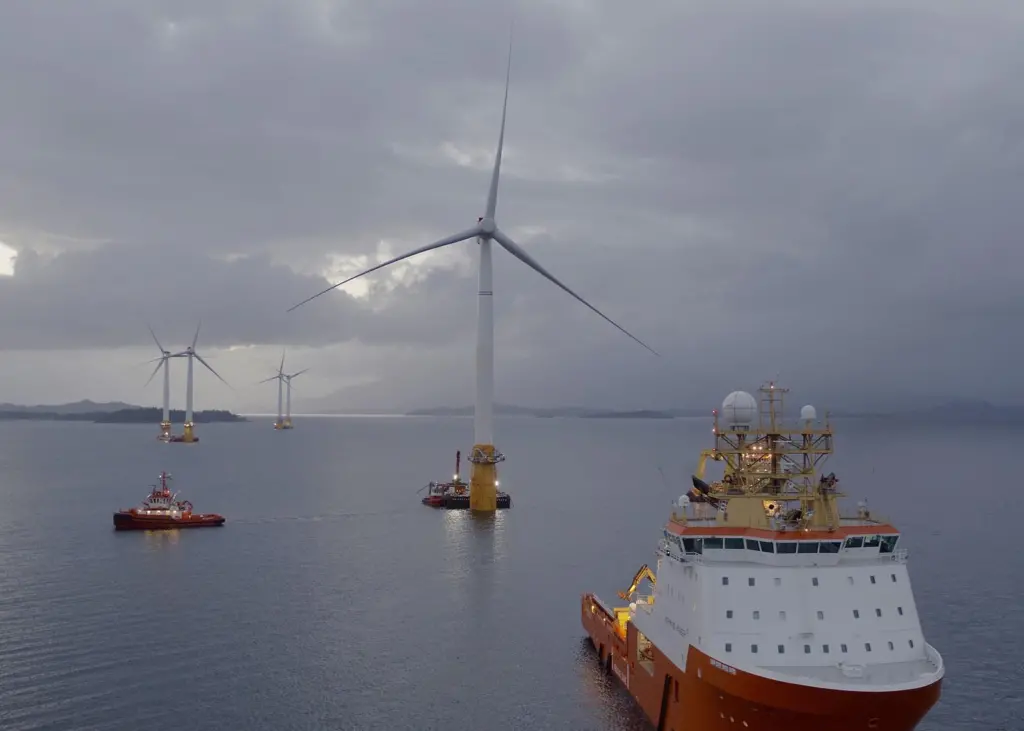
The first of five 11,500-tonne 6MW turbines has been towed into place at the world’s first commercial-scale project of its kind, Norwegian Statoil’s £190m Hywind wind farm, located 15m off the coast of Peterhead, Aberdeenshire.
The Statoil-manufactured turbine will operate in water depths of 95-129m. The technology will currently work in water depths down to 700m.
The turbine was towed from Norway, where four more are waiting to be brought over for the trial scheme.
According to the BBC, Statoil, which owns 75% of the project, said that output from the turbines is expected to equal or surpass generation from current ones.
The farm is expected to power about 20,000 homes.
The blades of the turbines are 75m long while the supporting towers, tethered to anchors fixed in the seabed, add another 100m to each structure.
The Hywind project is being run in collaboration with the Abu Dhabi-based energy company Masdar, which owns the remaining 25% of the project.
Statoil told Maritime Journal: “In addition to Hywind, several other floating offshore wind concepts are under development, and the demand for renewable energy is growing. We hope through Hywind Scotland to prove that our concept is scalable and can be developed further and in larger parks in the future.”
Lindsay Roberts, senior policy manager at Scottish Renewables, said: “This is a hugely exciting development for a ground-breaking project.
“The potential global market for floating offshore wind technologies is significant, so it’s fantastic to see Scotland once again at the forefront of an innovative, burgeoning industry.”
By Rebecca Jeffrey

Related Articles
 OFFSHORE RENEWABLES
 OFFSHORE RENEWABLES
 ENVIRONMENT