![MaritimeJournal[Seawork]](https://www.maritimejournal.com/wp-content/uploads/2026/09/MaritimeJournalSeawork.svg)

Van Oord cable-layer joins their windfarm fleet
Offshore contractor Van Oord has taken delivery of the first of class Damen Offshore Carrier Nexus, configured as a cable-laying vessel for installation of subsea cables at offshore windfarms.
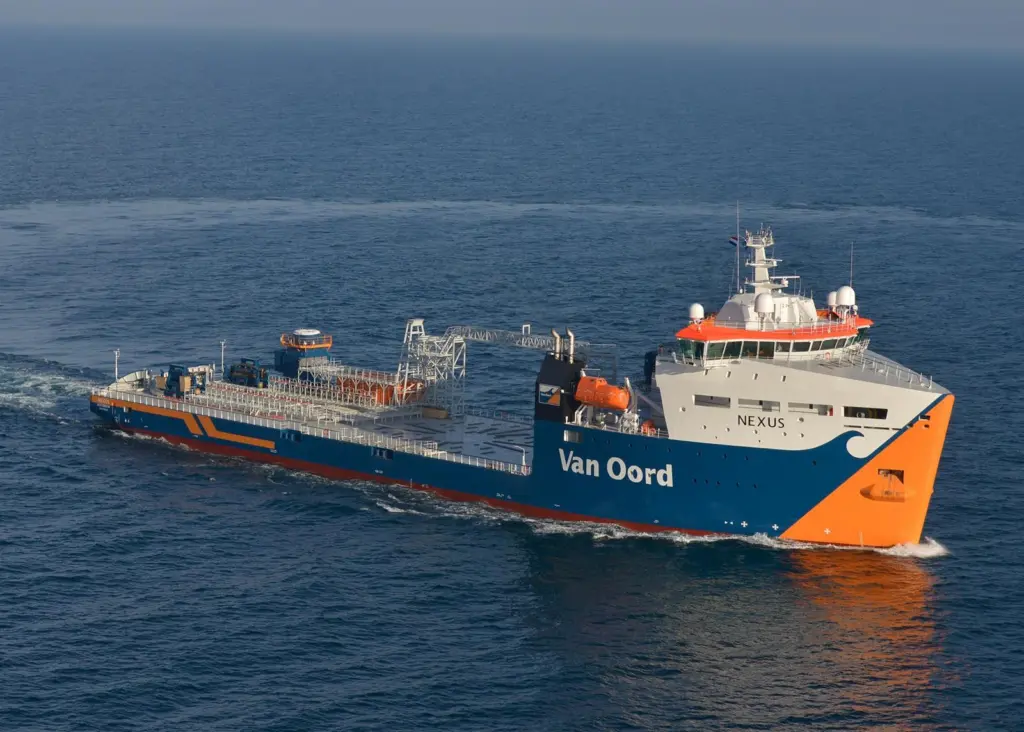
This story is of interest on two fronts: as well as the first example of Damen’s Offshore Carrier (DOC), it underlines Van Oord’s involvement in the offshore wind industry, adding to their more traditional areas of activity: dredging and offshore oil and gas support.
Van Oord have actually been involved in the offshore wind industry for over ten years, the early days seeing for example the multipurpose support vessel Jan Steen, built as a side stone dumping vessel, later modified to lay inter-array cables. The company recently took delivery of their innovative newbuild turbine installation vessel Aeolus, with a 990 tonne capacity crane well suited for installing current and next generation windfarms.
The cable-laying sector of the industry, particularly the inter-array elements, has faced particular challenges which Van Oord are meeting head-on. Their investment has been rewarded by being chosen as EPC subcontractors providing construction services such as foundation and turbine installation, cable installation and scour protection for several prominent windfarm projects.
DAMEN’S NEW OFFERING
Designing specialist offshore vessels, be they cable-layers, heavyload carriers or accommodation vessels to name a few can result in bespoke one-off vessels moulded around a specific requirement. Another route is to base the vessel on a standard hull designed in such a way as to make it adaptable for various roles, a particularly common approach for the offshore oil and gas industry. Damen’s Offshore Carrier appears to fit this criteria and the potential of the new design has clearly been recognised with the order for another DOC, also configured as a cable-layer for DeepOcean/Maersk Supply Service.
The DOC was first introduced in 2012 as a cost-effective smaller heavy transport, offshore installation and ro-ro platform aimed at multiple markets. At the heart of its adaptability is the spacious and flush open deck and modular construction allowing it to change quickly and economically between roles. The first task for Nexus is scheduled to be cable-laying duties at the Gemini offshore windfarm, to be constructed 55km north of the Schiermonnikoog, one of the Dutch Wadden Islands, a project Van Oord will be heavily involved in.
The vessel was delivered several days ahead of schedule, the entire design, engineering and build taking just 15 months, a notable achievement considering additional works was added to the specification after the contract was signed with additional cable-laying infrastructure installed prior to handover. Six Damen companies in Romania, Ukraine and the Netherlands contributed to the project, the vessel itself built at Damen Shipyards Galati. Upon completion Nexus sailed to Damen Shiprepair Vlissingen where Van Oord built and installed the cable-laying equipment.
Detailed specification is provided by both Damen and Van Oord and Nexus sails under the Dutch flag with the Lloyd’s Register notation: +100A1 Offshore Supply Ship, +LMC, UMS, D.P. (A.A.), NAV1, CAC1, I.W.S.W.S.L. ECO (A, B.W.T., G.W., IHM, O.W., P), unrestricted trading area. Main dimensions include LOA 122.68m, Beam 27.45m, depth main deck at side 9m, summer/design draught 5.82m, GT 8,637tonnes, 8,398 dwt. Main tank capacities include MGO fuel total (including settling and day tanks) 1,678m3, potable water 187m3 and ballast water 13,400m3. Provision is also included for two main deck water drain tanks, each holding approximately 6m3.
Propulsion comprises a diesel/electric installation, power provided by four main generators; two MAK 8 M25 (2,666 kWe each) and two MAK 6 M25 (2,000 kWe each) diesel engines making a total installed power of 10,948 kW. A high degree of manoeuvrability is required for precise positioning when cable-laying close to fixed turbine structures and is provided by: two 2,100 kW, 2,650mm diameter azimuth thrusters aft, two 1,000 kW, 2,250mm diameter tunnel thrusters forward and a 1,000 kW, 1,750mm diameter retractable thruster also forward. Propellers on all the thrusters are four-bladed fixed-pitch. On trials the vesselachieved a speed of 12.4 knots at summer draught (4,200 kW).
As to be expected with a complex ship such as Nexus there is a comprehensive list of auxiliary equipment. An additional 1,432 kW generator set is provided and other equipment includes a thermal water boiler in combination with waste heat recovery; two self-cleaning purifier units for MGO and four for LO; a sewage treatment plant; a ballast water treatment plant; two fresh water generators; two starting air compressors; one bilge water separator; a CO2 and water mist fire-fighting system for the engine room; four ballast pumps in the cargo area, each 1,000 m3/hr and finally four general service pumps each 100 m3/hr.
The previously mentioned clear after deck has been utilised for the cable-laying installation. This is dominated by the 5,000 ton capacity cable basket carousel, aft of which on the port side is the main knuckleboom crane with a capacity (main hoist) of 100 tons at 15m and 10 tons at 34m (auxiliary hoist). An auxiliary crane abaft the accommodation has a capacity of 14 tons at 9m and 3.7 tons at 24m. Damen’s product information for the DOC 8500 indicates two moonpools (5.4m x 5.4m and 1.5m x 1.3m) and a support for an A-frame.
Deck equipment includes: two electro-hydraulic bow anchor winches, four electro-hydraulic mooring winches (two forward and two aft) and two 45 person lifeboats. The radio equipment is specified for GMDSS Area A3 and accommodation is provided for 90 persons.
Visit Damen Shipyards on stand A75 at this year’s Seawork International.
By Peter Barker