
Specialist works on show for special historic vessel replica
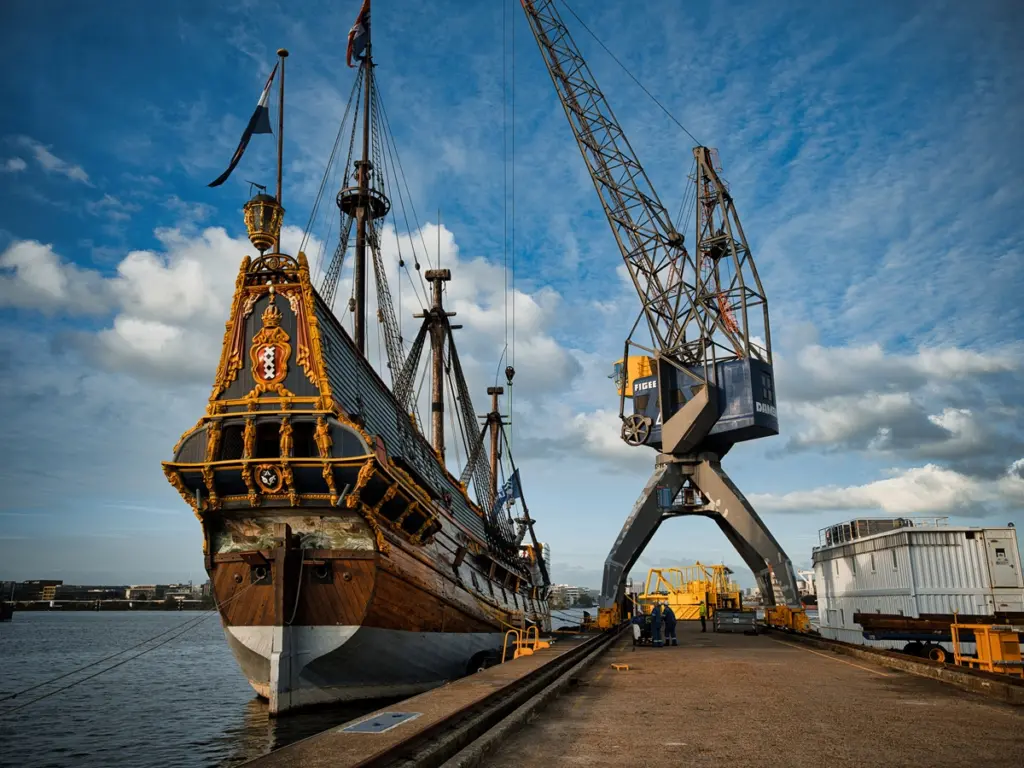
A 56-metre replica of a 17th-century Dutch East India Company vessel has arrived at Damen Shiprepair Amsterdam (DSAm) for a specialist preservation project to put her on permanent display.
The Batavia was a Dutch East India Company (VOC) mirror-return ship, built in Amsterdam in 1627–28 for long-distance trading voyages between the Netherlands and the East Indies. On her maiden voyage in 1628, she carried 341 people, valuable cargo and substantial armament, but wrecked off Western Australia on 4 June 1629.
The full-scale reconstruction is a three-masted wooden ship, 56.5m long, 10.5m beam and with a 5.1m maximum draught, capable of carrying 600 tonnes of goods. She was built in Lelystad between 1985 and 1995 using traditional materials and techniques and will now be transferred to a purpose-built cradle ahead of her permanent display at Museum Batavialand in Lelystad.
The project involves a number of complex marine operations, including the build and preparation of a 90-tonne steel support cradle, the controlled lowering of the vessel into the cradle and the removal of approximately 20kg lead ballast pigs that have been used to stabilise the vessel during her years afloat.
90 tonnes of bespoke steelwork
The centrepiece of the project is a purpose-built steel cradle designed and built by DSAm’s sister company, Niron Staal.
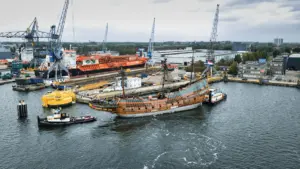
The cradle was made at DSAm over a period of two months before being blasted and painted with the support of local industrial surface-treatment specialist Braspenning. Museum Batavialand subsequently installed timber onto the steel structure to provide a cushioned landing surface for the vessel.
The cradle has been specifically engineered to support the Batavia once she is taken out of the water, allowing the historic vessel to be preserved and displayed safely ashore.
DSAm is carrying out the marine operations required to transfer the vessel from the water onto the new support structure.
The cradle was lifted onto a transport pontoon before the pontoon was submerged in DSAm’s Dock 4. The dock, measuring 450 metres by 39 metres and with an eight-metre draught, provides the depth required to accommodate the combined draught of the pontoon and vessel.
The Batavia will be towed into the dock and carefully positioned above the cradle. DSAm will then pump the dock dry, lowering the water level gradually so that the vessel settles slowly and safely into its new support structure.
Once the vessel is supported by the cradle, water will be pumped from the pontoon’s ballast tanks, allowing the pontoon and vessel to be refloated before the Batavia begins her journey back to Lelystad.
Removing the vessel’s water ballast
Before the vessel leaves DSAm, she will be positioned alongside the yard’s jetty while a team of volunteers working on behalf of Museum Batavialand removes the lead ballast pigs that have been used to stabilise the vessel while afloat.
The ballast consists of individual pigs weighing approximately 20 kilograms. Their removal is an essential part of preparing the Batavia for her transition from a floating vessel to a permanently supported museum exhibit.
Following completion of the operation, the vessel will be towed back to Lelystad. She is scheduled to be brought ashore on 1 October using self-propelled modular transporters (SPMTs).
“We are delighted to welcome the Batavia back to DSAm and to be involved in the next stage of her preservation,” said DSAm Commercial Manager Paul van de Craats. “This is a very different type of marine project from a conventional repair or maintenance docking, but it requires the same careful planning, specialist engineering and precision in execution.
“The construction of the 90-tonne cradle and the controlled docking operation are critical to ensuring that the vessel can be safely transferred from a floating structure to permanent support ashore.”