

‘Uncertain picture’ painted for offshore wind at IMCA
by Debbie Mason, reporting from Antwerp
IMCA delegates at its annual conference last week were told the future for offshore wind looked uncertain despite having a 56% share of offshore energy spending.
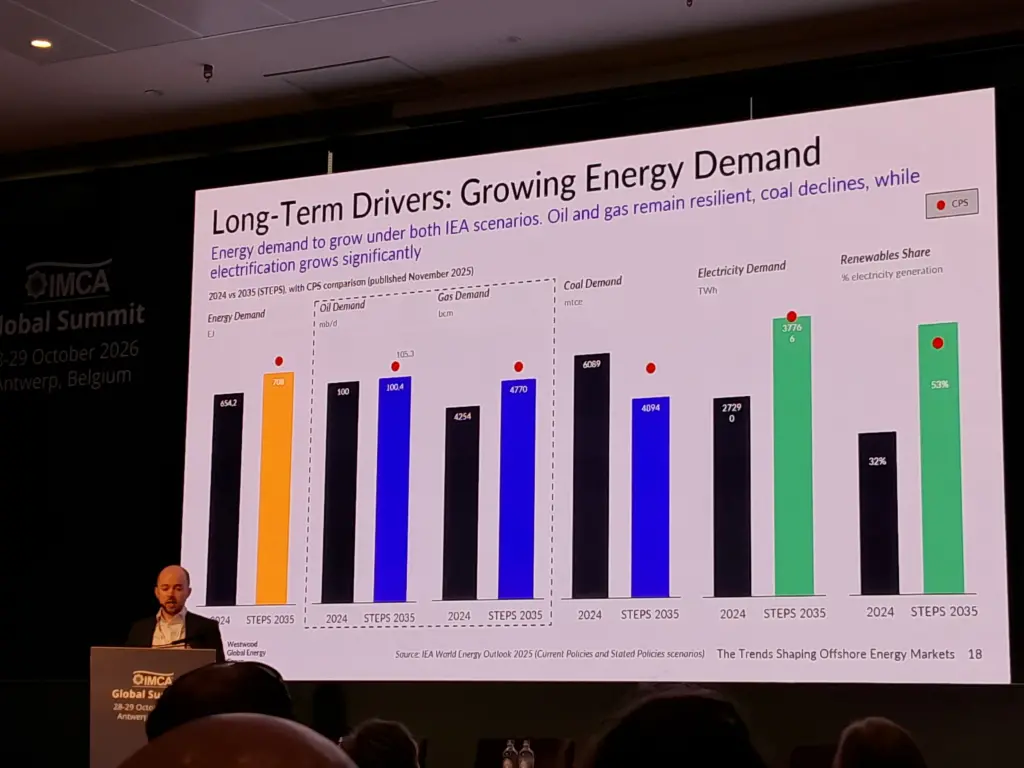
“Rising inflation, interest rates and return on investment demand have created challenges for offshore wind and forecasts have been revised 40% down due to project slippage, timeline slippage, developers pulling out of the market,” said Westwood Global Energy Group senior analyst Peter Lloyd-Williams at the event in Antwerp.
“It’s an uncertain picture in offshore wind. Rather than taking on new developments, developers are expanding existing ones but the overall trajectory is of growth with more regions getting involved.”
Lloyd-Williams, who said oil and gas made up 42% of total spending on energy, with carbon capture the remaining 2%, said governments were showing more willingness to support projects financially, but at the same time oil and gas was growing at an ‘elevated pace’ with a ‘bumper 2026’.
Overall offshore energy CAPEX had grown from $500 billion in the last five-year period to $744 billion in the next, he said, and offshore wind was continuing to grow.
Supply chain
“One thing we really need is continuous construction of wind farms and oil and gas,” said DEME CEO Hugo Bouvy, speaking in another conference session. “We need to build our own factories and vessels and have a continuous flow of work. We have too many cycles causing vessels to be idle and prices will go up to make back the money they have lost.
“The supply chain is ready to build 50GW a year – there are no bottlenecks but there are threats from the lack of financial closure of projects. The vessels are already there – we have more than enough WTIVs, cable layers. You will see more spending in SOVs and a lot of vessels being idle because not enough wind farms are being built.
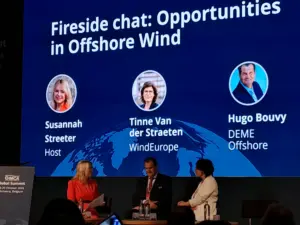 “We need to talk about wise decisions. It’s a transition we are in. We have to do it smoothly. The electricity from Hinckley Point will still not be cheap. We need to stop with the stupid smaller wind farms and scale up. We also need to give more space with the supply chain to build instead of making stupid decisions.”
Moderating one session was Susannah Streeter, a former BBC business anchor, who said China was the ‘elephant in the room’ that could do all of this so much more cheaply.
“What should the priority be?” she asked. “Cheaper energy overall? Enable offshore wind to take off?”
“It should be a mix,” said Bouvy. “We can’t be buying all our products from one part of the world and not selling anything or there will be no jobs. We need to be able to do it ourselves. We need to be competitive.”
First line of defence
WindEurope CEO Tinne Van der Straeten told the session that she believed sea bases should be turned into the ‘powerhouses of Europe’.
“Electrification is the first line of defence,” she said. “Yet offshore wind is just 20 per cent. Electricity is a quarter of the energy we use, but with imported fossil fuels – we don’t know if they will be available, we don’t know what the price will be. We need more home-grown electricity.
“We have the capacity, the capability to build new offshore wind at least 10GW per year. But we are moving to 5GW. Last year we built 2GW. This year we are building 6GW. We are not using the supply chain we have.
“It’s an opportunity to keep jobs in Europe and to keep factories running. We can’t afford to keep factories idle or they will close.