![MaritimeJournal[Seawork]](https://www.maritimejournal.com/wp-content/uploads/2026/09/MaritimeJournalSeawork.svg)



Pollution in ports and harbours
Just like shipping, Ports and harbours have a responsibility to prevent pollution to the environment. Alan Scrafton, from UK spill responder, Adler and Allan, spoke to ‘Maritime Journal’ about this legislation and how to prevent and clean-up spills.
For ships, rigs and other sea-based platforms, pollution prevention is governed by the MARPOL Regulations, but under the Merchant Shipping Regulations 1997, ports, harbours, terminal operators and marinas also have a duty to plan for the provision of reception facilities for certain ship and boat generated MARPOL wastes. Port and harbours have a statutory ‘duty of care’ to ensure that waste is safely contained and is only transferred to authorised persons under the Environmental Protection Act 1990.
OIL POLLUTION PREPAREDNESS REGULATIONS
In addition, ports must meet the requirements of the Oil Pollution Preparedness Response and Co-operation (OPRC) Convention. The national competent authority that oversees compliance in the UK is the Maritime and Coastguard Agency, which requires all qualifying ports to possess an approved contingency plan to deal with oil spills, including provision of ‘self-help’ (Tier 1) and regional assistance (Tier 2).
Where accidental spills in a harbour occur from vessels, the statutory harbour authority has powers to prosecute offenders. Where the source of the spill is on land, the Environment Agency is the prosecuting authority, with the harbour authority assisting in the provision of evidence.
DEALING WITH SPILLS
If a spill does occur preparation is key, oil spill contingency plans must be in place to enable ports to stop pollution in its tracks, quickly. Part of these plans should include keeping the appropriate spill equipment on site supported by trained staff – essential for ISO14001 compliance. Tier 1 is the first line of defence, but in many cases it will not be enough. Having an expert team (Tier 2) on hand to respond round the clock is essential to avoiding chronic damage, loss of business continuity and environmental pollution.
Following a spill, there is a legal obligation to clean up the area thoroughly, remediating the marine environment and/or land back to its pre-spill state. This will require expert support, with a post-spill assessment conducted in order to implement the best course of action.
SPILL CLEAN-UP IN ACTION
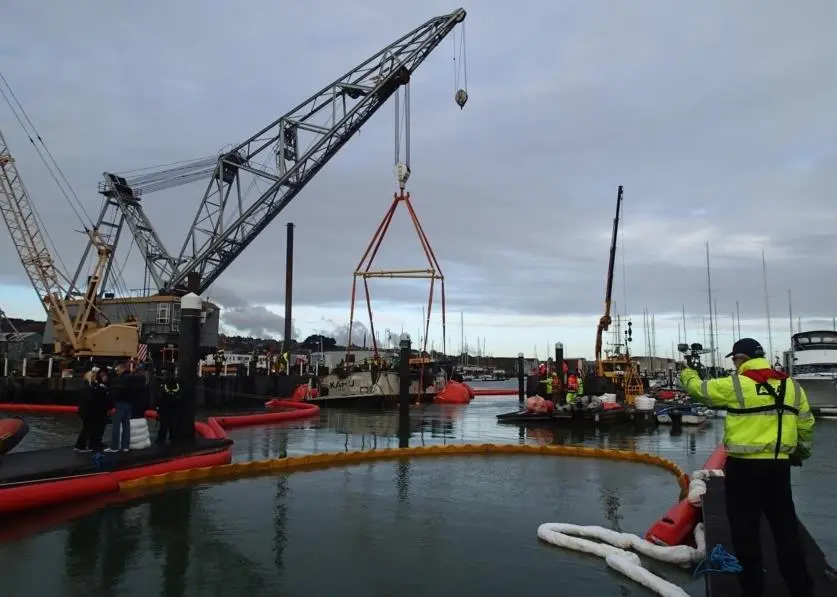
Adler and Allan’s Tier 2 response team helped in the recovery of the luxury motor yacht, Kahu, from the seabed at East Cowes Marina on the Medina River, while limiting the spread of pollution by containing and removing leaked oil.
Following a fire in November 2013, Kahu sank with an estimated 9,000 litres of marine diesel fuel oil on-board. Adler and Allan used booms and skimmers to contain and collect the diesel oil and protect an upriver wild fowl conservation site, at threat from a strong flood tide carrying pollution to its banks
While preparations were being made to remove Kahu from the seabed, the Adler and Allan team managed the pollution threat around the clock and provided daily environmental reports to the Harbour Master and Environment Group.
Kahu was lifted by a floating crane onto a salvage barge. Adler and Allan deployed further oil booms and skimmer systems to mitigate any potential major loss of fuel from the Kahu’s tanks during the lift. Prior to the final stages of the lift, a team boarded the boat and pumped out fuel tanks and engine boom bilges. Divers also cleared the sea bed where Kahu’s hull rested.
Adler and Allan claims to be the leading marine spill response company for coastal facilities in the UK, providing accredited Tier 2 pollution response services to over 85 ports, harbours and terminals from its nationwide network. In addition to pollution response, Adler and Allan is accredited by the Nautical Institute on behalf of the Maritime and Coastguard Agency to undertake marine pollution training from Foundation to Commander Level.
Adler and Allan also provide dedicated consultancy services to assist ports in the preparation and submission of Contingency Plans, the scoping and facilitation of exercises and the remediation of contaminated sites. For more information, visit: www.adlerandallan.co.uk.
By Jake Frith
Related Articles
 ACCESSORIES & EQUIPMENT
 ENVIRONMENT
 MARINE CONSTRUCTION