![MaritimeJournal[Seawork]](https://www.maritimejournal.com/wp-content/uploads/2026/09/MaritimeJournalSeawork.svg)



A solution for Venice?
Venice has had big issues; the fragility of its foundations has pitted the city’s protectionists and the cruise industry in a head-to-head battle that has gone on for years.
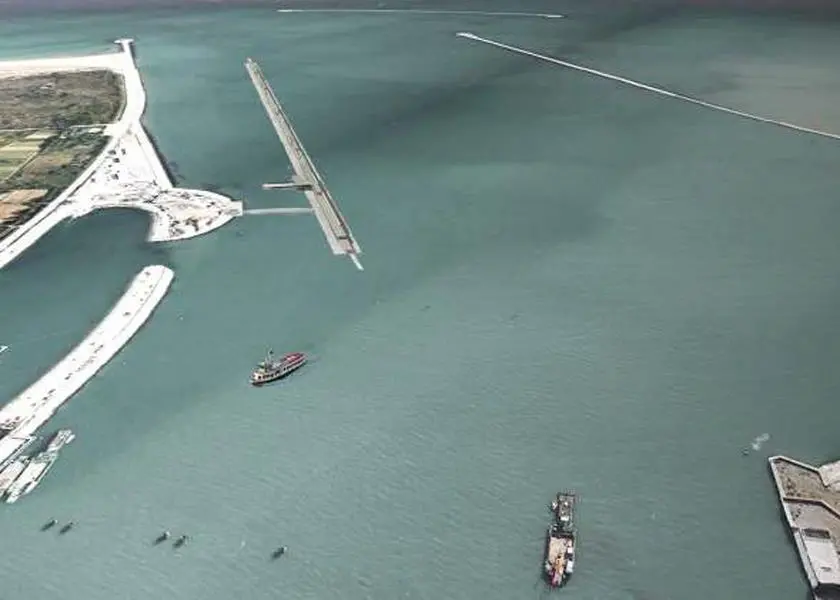
The problem has been the government’s controversial solution to reroute the huge cruise ships along the aptly named Canale Contorta Sant’ Angelo would necessitate dredging and remodelling this narrow waterway to a width of 100m and 10m deep. Opponents said this would further undermine Venice’s sediment as well as bringing in pollution from the Canale dei Petroli.
However, an alternative proposed by Duferco Engineering could resolve the difficulties – and keep the big cruise ships from further undermining the city.
Ezio Palmisani, CEO of Duferco told MJ that the idea is to create a new terminal around six nautical miles out from the Venice lagoon, able to accommodate five large cruise ships measuring 320m at a time.
The Venis Cruise 2.0 project would be just short of 1km long, located a few hundred metres from the Nord del Cavallino breakwater and made of prefabricated modules that, interestingly, will also make it fully removable. It will have a direct link to the nearby land through a connecting pier with a central drawbridge, allowing free passage of vessels between it and the shore, and it also wouldn’t interfere with the city’s nearby emergency floodgates.
It’s worth noting that the passengers would still be arriving into the heart of Venice by water, as large catamarans able to carry 900 people at a time would ferry the passengers from the terminal to the centre. “These would have a low impact on the environment, having only a shallow draft and a slow speed of 3.2 knots. More, they would be of a battery hybrid design,” said Mr Palmisani, making them extremely ‘green’.
The terminal itself would be fitted with renewable energy sources said Mr Palmisani, roof tops of waiting area shelters and gates will be fitted with photovoltaic solar energy panels, small wind turbines will be installed at the head of the pier and tidal energy generators will be installed on some of the pier’s support structures. These sources will support the shorepower links that will cut emissions from ships at berth.
So, the terminal will not only suitable for the latest generation of cruise ships but also those due to come into service in the next four or five years, “unlike the present terminal” concluded Mr Palmisani.
However, he admits the biggest challenge is not the engineering, it’s actually the politics. Despite a high profile plea by UNESCO along with a celebrity petition signed by Michael Douglas, Cate Blanchett, Sir Michael Caine and many others a recent ban on visits by ultralarge ships was recently overturned. So now it’s a matter of waiting to see if ongoing pressure will encourage the Italian government to take the issue seriously enough to support such an innovative solution.
By Stevie Knight
Related Articles
 OTHER NEWS
 OTHER NEWS
 FEATURES & VIDEOS