![MaritimeJournal[Seawork]](https://www.maritimejournal.com/wp-content/uploads/2026/09/MaritimeJournalSeawork.svg)



Aarsleff goes on the defence
Ceredigion County Council in the UK is carrying out extensive repairs to some of the sea defences at Aberaeron on the west Wales coast of Cardigan Bay.
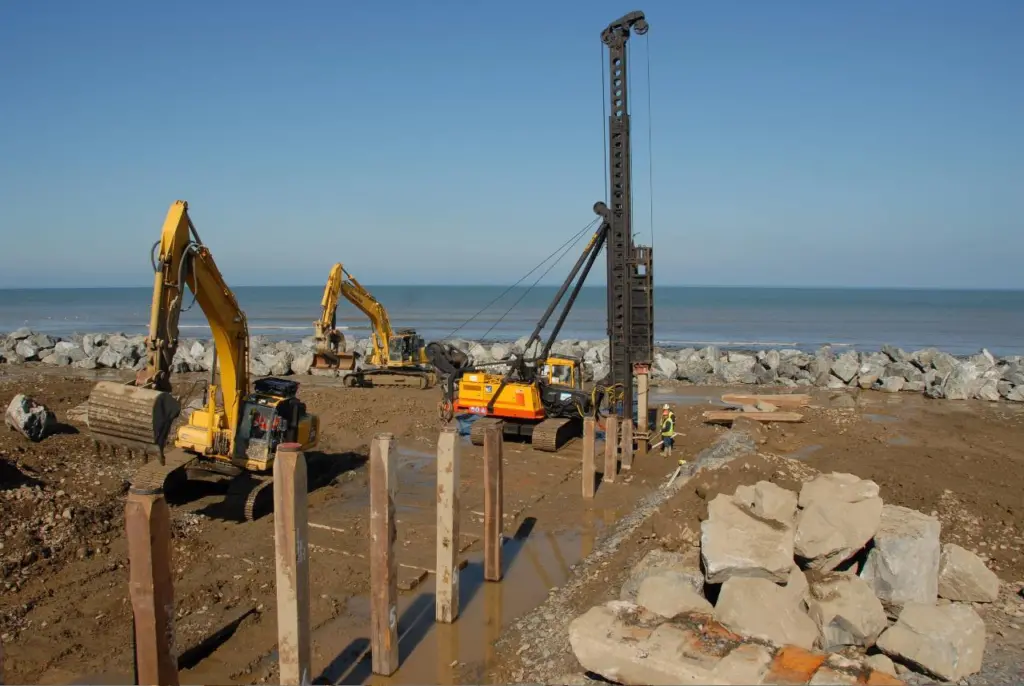
Some of the dilapidated timber groynes along a 540m long stretch of the town’s north beach are being replaced, rock groynes and revetment protection added and a flood bund built to protect low lying properties and a coastal caravan park.
The improvements to the sea defences are needed to prevent further erosion and lowering of beach levels and reduce the risk of flooding during storms in the Irish Sea. The southern promenade section of the northern frontage, protected by a seawall, is subject to overtopping during storm conditions, while the bank protecting the northern end of the frontage is suffering from wave erosion and is at risk of breaching. A breach in the defences would flood about 240 properties and the caravan park.
The new coastal protection scheme, costing about £5M and partly funded by the Welsh Assembly Government, has been designed by civil works consulting engineer Atkins on behalf of Ceredigion County Council. Two new 40m long rock groynes, one straight and the other with a 15m long north facing dog leg spur, will be built just north of the town’s harbour entrance and be bisected by a new timber groyne. A further eight timber groynes will be erected along the beach and at the northern end of the scheme a 280m long steel sheet piled retaining wall will be driven inland to provide a flood cut off barrier.
Atkins is also supervising the work, which is being carried out by main contractor BAM Nuttall who started onsite last December. One of the first tasks for BAM Nuttall was to import all the rock groyne armour from a quarry in North Wales. The large boulders were placed in a stockpile bund along the toe of the beach to act as temporary and partial protection during replacement of the timber groynes. Working round the tides BAM Nuttall dug trenches alongside the old and dilapidated timber piled groynes and pushed them over prior to removal and a start on their new replacements.
BAM Nuttall awarded the specialist piling contractor Aarsleff Piling a contract just to install the 168 Greenheart timber piles for the nine new groynes, which range from 30m to 40m long. The 305mm by 305mm square section piles have pyramid shaped steel points and steel rings on their tops and vary in length from 4m to 8m. Depending on the length of the groyne, between 17 and 18 piles are driven at 2.5m centres and in a straight line down the beach. Aarsleff, using one of its Banut 700 self erecting piling rigs and working about 4 hours between high and low water, is driving the piles through a mixture of beach sand, cobbles and boulders. All piles are driven to specific levels. In the instances where individual piles hit boulders and are pushed off line, they are extracted and the obstruction dug out and removed by BAM Nuttall, prior to Aarsleff redriving.
On completion of the piling in each groyne, BAM Nuttall follows behind bolting on 225mm by 75mm Greenheart planks to the face of the timber piles. The temporary rock bund will then be removed by Komastu excavators with grapples and replaced to construct the two new rock groynes. A blanket of rock revetment will follow and be placed the length of the new defences from the shoreline and out to about 20m down the beach as the final part of the new coastal defences, which BAM Nuttall is on schedule to complete in the autumn.
Related Articles
 FEATURES & VIDEOS
 MARINE CIVILS
 OTHER NEWS