![MaritimeJournal[Seawork]](https://www.maritimejournal.com/wp-content/uploads/2026/09/MaritimeJournalSeawork.svg)





An airport all at sea, a bonanza for the industry
A long running debate about a subject with no connection to the maritime world could have major implications for the marine civil engineering industry with opportunities on a scale not seen for many years.
London’s existing main airports of Heathrow, Gatwick and Stansted are all operating close to capacity. With air travel increasing and the government determined that London should maintain its global hub status, the search is on for additional capacity to satisfy the seemingly insatiable demand.
Providing additional runways at one or more of the existing airports is fraught with problems, the region already heavily populated and existing infrastructure struggling to keep up with demand. Significant local opposition to such expansion is also only to be expected. Planners are therefore looking further afield, including locating a new airport in the nearby Thames estuary.
In 2012 the UK government set up The Airports Commission to examine the need for additional UK airport capacity and provide recommendations covering the short, medium and long term. A final report on the longer term options is due in 2015. Pressure will then be on the government of the day to finally take the plunge and act on the recommendations.
The last 40 years have seen five proposals for a Thames estuary airport, most either being rejected or falling by the wayside. Two proposals are currently leading the news agenda however. The Mayor of London, Boris Johnson, never fails to attract press attention and his interest in the proposal for an airport close to the Shivering Sands, east of the Isle of Sheppey soon gained the popular nickname Boris Island.
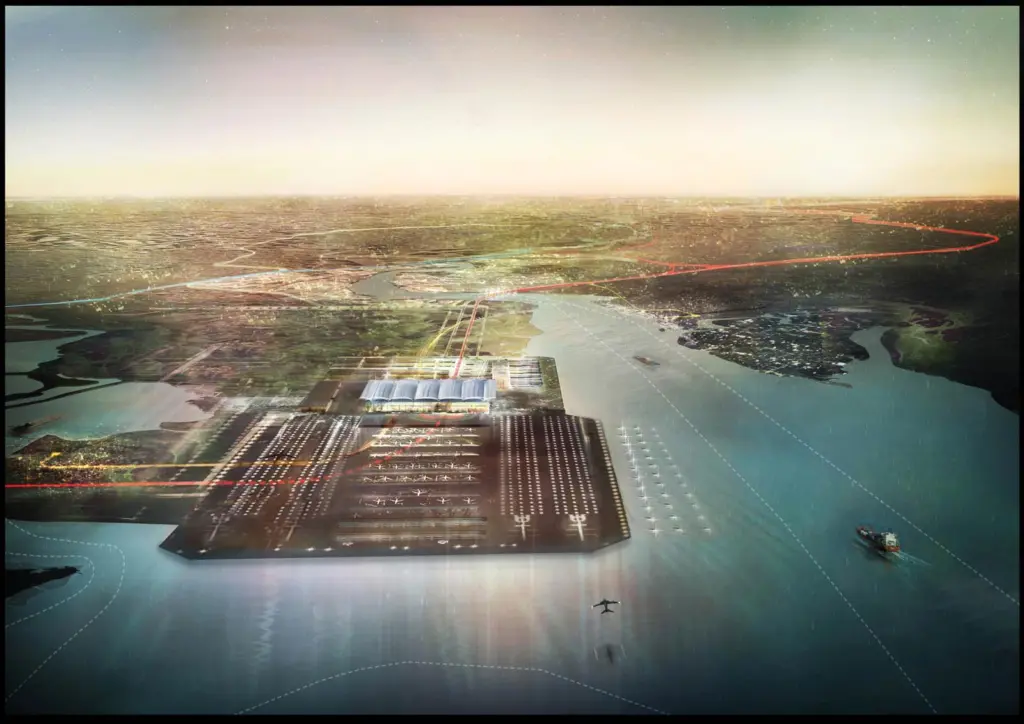
Arguably the most ambitious proposal is the GB£50bn Thames Hub. London based architects Foster + Partners are proposing a four runway airport built on a platform straddling the land and sea off the isle of Grain, described as “A bold new approach to future infrastructure development in Britain”, adding: “It brings together rail, freight, logistics, aviation, energy and its transmission, flood protection and regional development.”
The scale of the Thames Hub proposal is enormous. Much more than just a new airport, it would provide major opportunities for the marine civil engineering industry beyond simply delivering reclaimed land to be developed. The plans also include a new flood barrier, upstream from the London Gateway port development. No ordinary flood barrier however, it would incorporate rail and road tunnels, utilities, communications networks and hydropower generation.
At the heart of the concept is incorporating the hub with integrated rail lines connecting with ports and major cities as far north as Glasgow and Edinburgh via a new London orbital freight rail line.
Another proposal, outside the Thames estuary, originates from London based maritime engineers Beckett Rankine, who propose an airport on reclaimed land within a perimeter sea defence bund on the Goodwin Sands around 3km off the east Kent coast.
Much of the Goodwins is around 3m below MSL, therefore not requiring excessive fill material. Comparison is made with Amsterdam’s Schipol Airport at a similar elevation (albeit inland). Space would certainly not be a problem, with room for up to five runways. The developers note that the Thames estuary proposals are located within internationally designated environmentally sensitive areas, something not applying with the Goodwin Sands.
Any offshore airport expansion in the south east would be of major significance and the idea is not unique. Similar projects have been adopted at South Korea’s new Incheon Airport, Kansai Airport in Japan and Chep Lap Kok in Hong Kong. With current airport capacity close to crunch point, the political will after so many years of debate may at last be building towards seeing serious consideration to resolve a dilemma that holds huge potential for the industry.
By Peter Barker
Related Articles
 FEATURES & VIDEOS
 MARINE CIVILS
 OTHER NEWS