![MaritimeJournal[Seawork]](https://www.maritimejournal.com/wp-content/uploads/2026/09/MaritimeJournalSeawork.svg)




Asia to Europe subsea link to proceed
The first ever high voltage submarine power cable link in Turkey is going ahead, connecting Europe and Asia by crossing the Dardanelles Strait.
Energy and telecom cable specialist Prysmian Group is designing, installing and commissioning the link for the Turkish electricity transmission utility TEIAS. The contract is worth a total of €67m.
The link, which aims to start power transmission in 2014, is comprised of a double AC power transmission circuit of approximately 4km. It will have a rating of 1,000 MW for each circuit between the substations of Lapseki (on the Asian side) and Sütlüce (on the European side), traversing the Dardanelles strait.
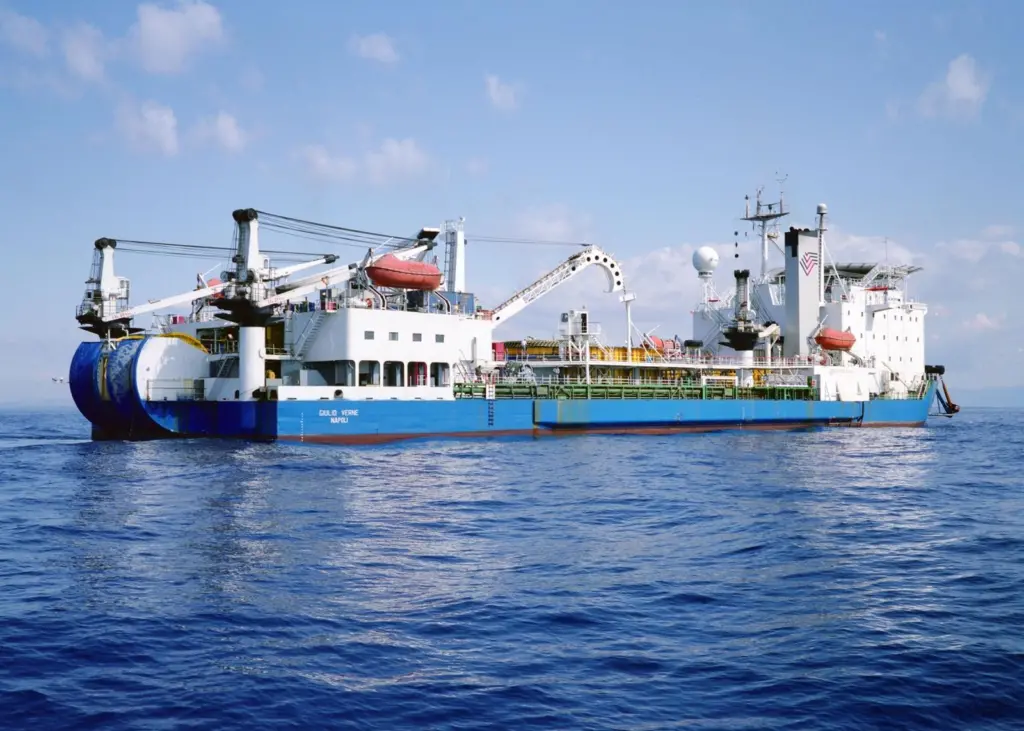
The 380kV XLPE insulated cables (one of the first uses of the XLPE insulated cables in a submarine link) will be manufactured in Prysmian’s European submarine production units. Installation will be carried out by the group’s cableship Giulio Verne.
The 10,600 gt Giulio Verne was built in 1983, has a length of 130m, a beam of 32m and a top speed of 10 knots. Originally named ITM Venturer, it was built for and operated by ITM Offshore as a cable layer and flexible pipelayer but it has had a history that spanned the fortunes of a number of companies, finally ending up with the Prysmian Group on its acquisition of Pirelli in 2005.
Prysmian has a long track record in the development of submarine cable milestone
projects in the Mediterranean region. They include the Italy-Greece links, the Spain-Morocco I and II projects, the Iberian Peninsula-Mallorca (Romulo) link and the Sardinia-Italian Peninsula (SAPEI) project. The latter is probably the deepest in the world, with a submarine cable from Fiume Santo to Latina running at 1,600m below sea level across the Tyrrhenian Sea.
The Prysmian group is also a founding member of the industrial partnership Medgrid, launched to study the feasibility of a high voltage direct current interconnection project to transmit electricity from solar or wind power plants to load centres on either rim of the Mediterranean.
Related Articles
 FEATURES & VIDEOS
 MARINE CIVILS
 OTHER NEWS