![MaritimeJournal[Seawork]](https://www.maritimejournal.com/wp-content/uploads/2026/09/MaritimeJournalSeawork.svg)




Controversial JWP clears final hurdles
Controversy has dogged Germany’s first deepwater container terminal, the JadeWeserPort (JWP) since the beginning and it is not loosening its grip.
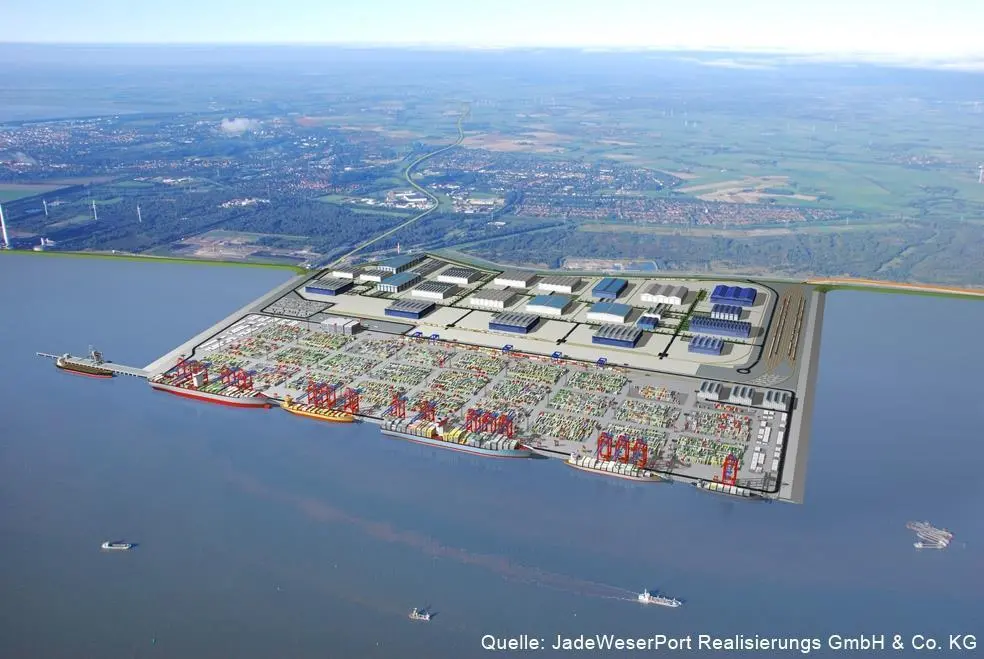
The terminal, one of the country’s biggest ever maritime engineering projects, is heading for completion later than planned.
The €1bn, 360 hectare, common-user terminal had been due to start first phase operation along the first 1,000m of its total 1,725m quayside on 5 August. The rest of the terminal, on 18m of water, will open a year later and will boast four berths and 16 portal cranes to handle container ships of 430m length, independent of tide.
The JWP is owned by the JadeWeserPort Realisierungs Gesellschaft, grouping Lower Saxony (50.1%) and Bremen (49.9%), and it expects to handle 2.7m TEU a year. It is costing about €650m to build and a further €350m is being spent on superstructures by operators Eurogate, with the A.P. Möller-Maersk Group holding a 30% share.
As the year got underway, little stood in the way of inauguration as planned. However, last minute construction problems have now put paid to that and while they are being sorted out, opening has been put back to September. According to some reports it will be the end of that month, but Susanne Thomas, spokeswoman for the JadeWeserPort Realisierungs GmbH & Co. KG (JWP), told MJ no exact date had been agreed.
It may appear another bitter pill to swallow for those involved in the JWP’s colourful decade of development and construction. But, lets face it, two months are just a blip in the overall time scale and the JWP is in good company when it comes to terminal teething problems. Altenwerder in Hamburg, celebrating ten years of successful operation, also began with plenty of hiccups. It’s difficult not to see the JWP being just as successful.
Designed as Germany’s deepwater answer to Rotterdam and the other Rhine Estuary ports, the JWP could rescue the country’s deepsea container shipping industry in a future dominated by deepsea mega-boxships.
Around the turn of the century, when the first concrete plans were being made for the JWP, supporters said Germany’s conventional seaports would with time be unable to cope with the mega-ships. In the meantime they have grown to 13,000 and more TEU and are likely to get even bigger.
The writing is on the wall for full mega-loads in Hamburg, with or without Elbe deepening, and for the Weser too. The future of those ports, many believe, lies in feeder traffic, albeit large scale, with the JWP performing a vital boxship hub role as the only German facility capable of handling them fully laden, alongside and on deepwater channel approaches.
Since JWP planning started, the facility has gone through crisis after crisis. They have included a battle over where the terminal should be located, with Wilhelmshaven and the Jade finally chosen over Cuxhaven on the Elbe. The withdrawal of Hamburg in 2002 from the trio of federal states which originally agreed to fund the project was associated with that choice. Despite periodic reports to the contrary over the years, some of them quite recently, Hamburg has never rejoined the project. Hamburg said early on it should be investing in expanding and improving its own facilities rather than on a terminal which, it said, will benefit the Weser rather than the Elbe.
Political infighting, controversy over irregularities in the award of the original construction project and, latterly, differences over whether the market is even ready for the JWP, have all also added to the problems. As costs rose, completion was pushed back from an originally hoped for but unrealistic 2006 to 2010, 2011 and, now, 2012/13.
The terminal now faces what is, hopefully, its final hurdle prior to operation. The latest problem surfaced early this year when bolt bursts were reported in the sheet piling along the new main quay wall. Apparently the first of those was discovered in September last year.
Initially Manfred Wendt, MD of the BUNTE construction group which heads the consortium building the JWP infrastructure, described the faults as “regrettable but not unusual with projects of this size”.
Wendt’s remarks follow the discovery of 47 defect bolt applications out of about 4,000 bolts drilled to join quay wall sheet piling. He said “neither structural engineering factors nor the load bearing capacity or stability of the … quay wall have been endangered in any way” by the damage. He said it was mainly in sections where pilings had been rammed into clay rather than sand. Those bolt bursts discovered in sandy areas had already been sealed to prevent sand leakage, he said.
Wendt rejected media criticism of the technical competence of the ramming work by the JWP consortium, which also groups Josef Möbius, Ludwig Voss and Heinrich Hecker. He said it had been of the highest standard and had involved the latest technology and equipment. It had also been carried out from firmly anchored working platforms to JWP instructions and ramming accuracy on more than 1,600 driven pilings had been significantly better than permitted tolerances, he added.
“We have created a sheet piling quay wall of the required stability, which needs fear no quality comparison anywhere”, Wendt said at the time.
JWP managing director Axel Kluth later said a “rough estimate” of the cost of quay wall repairs was about €15m, with the builders liable through insurance. The issue, however, has snowballed dramatically since then. As of June some 250 similar defects were being reported in the quay wall, with the JWP saying it would cost around €50m to repair the damage.
It became clear that the problems could not be fixed in time for scheduled first phase operation to begin. Indeed, Eurogate voiced doubts about that and also about problems and space restrictions in May when the terminal’s Chinese built container portal cranes were being installed. Lower Saxony, however, said at the time that operation would begin as scheduled.
Some compromise appeared inevitable given repair times and terminal test operations and it came in early June when the head of the Lower Saxony government, David McAllister, and the mayor of Bremen, Jens Böhrnsen, met Eurogate chief Emanuel Schiffer and the JWP’s Axel Kluth. They agreed that the JWP opening would be delayed until September provided that the quay damage can be rectified by the end of July. “We have a joint interest in seeing that this once in a century project is a success”, McAllister was quoted as saying.
Böhrnsen has said the two federal states have no intention of paying the additional costs of repair and delays. He reportedly said “we are all victims of the delays which have been caused by the construction consortium”.
As the insurance and legal responsibilities connected with those delays are sorted, repairs are being carried out for the BUNTE consortium by Betonwerk Stahl & Beton Hupasch (SBH). By the end of July concrete slabs are being sunk in front of the JWP’s already built steel sheet quay wall to create a second, concrete wall 650m long.
JWP’s Susanne Thomas told MJ a total 446 pre-manufactured concrete slabs were being sunk and that as of late June “the rectification work is progressing well”. She said more than 200 slabs had been positioned by that time and that they were being laid five high, to a depth of 11m. The space between the concrete wall and the damaged quay was being filled with underwater concrete, she said.
The work is due to be finished by 29 July, after which 1,000m of finished quayside will be available for Eurogate to carry out terminal trial operations in early August. The test runs should have taken place in May.
Plans for the delayed opening ceremony have in the meantime been put on the back burner. JWP said they would be revived when the smooth running of the new terminal could be guaranteed for Eurogate.
Elsewhere, the insurance and construction experts continue to search for the reasons and place blame for the construction damage to the JWP quay wall. Just who will be eventually be found responsible and foot the bill was not known. Controversy continues to rage, but that’s par for the course at the JWP.
By Tom Todd
Related Articles
 FEATURES & VIDEOS
 MARINE CIVILS
 OTHER NEWS