![MaritimeJournal[Seawork]](https://www.maritimejournal.com/wp-content/uploads/2026/09/MaritimeJournalSeawork.svg)






Costs soar on delayed Emden lock project
Technical and legal complications have further delayed completion of the long-planned renovation of the port of Emden’s Nesserlander Lock until 2017 and also “significantly” increased the estimated cost of the project.
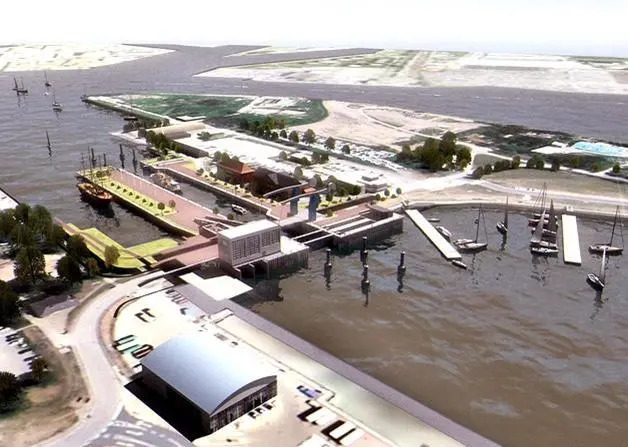
Built in the 1880s and originally 14m wide and 110m long, the lock links the busy north German port with the Dollart Hafen on the Ems Estuary and with the North Sea on the border with Holland.
The Nesserlander Lock has undergone various renovations over the years, notably in the early 1960s and 1980s but was closed down in late 2006 for renovation after severe flooding in the area. Since then ship traffic between Emden and the sea has used another lock, the Grosse Seeschleuse, which is now also in need of renovation.
The plans for the latest Nesserlander Lock renovation after its closure were drawn up to meet not only more stringent coastal defence requirements but also the increased demands of modern hinterland and coastal shipping.
When the plans were first aired, the cost was put at something over €30 million for renovation alone. This doubled when it was decided to also lengthen the lock to 170m and widen it to 18m. Costs increased even further when construction and engineering complications later delayed completion and sometimes involved legal ramifications.
NPorts said construction costs would rise to €120 million with completion expected in 2017. It said delays in awarding the main contract and resultant legal issues had led to “considerable additional costs”. There had also been unexpected construction difficulties with foundations and lock anchoring which had meant that new plans had to be drawn up which among other things involved the relocation of the outer lock entrance and also increased costs. Finally, underground culvert operators demanded late additional below-ground and other protection work which had meant further far-reaching project changes, NPorts said.
NPorts MD Holger Banik said however technically workable solutions to the problems had now been worked out and further major obstacles could be ruled out.
Doerte Schmitz, a spokeswoman for Niedersachsen Ports (NPorts), which is responsible for the project, told Maritime Journal the concrete lock bottom had been laid and lock walls were being erected as of the end of April. Work on the outer lock had continued undisturbed despite other construction complications, she said. She also reported that the lock chamber, as now finally planned, would be 24m wide with an entrance of 18m and that the overall length between gates would be 180m with an inner length of 155m.
Ms Schmitz listed main building contractors as a consortium grouping the German construction firms August Prien in Hamburg and Gebr. Neumann in Emden. She said other firms involved in various other technical sectors included Hollandia, Osmo, MCE and Matthai.
BY TOM TODD
Related Articles
 FEATURES & VIDEOS
 MARINE CIVILS
 OTHER NEWS