![MaritimeJournal[Seawork]](https://www.maritimejournal.com/wp-content/uploads/2026/09/MaritimeJournalSeawork.svg)






Dover upgrade keeps pace with demand
The UK port of Dover is currently midway through a major refurbishment and upgrade of facilities, reinforcing its position as Europe’s busiest ferry port and ensuring it is prepared for future growth.
For those not familiar with the Port of Dover, a satellite view first gives the impression of a small compact port, restricted in area by the symbolic white cliffs of Dover behind it and breakwaters enclosing ‘the bay’ to seawards. Construction of the Admiralty Pier or Western Arm commenced in 1847 (cutting off the easterly drift of shingle from the direction of Folkestone) with construction of the Eastern Arm and Southern Breakwater following in 1897, making it an effective harbour protected from the elements with entrances at the eastern and western corners providing a choice depending on the prevailing weather and the not insignificant tidal conditions. Dover Harbour Board (DHB) received it Royal Charter in 1606 making it a trust port, the board currently made up of eight: Chairman, four other members appointed by the Secretary of State, two ex-officio members and an eighth member appointed by the other seven.
Dover’s location is strategically important. Just five miles from the main Dover Strait Traffic Separation Scheme makes it is an attractive stop for cruise ships and as a result, the UK’s second largest cruise vessel port. Its close proximity to mainland Europe (just 31 and 21 miles as the crow flies to the current ferry destinations of Dunkerque and Calais respectively) has resulted in Dover’s steady growth and the need to invest to provide for anticipated future expansion in the port’s thriving cross-channel ferry business. Over generations this has seen conventional passenger roro ferries, freight ferries, train ferries, high-speed ferries, jetfoils and hovercraft operating cross channel-services. The statistics speak for themselves when painting a picture of the scale of the operation. In any one year, goods to the value of £80bn are moved through the port along with 4.5 million vehicles and 12 million passengers: a vessel movement is recorded in this relatively small port every ten minutes, 24/7. While some traffic volume figures have reduced, the port has endured the global financial downturn well taking a positive view on future trends: in August 2013, car and coach traffic volumes were up 19% and 20% respectively with freight levels now restored to 2011 levels
EASTERN DOCKS DEVELOPMENT
Various routes have operated from the Western Docks over the years including train ferries and hovercraft services. This end of the port is however now home to the cruise terminal, marina and port service vessels. Dover’s first two drive-on drive-off berths opened in the Eastern Docks in 1953 and it is at this end of the port the cross-channel passenger and freight traffic activity is now based, known as Terminal 1. A busy cargo terminal is also located here, predominantly handling reefer cargoes.
The nine roro berths catering for the growing cross-channel trade in the Eastern Docks are currently in the middle of a long-term £85m capital plan, rolling programme of refurbishment and upgrading. A number of factors lay behind the requirement to carry out these works. There is the need to keep up with steady increases in traffic volumes and ensure facilities not only keep pace with developments but are able to accommodate future anticipated growth. When considering natural wear-and-tear on the berth infrastructure a snap-shot look at the ferry operators’ timetables tells the story. In a typical 24 hour period in July this year, the three ferry companies DFDS, P&O Ferries and MyFerryLink are offering 54 sailings to Calais and/or Dunkerque, over 100 berthing and sailing movements during that period. Two harbour tugs allow operations to continue in all but the most severe weather conditions: the ‘port closed’ sign is rarely displayed. A more visual indication of the need to keep pace with developments is the increase in size and capacity of the ferries themselves. In 1965, Townsend Brothers Ferries took delivery of the Free Enterprise II for the Calais route. At 4,011gt and 98m LOA the vessel had capacity for 1,200 passengers and 230 cars. By contrast, in 2011 P&O Ferries introduced the Spirit of Britain, first of two identical ships for the same route. Its equivalent statistics are 47,592gt, 210m LOA and capacity for 2,000 passengers, 180 freight units or 1,059 cars. The port’s infrastructure clearly had to keep pace with the trend, including accommodating introduction of simultaneous double-deck loading, three levels when including passenger only walkways.
The current rolling programme of upgrading and refurbishment at Terminal 1 in the Eastern Docks has had to be carried out in stages to maintain continuous operation of the port, particularly during periods of peak traffic flow. Piers D and E are two conjoined piers, the former built for berth 7 in 2010 and later extended to provide the port with the capacity to accommodate longer ferries. While operators may use certain berths on a regular basis, partly determined by the length of the ship versus the berth, they are generally interchangeable between operators and ships.
BERTH 6 RENEWAL
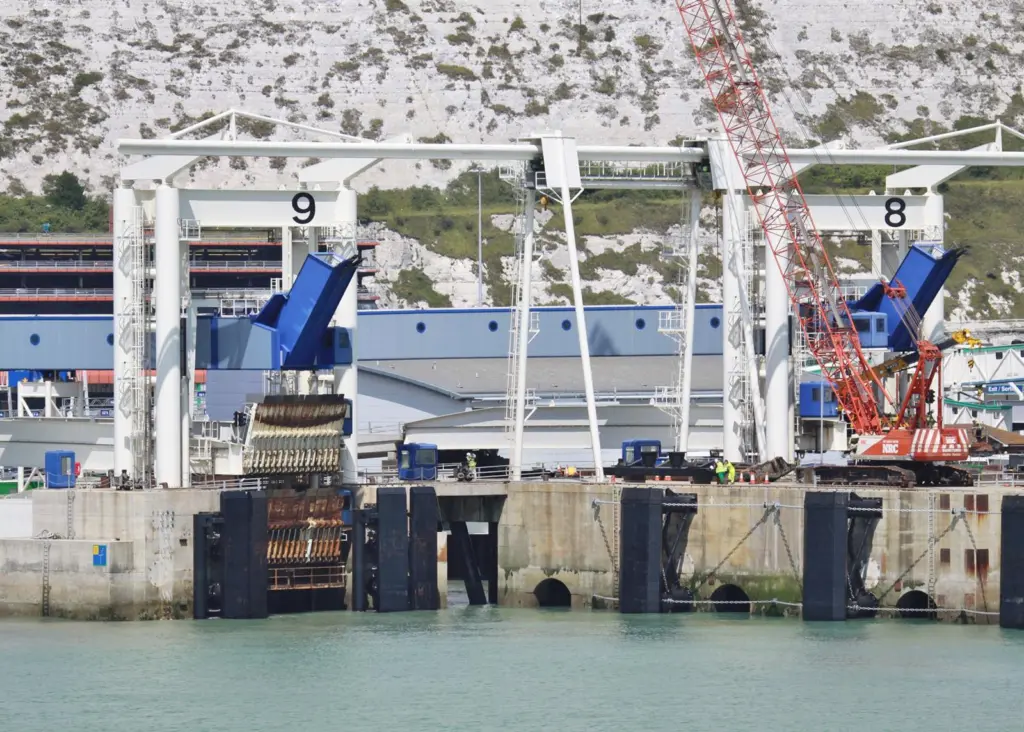
A particular major project currently close to completion is the refurbishment of berth 6. Installed in 1979, the berth was modified and widened in 1991 to accommodate larger 28m beam ferries of the Pride of Dover/Calais and Seafrance Rodin/Berlioz class. Being home to the busy Calais route meant berth 6 was the most heavily used in the port and years of hard use, particularly to the lower deck took its toll. Inspections, assessments and reports confirmed the berth was life expired and requiring replacement. In 2011 Rowecord Engineering of Newport, Wales were appointed to design and build a new state of the art berth fit for the next 30 years. Fabrication of the main elements took place at Rowecord’s premises in Newport and transported to the now disused hoverport in the Western Docks. Here they were assembled before being lifted and transported into position in the Eastern Docks by floating sheerlegs. Meanwhile of course, the old berth had to be dismantled and removed and again the old hoverport was utilised for this operation. Over an eight day period in January 2013, taking advantage of an unseasonal weather window, a 400t floating sheerlegs removed the old machine room complete with legs, relocating it to the hoverport for disposal. The lift was carried out over the Prince of Wales Pier (adjacent to the hoverport) which was closed for the operation. In all around 550t of steel was removed for recycling. The various components of the new three-level berth were assembled adjacent to the site and over the course of 2013 construction work completed.
In 2012 similar work was completed at Berth 3 including extensive work on Pier A which also serves berth 2. The pier itself was extended and the stern and side fenders replaced. For Berth 3 itself, the scope of the bridgeworks refurbishment included addressing issues arising out of fatigue assessment reports, the replacement/overhaul of winch machinery and hydraulic equipment, installation of self-supporting fingers and extension of linkspan bridges and passenger access brow to maintain compatibility with proposed larger stern fenders. Additional work included a capacity upgrade of the overhead gantry crane, resurfacing vehicle decks and other painting and cladding works. Plenty more work is still in the pipeline, with similar work to Berth 3 planned for Berth 2 this year and for Berth 7 in 2015. The two most recently constructed berths at Dover are Berths 8 and 9, either side of Pier F, designed to accommodate larger vessels including P&O’s Spirit of Britain/France class. These berths were completed in 2003/2004. Major shore-based work known as the Traffic Management Improvement project are also underway to improve the resilience of the port’s operation. The work includes a temporary holding area for the equivalent of almost 4km of traffic within the port at peak demand and bad weather times.
DHB has a long-term vision for the future of the port far beyond the aforementioned work in the Eastern Dock and as MJ went to press it unveiled proposals to pursue a major opportunity in the Western Dock that would act as a catalyst for the regeneration of Dover.
DHB received government approval to develop the Western Docks in 2012, with the original plan including the establishment of additional ro-ro ferry berths. Discussion on the new vision first commenced at the independently chaired Port and Community Forum and the port’s master plan has been reviewed over several months. The intention is to lock in the many benefits the review identified ‘just as soon as it possibly can’ and build on the early development of the approved consented footprint in the Western Docks, with potentially 600 new logistics industry jobs and safeguarding another 140 positions by developing a new cargo terminal.
The waterfront would also be transformed with the potential creation of a new marina. The current cargo terminal in the Eastern Dock would be moved to the Western Docks and the establishment of logistic park in this location is clearly a significant feature of the plan.
Related Articles
 FEATURES & VIDEOS
 MARINE CIVILS
 OTHER NEWS