![MaritimeJournal[Seawork]](https://www.maritimejournal.com/wp-content/uploads/2026/09/MaritimeJournalSeawork.svg)





Fehmarnbelt tunnel sediment spill plan
Femern A/S has revealed details of the effects, and how they will deal with the environmental impact of dredging the channel for the immersed sections of the Fehmarnbelt Tunnel.
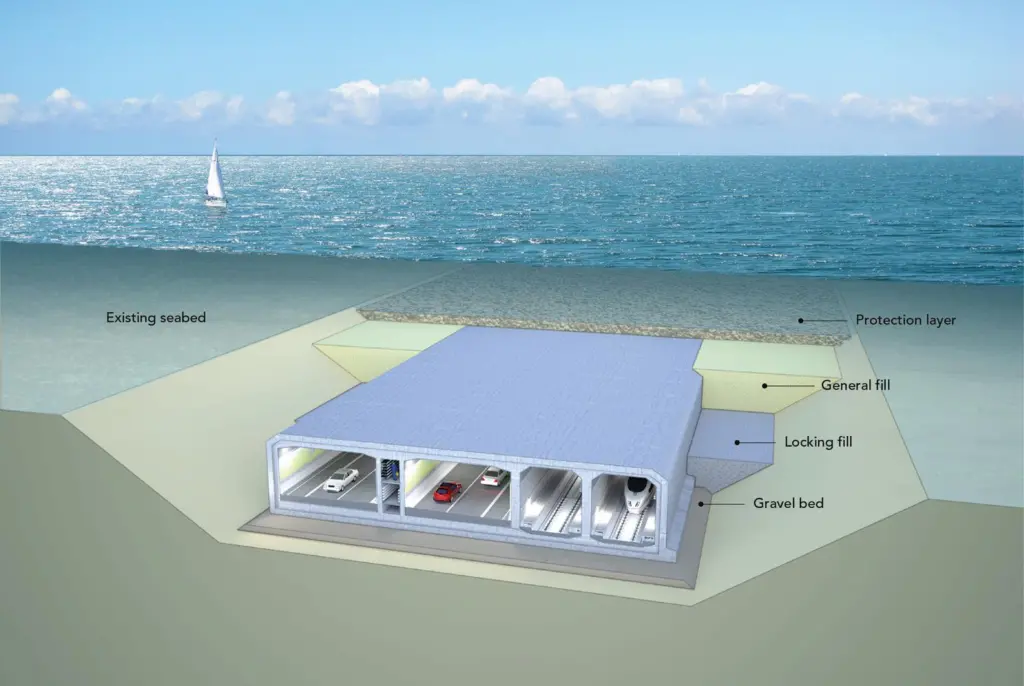
The fixed link between Germany and Denmark will consist of a 17.6km long immersed road and rail tunnel comprising eighty nine, 217m long elements each with a maximum weight of 73,500 tonnes. When completed it will be the world’s longest immersed tunnel, three times the length of the current record holder in San Francisco. Installation of the tunnel sections will require removal of approximately 19m m3 of soil and adequate measures will be required to limit the environmental impact of sediment spill during the dredging operations. The impact is not expected to be significant if spill is limited to approximately 0.75m m3. The volume of natural sediment transported annually through the Fehmarnbelt is ten times higher than the amount expected through the dredging operations.
Dredging of the tunnel trench, between 80 and 140m wide, will take place in stages from both sides of the Fehmarnbelt over approximately 18 months. Some of the dredged spoil will be used for establishing artificial peninsulas at Rødbyhavn and Puttgarden for the tunnel portals while most will be deposited off the Lolland coast to reclaim a new nature area of approximately 300ha. Construction of the peninsulas will take place behind closed stone dikes to prevent major spillage in the area. The dredging work is expected to cause spillage of a small volume of seabed spoil alongside the tunnel trench with fine particles in the spoil entering the water column in suspension and transported away from the dredging site. The Fehmarnbelt is a large body of water where wind and currents ensure a high rate of water exchange. A high rate of turbidity and water exchange has occurred naturally for centuries, resulting in fine particles from factors including coastal and seabed erosion and leaching from rivers and other bodies of water that flow into the sea. These enter the water in suspension and are then dispersed by currents, for example during heavy storms. Flora and fauna have adapted to the conditions and are capable of withstanding additional short-term and limited sediment spill from dredging works. The calculated spill figure is a small fraction of naturally occurring annual sediment transported through the area and expected to be dispersed rapidly by currents. Close to the tunnel trench the impact will be greater but temporary.
In calculating the impact of dredging, previous experience from construction of the Øresund Link was taken into account. It is expected that sediment spill can be limited to the same low volume but measures will still be taken to limit the effects of the dredging. Contractors will be required to use equipment with very large dredge buckets or other heavy duty equipment that gives rise to less spillage. They will also be required to schedule the works in respect of time, space and intensity taking special precautions when dredging in the most sensitive areas such as close to the coast when seabed vegetation is at its least sensitive in autumn and winter. Monitoring compliance with the requirements by Femern A/S will include contractors having to obtain prior approval for dredging schedules along with the monitoring and reporting of spill volume.
Sediment spill will occur in the form of dredging-induced turbidity as the dredger scoops or grabs sediment in the backhoe bucket or the clamshell grab, and the shedding of sediment as the bucket or grab travels up through the water to unload into barges. Approximately half of the spill will be sand: this high-mass component will sink immediately and be deposited around the tunnel trench. Finer sediment, silt and clay will be transported further away before it settles. This sediment will be re-suspended and transported to the next deposition site during and after storms. After time the sediment will settle at its final natural site in the Arkona Basin in the Baltic Sea, also in the Little Belt and in the Rødsand Lagoon east of Rødbyhavn.
One of the most visible consequences of sediment spillage will be cloudier water. During dredging works, this increased turbidity will in the first instance, affect plants and algae in the Fehmarnbelt with less sunlight able to penetrate the water for use in plant photosynthesis. This will result in reduced food for seabed animals, fish and birds dependent on the plants and algae. Environmental studies have demonstrated however that the impacts will be very limited and temporary. Fish populations in the Fehmarnbelt are not expected to be unduly impacted by the dredging works. Fish foraging and migration opportunities are already present due to the sporadic natural occurrences of increased turbidity.
Bathers are not expected to find the water cloudier than normal, dredging works not taking place close to the coast during summer months. The slight increase in turbidity will consequently only affect bathing water by making it appear cloudy at certain locations and outside the bathing season. Femern A/S has also investigated the sediment in the intended areas for the immersed tunnel sections for the presence of environmentally hazardous substances. These investigations have demonstrated that the sediment will exhibit a very low content of heavy metals and organic compounds simply because the area has not been subjected to any significant volume of industrial activity that may potentially have discharged environmentally hazardous substances, but also because the area is flushed by the large volumes of water exchanged between the Baltic Sea and North Sea.
Nine large contractor consortia have now prequalified to submit tenders for the four main construction contracts with final bids due to be considered in 2014 for inclusion in the Danish parliament’s work on the Construction Act.
Related Articles
 FEATURES & VIDEOS
 MARINE CIVILS
 OTHER NEWS