![MaritimeJournal[Seawork]](https://www.maritimejournal.com/wp-content/uploads/2026/09/MaritimeJournalSeawork.svg)





Frisian islanders complete new storm barriers
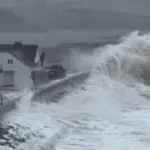
Officials on the German North Sea island of Borkum in the Ems Estuary have inaugurated new storm protection barriers after two and a half years of complex building.
The Berlin funded work began in 2011 in the 30 km long East Frisian island’s Westkopf district, an area constantly under threat from waves and currents. Strong storms in the past have severely damaged the region and affected shipping and maritime industries on the Ems.
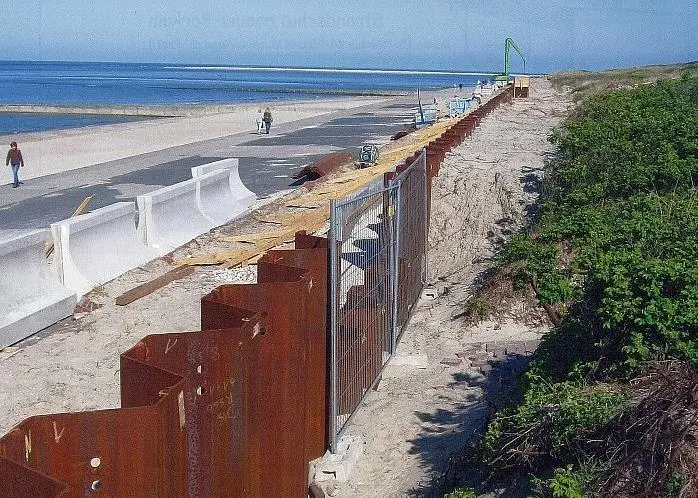
Now 1.5km of the four km long beach protection wall have been renewed at a cost of €16m, reported the water and shipping administration (WSV) in Aurich. Transport Ministry State Secretary Enak Ferlemann inaugurated the new protective facilities recently. He said, “The money is well spent. This massive and imposing structure will secure the future of the island and the River Ems for a long time to come, and has also given tourism an additional boost.”
The work covered the renewal, strengthening and in some cases adding to a long section of the coastal promenade. A consortium grouping Ludwig-Freytag and Tiefbau GmbH Unterweser (TAGU) with PRB Spezialtiefbau in Werder tackled sheet piling, reinforced concrete and wall construction. A second consortium consisting of Helmus, Möbius, and Hofschöer was responsible for surface, excavation and equipment.
The work could only be carried out in summer season when storms were less likely but tourists packed the island. As it was, the tourists reportedly showed a lot of understanding of and interest in a 55 tonne 400kW Sennebogen dredger of Type SR35T which was operating right alongside them. Contractors used an almost silently operating ABI piling unit coupled with an HPZ 700 4×800 kN hydro press.
WSV spokeswoman Eva Hülsmann told Maritime Journal the first pile was driven in February 2011 and in that year work mainly involving the sheet pilings and reinforced concrete water diversion channels was tackled. Some of the water diversion channels are on second protective step levels added at some points to raise the 13m wide promenade even further.
From Spring 2012 work concentrated on the construction of raised sloping surfaces and surfacing south of the main beach area. Here granite blocks were positioned and rocks laid. Materials for the whole job included 3,000 tonnes of sheet piling, 316 reinforced concrete wave diversion channel sections, 3,900m2 of asphalt surfacing and about 13,800m2 of concrete slabs. All the materials had to be brought in by ship from the mainland and transported across the island.
Eva Hülsmann said the WSV was “very satisfied with the work and with the cooperation shown by all those involved”. The job was probably unique at this time because, as far as she knew, no similar projects were underway or being planned on other local islands.
By Tom Todd
Related Articles
 FEATURES & VIDEOS
 MARINE CIVILS
 OTHER NEWS