![MaritimeJournal[Seawork]](https://www.maritimejournal.com/wp-content/uploads/2026/09/MaritimeJournalSeawork.svg)



German terminals book handling firsts
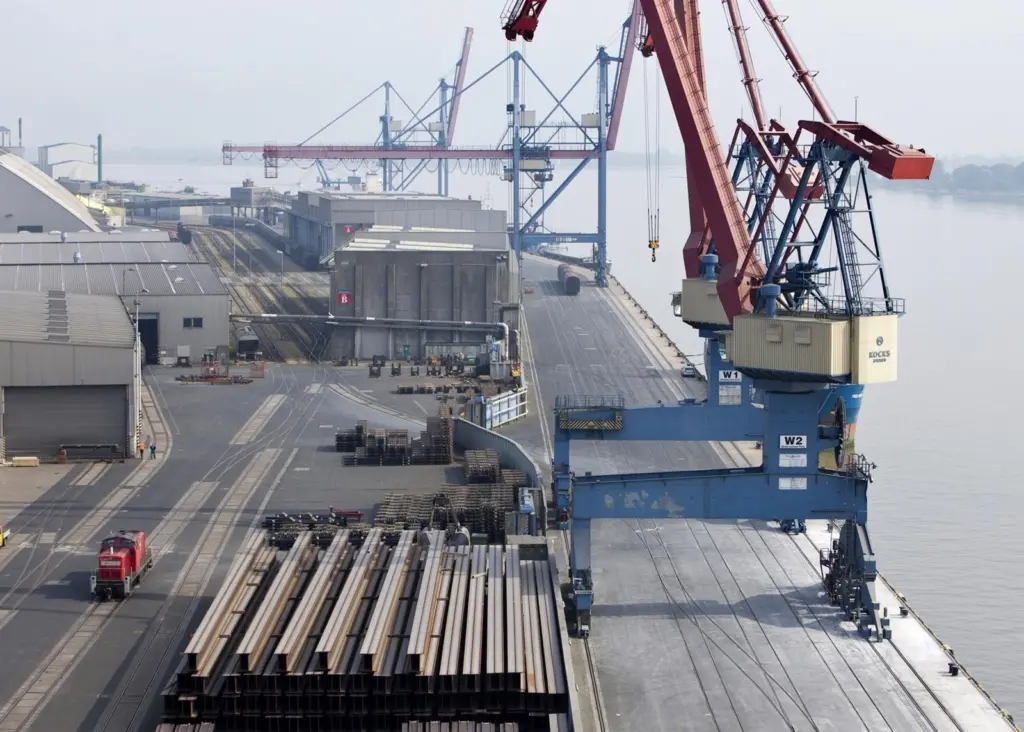
Two ocean going cargo ships have been handled for the first time at the 450m long double berth terminal facility just completed in the small German port of Brake on the Weser.
The 168m long, 21,400dwt Snoekgrat loaded wind energy components for Canada and the 200m 45,300dwt gearbulker Falcon Arrow took pipes onboard for Malaysia.
The ships berthed just a few days after the last dredger left the Niedersachsenkai site on completion of the second berth. That facility, which has taken two years to build, adds a further 180m to the existing 270m long quayside, completed in 2009. Behind the quays are 50 hectares of port area and behind that a further 60 hectares for port related industrial settlement. A Central Gate is also being built to control traffic flows. The site boasts two bridge cranes with capacities up to 60 tons and a mobile crane with 140 ton capacity.
The project was undertaken by Niedersachsen Ports (NP) to attract more cargo handling to the region and, since 2009, 720,000 tons of cargo have moved through the facility. Niedersachsenkai cost €20m and was financed under an agreement with Salzgitter Mannesmann and with money from the EU’s Regional Development Fund.
The Salzgitter Group wants more port handling space to cover its planned expansion and steel goods business. “Modern and efficient port equipment and stowage potential as well as optimal road and rail links increase the quality of the Port of Brake”, said NP MD Jens-Albert Oppel.
On the Elbe, a ‘first’ has also been claimed by another small German port, the tri-modal ElbePort Wittenberge. That multi-purpose terminal on the Elbe, strategically placed between Hamburg and Berlin, handled its first boxes since adding containers to its existing operations in May.
In promising start-up operation, officials said the first 100 boxes had been transshipped by Reachstacker from rail to truck inside just the first few weeks and that initial orders were for about 2,500 TEU a year.
Heinrich Ahlers, management chairman of major shareholder Buss Port Logistics, said the good start “shows the potential of this location and the high demands of local industry”.
In 2009, the port inaugurated its first pier and berth facility for inland ships carrying liquid bulk and grain. A second berth and pier with a 400 ton capacity steel platform, designed to handle containers, conventional and bulk cargo, was completed last year.
Now with water, road and rail links, the second berth is backed by 1.5 hectares of space and can handle bulk and conventional cargo as well as containers and project loads, including components for land based wind farms. The site has 5,300m of track and 14 switches available and offers round the clock marshalling and loading.
By Tom Todd
Related Articles
 FEATURES & VIDEOS
 MARINE CIVILS
 OTHER NEWS