![MaritimeJournal[Seawork]](https://www.maritimejournal.com/wp-content/uploads/2026/09/MaritimeJournalSeawork.svg)





Hydrodemolition Speeds Panama Canal Lock Repairs
Conjet hydrodemolition equipment is playing a key role in removing concrete and assisting with the replacement of the Panama Canals special tow track rail system. The track is used by powerful electric rack and pinion drive locomotives to assist in towing and guiding ships through the canals three sets of twin lane locks.
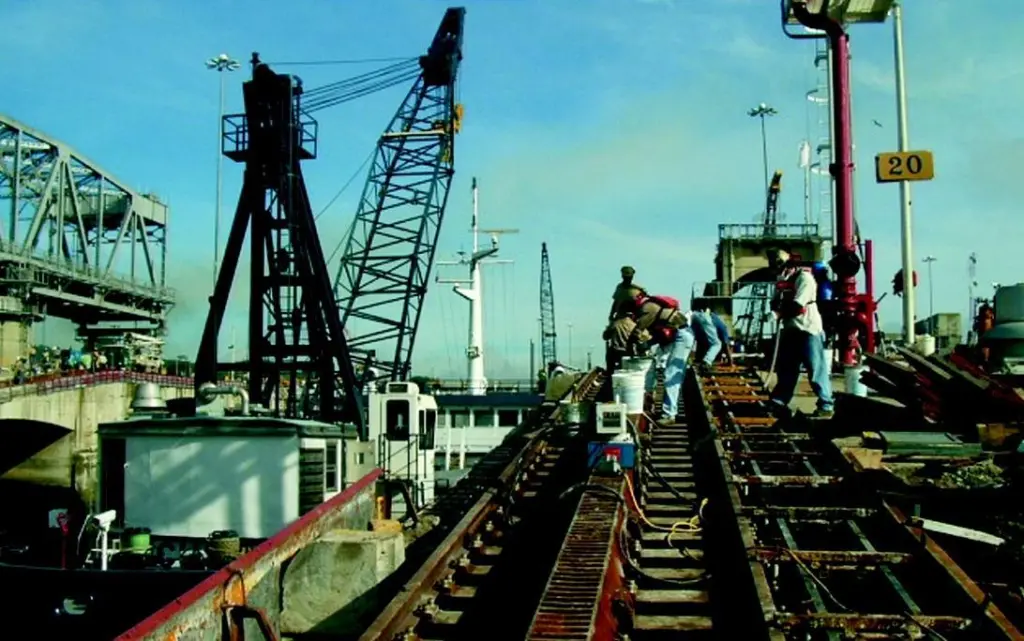
The Panama Canal Authority (ACP), which is in charge of the canal’s administration, management, operation and maintenance, is responsible for removing the 16,188m of worn out track, which runs along the tops of the lock walls, and replacing with a new stronger system to cater for the increase in canal traffic and high loadings from the locomotives.
The ACP Locks Track & Structural Maintenance Unit is supervising the tow track modernisation programme. The ACP is using a pair of Conjet Jetframe 122 hydrodemolition machines to accurately cut out the old concrete between the waterside rail and edge of the locks and between the twin rail’s supporting steel crossties prior to taking out sections of the worn out track.
The original track was initially designed for loads of 41 tonnes on the waterside rail, which, being nearest the edge of the locks, has to accommodate the highest forces. Increase in canal traffic and the weight of the ships since it was opened in 1914 has required heavier and more powerful locomotives, which has increased the load on the waterside rail to 85 tonnes in 1965 and 92 tonnes in 1996.
The increase in the forces and the loading has caused extensive cracking of the surrounding concrete along the entire tow track system. This has led the ACP into a complete redesign of the worn out tow track and an eight year major reconstruction project costing an estimated US$121 million, which is part of a current US$1 billion capital investment and modernisation programme to cater for a 20% increase in canal traffic.
The loss of revenue from the reduction of canal traffic during repairs has dictated the reconstruction sequence and the speed of construction, with the ACP focusing on reducing partial closure of the locks to a minimum.
Some of the very largest vessels have to pay toll fees of up to US$200,000 to navigate the canal.
The Conjet Jetframe, which supports the shrouded oscillating jet nozzle and travelling feedbeam assembly, is controlled by a remotely operated Conjet CCU197 computer control unit.
High pressure water is supplied to the nozzle through a flexible hose from a Conjet 345-400 power pack housing a 400kW Caterpillar engine driving a high pressure pump providing 195 litres/ minute at a pressure of 1,100bar.
The Jetframe equipment cuts out a 300mm wide by 350mm deep trench alongside the edge of the waterside rail and also blasts away concrete between the twin track’s supporting steel crossties.
The tow track repair and maintenance work is always programmed during lane closures, when the lock’s mitre gates, culverts and valves also receive maintenance and repair. The ACP spends several weeks using the Conjet and other demolition equipment in advance preparation to replace between 300m and 750m of track, depending on location, during an approximate 11 day occupation of one of the lock’s two lanes. The process is geared for a combination of speed, quality and safety, with the ACP prefabricating 9m long sections of track.
These pre-assembled sections can then be quickly positioned and concreted in place after final cutting and lifting out approximate 15 tonne blocks of concrete about 3m wide and 0.5m deep complete with the old track sections. Unusually, the ACP civil engineering team has, for them, to work to a very tight mechanical tolerance of plus or minus 2mm in 450m of track.
MJ Information No: 18727

Related Articles
 OTHER NEWS
 OTHER NEWS
 FEATURES & VIDEOS