![MaritimeJournal[Seawork]](https://www.maritimejournal.com/wp-content/uploads/2026/09/MaritimeJournalSeawork.svg)




Key role for MARIN at Port of Gijón
Maritime Research Institute Netherlands (MARIN) and Deltares in The Netherlands are playing a key role in Gijón Port Authoritys plans to extend the port, including construction of new basin seaward of the existing port facilities.
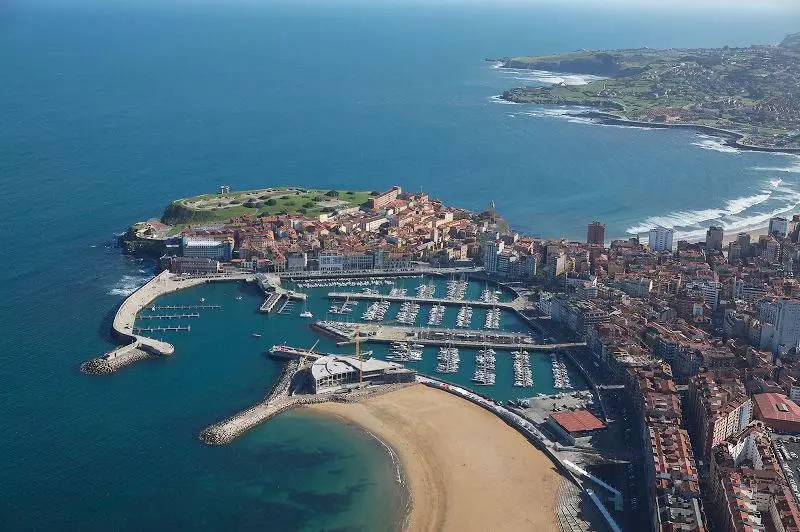
Construction of the new facility was expected to be difficult because the local wave climate is dominated by swells. To improve the operability, UTE Dique Torres (Dragados, FCC, SATO, FPS and Alvargonzález Contratas) asked Deltares (formerly Delft Hydraulics) and MARIN to perform model tests and simulations.
The Gijón project thus brought together Deltares capabilities in coastal engineering and MARIN’s expertise in the field of the dynamics of floating structures, one of the main objectives being to optimise installation of the caissons. Possible improvements would increase the allowable weather window and reduce the time needed for the installation procedure, so that more caissons could be placed in the same time window.
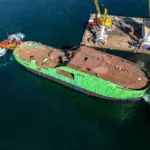
The northern boundary of the extension, the ‘Dique Norte,’ is formed by caissons approximately 50m long, placed on a gravel bed. Around 30 caissons are needed to form the 1,530m long boundary. Accuracy was crucial when placing the caissons and in order to be able to close the gaps between the caissons once installed. It was also important to avoid (or limit) impact loads between caissons. Another important consideration was the loads on the caisson and disturbance of the gravel bed during “touch down”. Loads on the mooring lines also had to be taken into account, along with the need for assistance from barges/vessels, both for anchoring to the seabed, and between the different structures.
This project was divided into the following tasks:
- Physical scale model tests of caisson motions and line tensions during installation.
- Building and fine tuning a numerical model to describe the motion behaviour of the caisson and pontoon during installation.
- Numerical computations for optimizing the installation procedure for a large number of wave conditions.
- Physical scale model tests of the proposed caisson installation procedure.
The first three tasks were performed in Wageningen, where MARIN deployed aNySIM, its multi-body, time domain simulation program. Developed for offshore operations such as side by side and tandem offloading of oil and gas, the program proved to be a very good tool for analyzing the coastal construction project.
A multi-body diffraction analysis was performed, and the results of the analysis (wave loads, added mass and damping) were included in the aNySIM program, together with the mooring system. Then the actual behaviour in waves of the last (floating) caisson was determined. The simulations were validated with model tests in MARIN’s Shallow Water Basin, making use of Deltares’ expertise in the modeling the gravel bed. After fine tuning to make allowances for damping, the results computed with the aNySIM model compared well with the basin results.
Task three included careful consideration of downtime as a function of wave period and wave height in the wave scatter diagram. The tuned aNySIM model was used to optimise the operation, in order to increase the weather windows for the installation process.
Finally, in Task Four, tests were carried out at Deltares, covering different wave directions and combined sea and swell conditions. These tests also included the actual installation procedure for the caisson, focusing on the behaviour of caissons while settling on the gravel bed.
Related Articles
 FEATURES & VIDEOS
 MARINE CIVILS
 OTHER NEWS