![MaritimeJournal[Seawork]](https://www.maritimejournal.com/wp-content/uploads/2026/09/MaritimeJournalSeawork.svg)




Klaas Act at CEDA Dredging Days
The cutter suction dredger is the beast of the industry, called upon when the going gets extremely tough and it is necessary to cut through hard compacted soils or solid rock in works such as the deepening of harbours and fairways.
The genre originated in 19th Century America before travelling to Japan and Europe, where stationary, non-self propelled versions worked only in sheltered waters. The Dutch and Belgians saw opportunities for self propelled cutter suction dredgers large enough to work in sea conditions and independently of other vessels while also effecting considerable savings of both time and money in mobilisation and demobilisation.
The culmination of cutter suction dredger development is the recently launched J.F.J. De Nul , built by IHC Holland for Belgian contractor Jan de Nul. The largest and most powerful self propelled cutter suction dredger ever, J.F.J. De Nul scales up existing technology by some 37%, updating automated processes, addressing legislative concerns for the environment and boosting total installed power to 27,500kW.
With two electric motors generating some 6,000kW of cutting power through the 35 tonne cutter head on new generation CSDs such as J.F.J.
De Nul , the time was right for someone to re-invent the bicycle and develop a safe, efficient and reliable replaceable tooth system for cutter heads which would be capable of handling the massively scaled up power.
Considering the vast leaps of progress in other aspects of dredging technology over the last decade, the process of changing cutter head teeth has remained almost prehistoric. Bringing the operation of an extremely expensive floating factory to a complete halt, the ladder is raised giving crew access to the cutter and they in turn must bash at the mounting lockings with sledgehammers to free teeth that have been ground to nubs.
Hundreds of personnel have been injured, mostly hit by hammers or razor-sharp steel splinters. The use of full protective clothing and copper hammers can prove impossibly uncomfortable and crucially lengthens the changeover time.
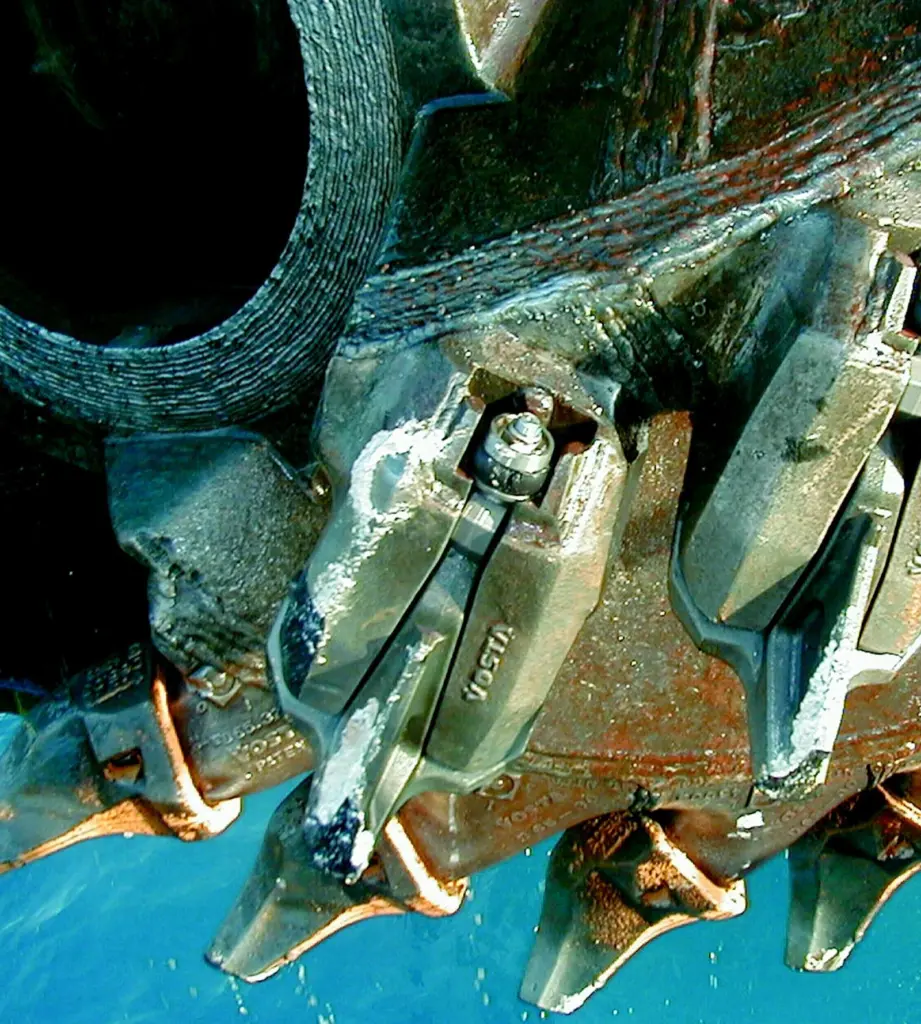
Fortunately, someone has re-invented the bicycle. At the CEDA Dredging Days Conference which accompanied Europort in Amsterdam last month, VOSTA LMG’s senior product manager Klaas Wijma presented a revolutionary new system of teeth, lockings and adaptors which he and his team have been working on for seven years. The new patent pending system, called ‘VOSTA T’ keeps the weight of teeth which will accommodate 6,000kW of power approximately the same (20kg) as teeth for current large CSDs deploying 3,600kW, maintaining compliance with the civil work codes of most countries. The new tooth consists of a tooth point and a coupling part. A locking system consists of a hook, a flexible element between steel rings and a locking nut. The locking system can easily hook onto the rear side of the tooth and in a recess in the adaptor, after which the locking system is pre-tensioned and secured by tightening the locking nut with a power drill. Tooth replacement time can be reduced approximately 30% in conditions vastly safer for the crew.
VOSTA LMG has been conducting field tests with prototypes in co-operation with a large dredging contractor on a powerful CSD operating in hard rock. The new system performed well on all set parameters and the dredging crew was positive about its performance. Reduced down time combined with less demanding and dangerous procedures for the crew delivered marked improvements in dredging’s endless quest for maximised efficiency.
Tooth replacement time is not the only factor in system competitiveness. VOSTA LMG also claims lower costs for teeth and extended wear life. Their calculations predict 10% cost savings through increased efficiency, a 20% savings on the cost of teeth due to fewer being used, another 20% savings on repairs due to fewer adaptors requiring it, and a total cost savings of 13% on the overall cost for a dredging project.
MJ Information No: 18923

Related Articles
 OTHER NEWS
 OTHER NEWS
 FEATURES & VIDEOS