![MaritimeJournal[Seawork]](https://www.maritimejournal.com/wp-content/uploads/2026/09/MaritimeJournalSeawork.svg)


Link up with linkspan experts at Seawork
Central to the revamping of Bologne as a major European hub port with fast Ro-Ro and passenger service turnaround is the new twin deck linkspan which will start to operate at the beginning of July.
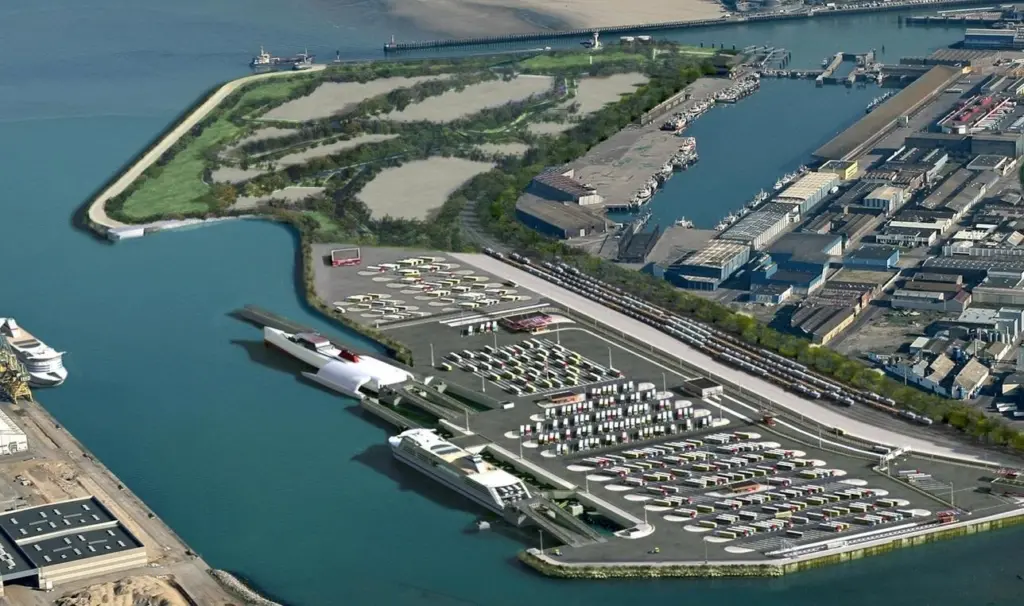
This new facility will start at around the same time as the new LD Lines high speed catamaran which will be introduced on the Dover–Boulogne route. At nearly 11,000 gross tonnes, the new craft is one of the largest vessels yet built by manufacturer Incat. The vessel is capable of carrying 1,200 passengers and crew and up to 417 cars or a mix of cars and trucks. The operators are looking at six return sailings a day, so turnaround times are especially important.
The fabrication of the new linkspan is being carried out by the well established Dutch firm and Seawork exhibitors Ravestein BV, with construction taking place at their Deest shipyard near the river Waal. The company specialises in the fabrication of large steel construction for ports, including bridges, lock gates, jetties and roll-on/roll-off landing stages, as well as differing types of pontoons and ships.
The Boulogne fabrication is not just a ‘standard’ floating foot linkspan. One of the most interesting features of the new construction is that it has a sliding lateral movement, and the complete unit will be able to move 18.5m across the terminal. Normally, the position of a linkspan at the rear of a ship is fixed. Because vessels are also positioned alongside the dock, simple physical constraints usually limit the vessel size that can be serviced to 30 to 35m.
The specially designed sideways tracking motion of the Boulogne installation will allow Ro-Ro vessels up to 56m to be served by the port, adding greatly to its flexibility. The twin deck span is 90m long, 25.6m wide and has one main access bridge to the lower deck and two upper deck access bridges, being based on the company’s Ravelink Phase 2 model. It is being constructed in accordance with the recent Lloyd’s Classification of Linkspan Rules and Regulations of July 2008.
Another innovative enhancement is the inclusion of an integral jetting system. This is designed to eliminate silt, a recurring problem for port structures. The linkspan’s automatic jetting will help keep the area around the pontoon structure free of silt and mud building up. A second linkspan is planned for 2010.
Related Articles
 FEATURES & VIDEOS
 MARINE CIVILS
 OTHER NEWS