![MaritimeJournal[Seawork]](https://www.maritimejournal.com/wp-content/uploads/2026/09/MaritimeJournalSeawork.svg)




Lunar Technology Aids Wind Farm Construction
The first of 30 turbines was fitted at the UKs newest offshore windfarm at North Hoyle , 8 to 11 km, off the coast of Wales, on 19 August. The site is set to generate 60MW of power, enough to run 50,000 homes, when it becomes operational later this year.
North Hoyle will be operated by National Wind Power Offshore and is one of 18 sites around the UK identified by Crown Estates in the first phase of offshore wind farm development. The purely ‘green’ electricity will flow into Juice , an unlikely joint venture involving npower and Greenpeace which, when it has signed up 50,000 subscribers at the same cost as from other suppliers, will start developing another offshore site.
The main construction contract was awarded to a consortium of Vestas-Celtic Wind Technology Ltd and Mayflower Energy Ltd. Acting as specialist subcontractor to Vestas-Celtic, offshore marine construction and geotechnical drilling specialist Seacore has been working around the clock to install the 30 large, 4m diameter steel monopile foundations in the seabed and is also responsible for the design, build and installation of a 50m high, fully instrumented, monopile supported meteorological mast.
Seacore has been operating from the Excalibur eight legged jack-up platform in six to 18m of water. The company has been using a large Menck MHU500T hydraulic piling hammer in conjunction with its own Seacore Teredo T40 reverse circulation drilling rig in a ‘drive, drill, drive’ operation to install the foundations deep into the seabed.
Excalibur is based on the former six legged jack-up Wijslift 6 but has added two further legs and installed a completely new platform jacking system which has considerably raised the speed of jacking the platform out of the water.
Seacore has also upgraded the bow to improve towing characteristics, extended deck length by 22m to an overall area of 60 by 32m, upgraded accommodation to cater for 25 people on board, extended the boom of the 250t Demag Ringlift crane to 54m and designed, built and fitted a special hydraulically operated twin masted pile leader handling frame to position, hold and guide the large, heavy monopiles during installation.
Once Excalibur has been positioned by DGPS and jacked up, the pile leader frame legs are lowered and jacked into the seabed and preloaded. The twinmasts are equipped with a pair of circular pile gate grippers which can be hydraulically raised and lowered independently of each other.
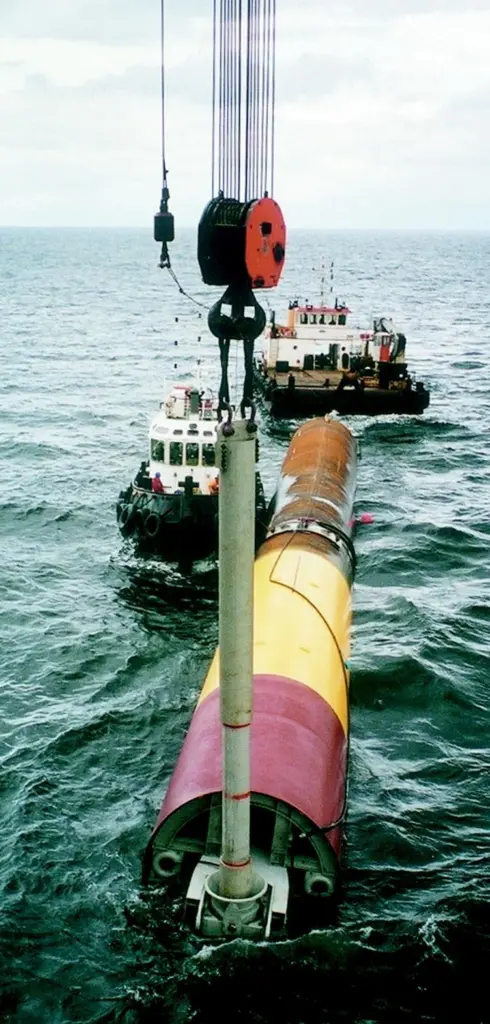
A floating pile, complete with removable stoppers in each end, is towed to Excalibur ready for lifting. Seacore has automated as much as possible the buoyant lifting sequence of the pile and has developed a special male to female cone latching lifting device on the top stopper and crane hook to spear and capture the pile, similar to the concept used by NASA for docking the lunar and service modules together in the Apollo Space Programme.
The jack-up’s Ringlift crane lifts the buoyant pile into the vertical position and into the leader frame’s open gates, which are then closed and pneumatic grippers in the top gate actuated to hold and take the weight of the pile. Lifting pins from the top stopper into the wall of the pile are retracted and pneumatic bladders round the circumference of this stopper deflated to allow the stopper assembly to be lifted away onto the supporting marine craft.
With the pile now held in the gripper gate, an air actuated 150mm ball valve in the bottom stopper is opened to flood the pile with water. The sealing bladder in the bottom stopper is deflated, allowing the stopper to fall about 2m to the seabed. The stopper is then pulled away by a tug and winched back on deck to take to shore for the next pile.
While held in the gates, the flooded pile is then jacked down the leader masts and pushed into the seabed about 1 to 2m. With the pile vertical the grippers in the pile gates are released but with the gates still round the pile.
The 120t Menck hammer is then lifted onto the pile top and the pile driven about 13 to 14m into the seabed through a variety of sands, gravels and stiff clays to the underlying rock head.
The pile gates are released and the hammer is removed to be replaced by Seacore’s own Teredo T40 reverse circulation drill rig, with a 3.7m diameter drill bit tripped inside the pile on stabilised drill pipe to clean out the overburden down to the rock head then cut through weak and strong mudstones and sandstone to complete a rock socket ahead of the pile toe and down to the pile’s final toe level. Drill rig, drill string and drill bit are then removed and replaced with the Menck hammer to drive the pile into the final elevation.
MJ Information No: 18633

Related Articles
 OTHER NEWS
 OTHER NEWS
 FEATURES & VIDEOS